 Guide On Map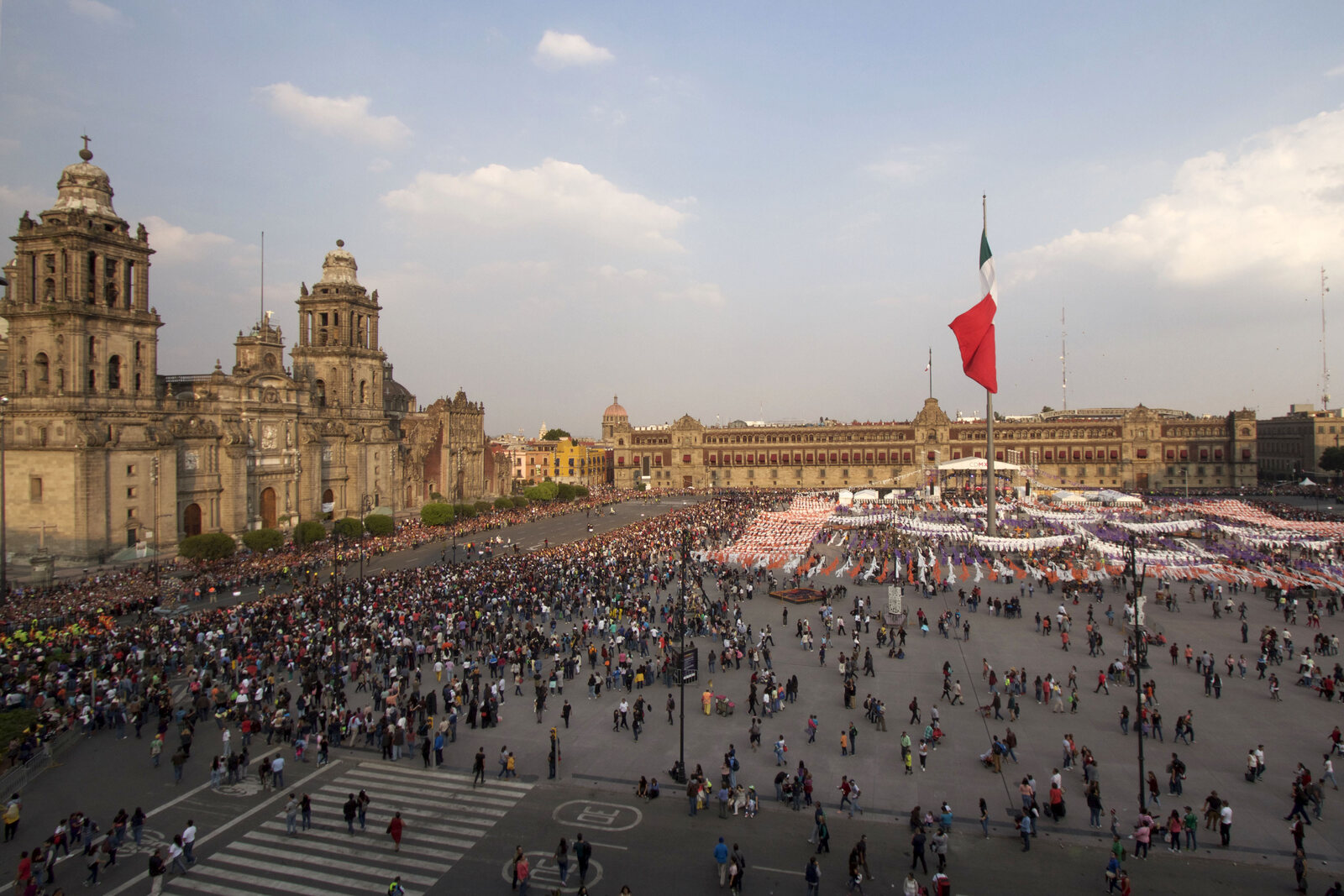
Look around first
What to notice
- Flagpole
- National flag
- Façade of the National Palace
- Two towers of the Mexico City Metropolitan Cathedral
The story of the place
Every day at the Zócalo, soldiers raise and lower a huge national flag. Stages are assembled here for concerts, and parades and civic ceremonies are held. All this requires an empty square—and its present emptiness came after a very specific eviction.
The Zócalo's official name is Constitution Square. It recalls not a Mexican law. On September thirtieth, eighteen twelve, Viceroy Francisco Javier Venegas, who governed New Spain on behalf of the Spanish monarch, and members of the highest colonial court swore an oath here to the Constitution of Cádiz. The public reading was arranged in the main square because the palace, town hall, and Mexico City Metropolitan Cathedral already stood around it: here, officials could turn the new law into an urban spectacle.
Thirty-one years later, General Antonio López de Santa Anna, a temporary president with emergency powers, conceived of a different spectacle. At that time, El Parián stood in front of the town hall—a stone market hall occupying nearly half the square. Its shops had once sold expensive imported goods; by the middle of the nineteenth century, shoemakers, hatmakers, and food vendors were working nearby. Many merchants had paid for the right to occupy a shop. That right could be resold or left to their children, and a permanent location provided credit and customers' trust.
Santa Anna wanted to clear the capital's center and place a column here in memory of Mexico's independence. On June twenty-eighth, eighteen forty-three, he ordered El Parián demolished and gave the merchants fifteen days to move out.
One hundred sixty-three shop owners replied with a collective letter. They explained that they would lose the money they had invested, their customers, and the ability to support their families. The president promised compensation, but ordered the city treasury to pay it—the very treasury that, after the demolition, would lose El Parián's rental income. The municipality had no money. The merchants secured only ten additional days, and by July twenty-seventh the market had been dismantled.
By December, sixty-three former tenants decided to continue the litigation. The following spring, officials ruled that losses would be compensated only for those who could document the purchase of the right to a shop after eighteen twenty-eight. Most did not meet that condition. Another ten years later, the claim for payment remained unresolved; researchers have still been unable to determine whether anyone received any money at all.
On the cleared site, Santa Anna commissioned the architect Lorenzo de la Hidalga to erect a monument to independence. On September sixteenth, eighteen forty-three, the first stone was laid. Nothing beyond the circular base was completed: the state treasury was in debt, and Santa Anna himself was soon overthrown and sent into exile.
The lower part of a pedestal is called a “zócalo” in Spanish. The unfinished base stood in the middle of the square for more than thirty years, and its name passed to the whole square. In eighteen seventy-five, a French bandstand was placed on top; later the bandstand was removed, the square was redesigned, and the stone platform was hidden beneath the paving.
In nineteen seventy-nine, the daily raising of the flag here was established by state decree. When the current flagpole was installed, construction workers cut through part of the old base. In two thousand seventeen, archaeologists found a circular platform slightly north of the pole, eight meters in diameter, built of stone and faced with basalt. They measured it, covered it with protective fabric, and buried it again. Above the slabs, the word “Zócalo” remained; the zócalo itself lies beneath them.
Useful on site
Stand closer to the edge of the square: from there, it is easier to listen to the story while seeing the buildings without remaining in the middle of pedestrian traffic or a ceremony.