 Guide On Map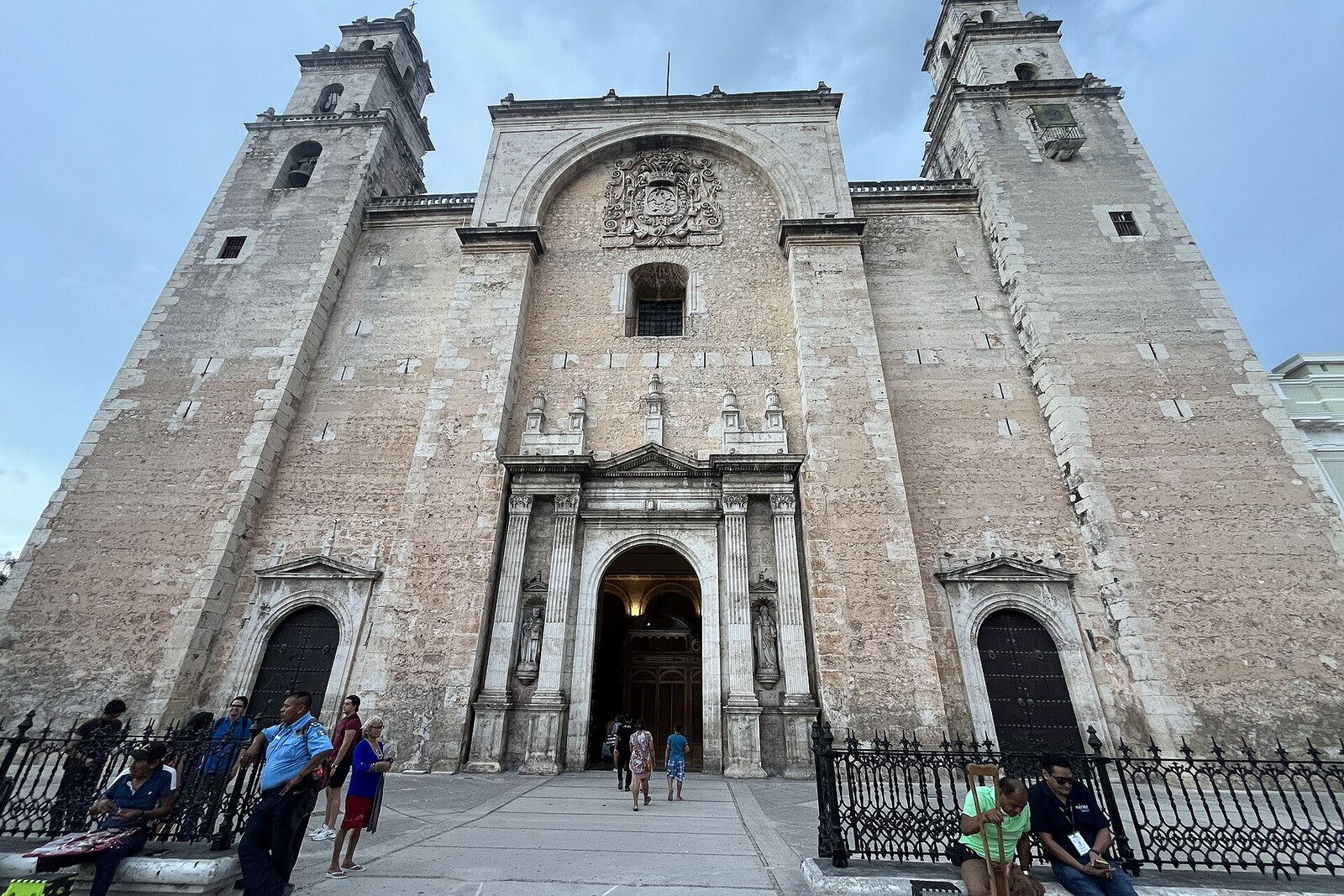
Look around first
What to notice
- The cathedral's stone walls
- The northern chapel
- The crucifix of Christ of the Blisters
The story of the place
The name San Ildefonso was given to the local church before its stone walls appeared. Ildefonsus was Archbishop of Toledo in the seventh century and a theologian who defended the veneration of the Virgin Mary. A colonial chronicle links the choice of patron saint to January twenty-third, fifteen forty-two, his feast day. On that day, Tutul Xiu, the Maya ruler of Maní, arrived in Mérida, recently founded by the Spaniards, acknowledged Francisco de Montejo, and formed an alliance with him. Spanish settlers declared the saint the patron of their colony, and nineteen years later a papal bull assigned his name to the new cathedral church.
Construction of the stone church began in fifteen sixty-two on the eastern side of the square. Its masonry included blocks from dismantled structures of T'ho, the Maya city on whose site the Spaniards founded Mérida. The church is called a cathedral because the cathedra of the bishop, and now of the Archbishop of Yucatán, is here. The cathedral had a chapter—a college of priests able to accept wills, administer donations, and maintain regular services. That is why a crucifix from a distant rural parish came here.
In the first half of the seventeenth century, the crucifix belonged to Juan de la Huerta, a parish priest from the settlement of Ichmul. According to local tradition, an unknown carver made it from wood that burned but was not consumed. Later, a fire destroyed Ichmul's church, and the dark figure of Christ allegedly retained blisters in its paint that resembled blisters on skin. Hence the name, Christ of the Blisters. This part of the story survives as tradition; documents confirm the existence of the old statue itself and its later presence in Mérida.
Before his death, de la Huerta wanted to ensure the crucifix's permanent veneration. He left the statue to the cathedral chapter together with his priestly savings and ordered the establishment of a chaplaincy—a fund whose income paid a priest to hold services at a particular altar. The following year, the crucifix was brought to Mérida, and later a separate chapel was arranged for it.
By the end of the nineteenth century, fifteen professional associations and a religious brotherhood observed the feast of Christ of the Blisters. Artisans, merchants, and landowners took turns arranging services and processions; shops prepared in advance for holiday purchases. Thus, the will of a rural priest turned a statue from Ichmul into one of Yucatán's principal shrines.
On September twenty-fourth, nineteen fifteen, during the anticlerical campaign of the revolutionary governor Salvador Alvarado, participants in a rally burst into the cathedral. They smashed altars and images, destroyed the organ, and wrecked the chapel of Christ of the Blisters. The old crucifix was dragged outside. Testimonies differ in the details: some claimed that the statue was broken apart, while others said that one of its arms was torn off and it was thrown into the street. The police took it to the military commandant's office; there is no further reliable information about the original.
The person who decided to return the venerated crucifix was Rafael Quintero, a Mérida engineer and entrepreneur. He earned money from urban and industrial projects and could pay for the restoration of the devastated chapel. Quintero commissioned a new crucifix in Querétaro, personally brought it to Mérida, and installed it here in nineteen nineteen. It was an open act by a man known in the city, carried out while anticlerical restrictions still remained. A few days later, Archbishop Martín Tritschler y Córdova consecrated the statue in the presence of clergy, professional associations, and many believers. Services at Christ of the Blisters resumed.
In the cathedral's northern chapel, it is precisely the crucifix brought by Quintero that is venerated. The old statue is not here: its last known address was the Mérida military commandant's office. The present Christ bears the name of the blisters that, according to tradition, fire left on the other, vanished figure.
Useful on site
An active church with no published, stable tourist schedule; access depends on services.
Checked: date not specified. Check the official source before visiting.You can listen to most of the story from outside. If you go in, do not disturb the service, and look for a copy of the shrine without expecting to see the lost original.