 Guide On Map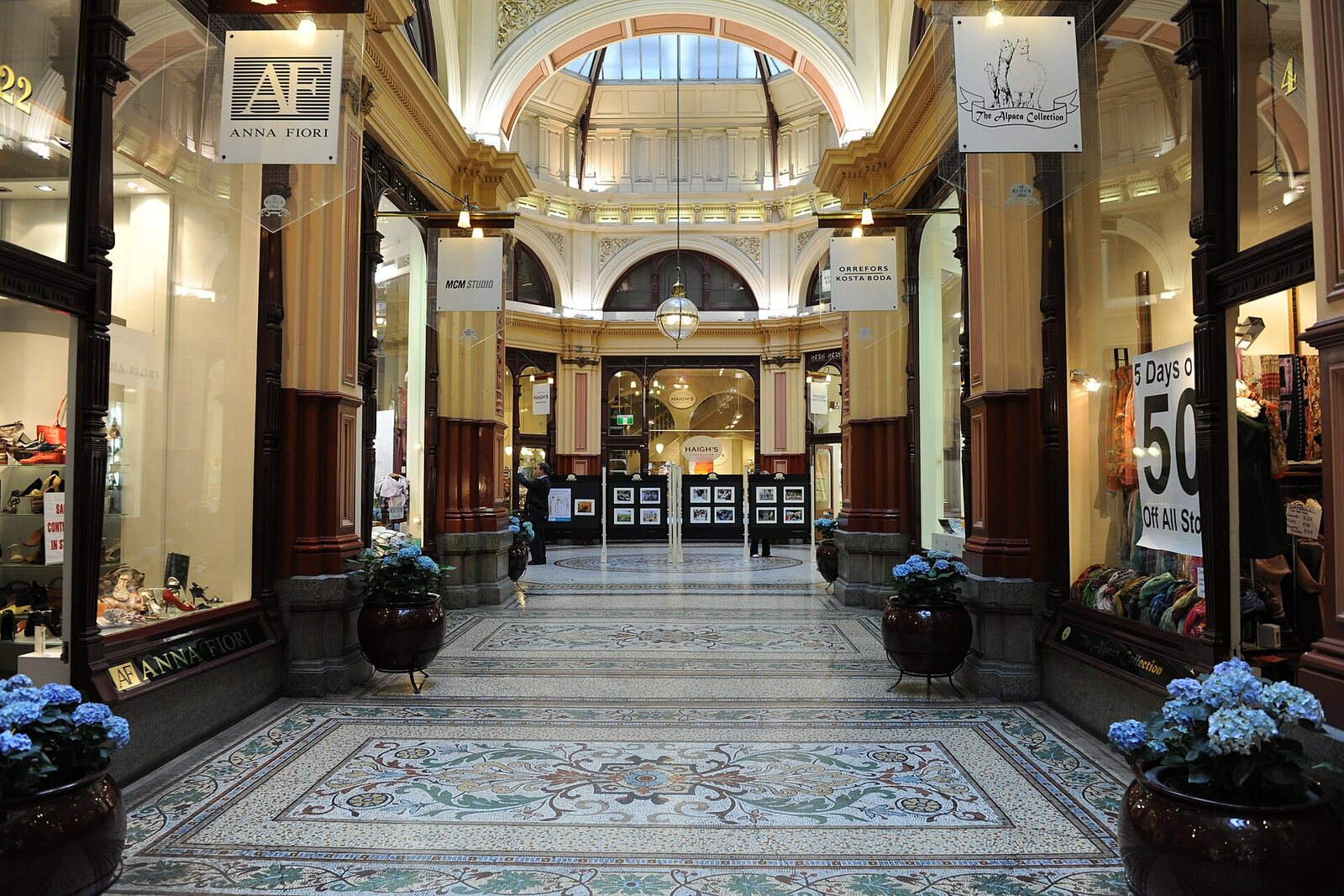
Look around first
What to notice
- Mosaic floor
- Glass vault
- Turn in the arcade
- Shop display windows
The story of the place
Daylight passes through the glass vault and falls on the mosaic floor of the long shopping arcade. It took the place of the department store where clothing, hats, furniture, and expensive imported goods were sold. The facade of that building has disappeared, but its bluestone foundations remain in the base of the arcade.
In the eighteen eighties, well-to-do Melburnians called this stretch of Collins Street simply the Block. Dressed well, they walked from Swanston Street to Elizabeth Street and back: meeting acquaintances, looking at shop windows, and showing themselves off. For young men and women, such a walk offered a rare chance to look each other over in public without breaking the rules of propriety. This activity was called “doing the Block.”
The brothers William George and Alfred George, owners of a fashionable department store, wanted to sell to precisely this public. In eighteen eighty-three, they occupied the four-story building that stood here. Inside, they sold clothing, hats, furniture, and expensive imported goods; a passage through the store led to Little Collins Street, and glass display windows already stood along it. A person could continue the familiar promenade while remaining among the George brothers’ goods.
Then Benjamin Fink, a financier and real-estate speculator who planned to build a covered shopping arcade here, acquired the site. Because of his project, the brothers had to look for another address. On September thirteenth, eighteen eighty-nine, their former department store burned down. The fire did not give rise to the idea for the arcade: Fink had been preparing it in advance, and the blaze merely hastened the clearing of the site. The brothers moved their business to another building farther up Collins Street and kept their business.
Fink instructed the architect David Askew to lay out, beneath a glass roof, a passage with display windows that turned from Collins Street toward Elizabeth Street. The first section opened in eighteen ninety-two. That same year, the collapse of the land boom ruined Fink himself: he declared his debts and left Melbourne. The directors of his company had to seek money separately to complete the wing to Elizabeth Street; it was finished in eighteen ninety-three.
The word “Block” retained the name of the earlier street promenade. Now the same stream of people passes shops along a mosaic floor and turns beneath a glass vault. The George brothers’ department store disappeared from view, but builders incorporated its old bluestone foundations into the base of the arcade.
Useful on site
General hours according to the city listing: Mon–Thu 08:00–18:00, Fri 08:00–20:00, Sat 08:00–17:00, Sun 09:00–17:00; individual tenants and tours operate on their own schedules.
Checked: date not specified. Check the official source before visiting.Look at the floor and the details above without holding up the flow at the entrances. The tearoom and shops are visited separately; no booking is needed to see the arcade itself.