 Guide On Map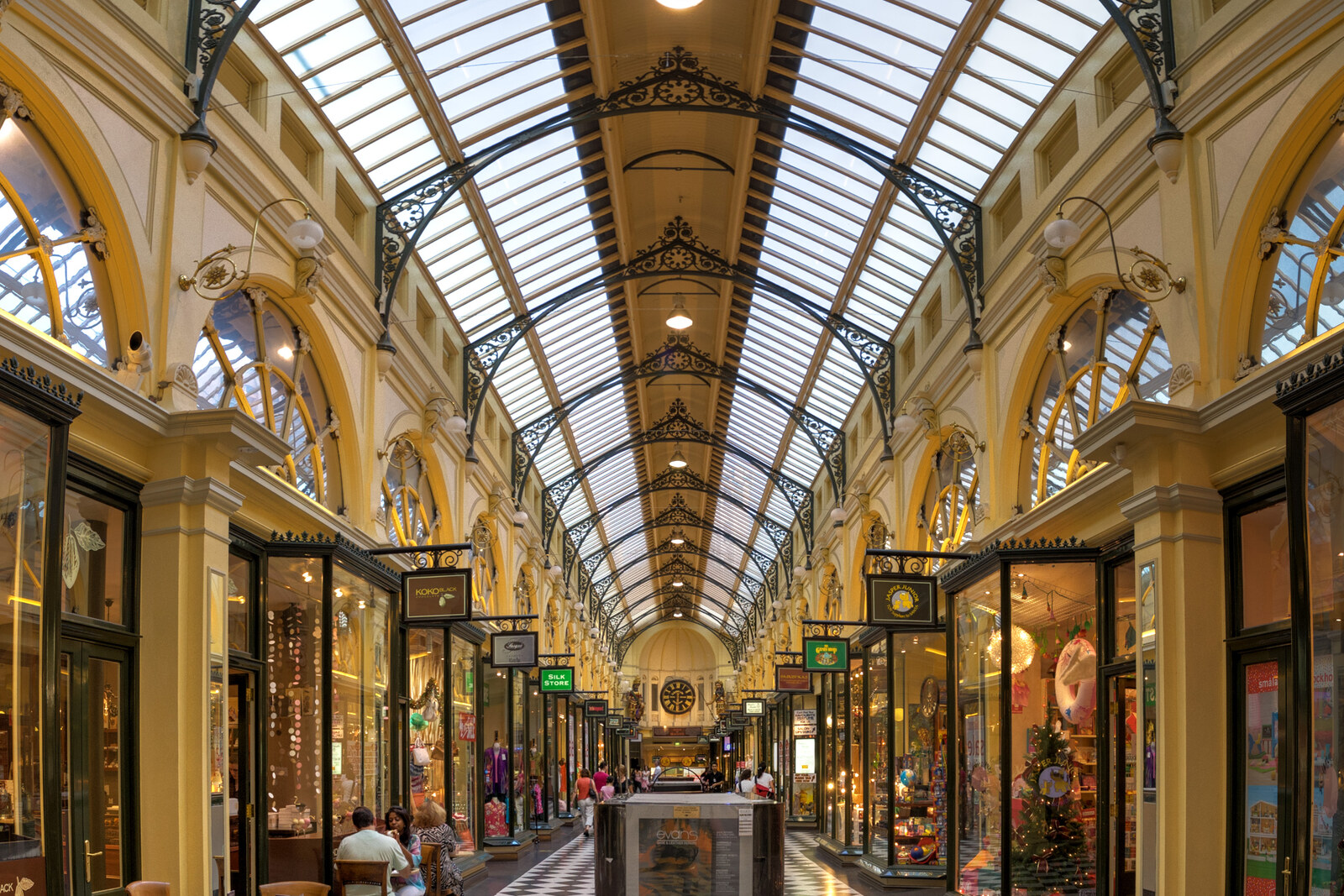
Look around first
What to notice
- Black-and-gold clock face
- Wooden figures of Gog and Magog
- Iron bells
- The name Thomas Gaunt
The story of the place
Beneath the roof of Royal Arcade stretches a shopping passage that the owners of the site opened with twenty-nine shops. They chose the name in honor of the British monarchy and as a promise of respectable trade. A clock workshop operated at its corner: people brought timepieces there to be sold and repaired, while the accuracy of its master clock was checked every day against a telegraph signal from Melbourne Observatory. Among Australia’s surviving shopping arcades, this one has remained the oldest.
The name Thomas Gaunt is written on the black-and-gold clock face between two wooden giants. When this clock was installed in eighteen ninety-two, Gaunt himself had already been dead for two years.
The owners of the site opened Royal Arcade in eighteen seventy as a covered shopping street with twenty-nine shops. “Royal” is a nod to the British monarchy and a promise of respectable trade, not a remembrance of a visit or an action by any one monarch. Today, it is Australia’s oldest surviving shopping arcade.
The clockmaker and jeweler Thomas Gaunt moved his workshop to its corner at about the same time. He earned money from trust in accuracy: he sold and repaired clocks and calibrated marine chronometers. Every day, Melbourne Observatory sent a signal to his shop by telegraph, and the workshop’s master clock was corrected by it. Before handing Gaunt their own mechanism, a customer could see the time here, calibrated by astronomers.
After the master’s death, the firm retained the sign “Thomas Gaunt and Company.” It was the firm that installed the new clock with moving figures above the passage. The mechanism itself is attributed to Fritz Ziegeler, a maker of large city clocks who worked for the firm. Mortimer Godfrey probably carved the two giants from pine. Both did the work, but the name of the business owner remained on the clock face.
Godfrey repeated figures from London’s town hall. Gog and Magog are not historical guards: according to a city legend, they are giants whom the Trojans defeated and forced to guard the gates. In Melbourne, they became part of a shop sign: the mechanism moves their arms, and the arms strike iron bells.
For more than thirty years, Ziegeler’s descendants sought to have a plaque placed nearby with the name of the clock’s real maker, but it was never installed. Gog’s and Magog’s wooden arms still strike the bells, and above them remains the name of the man who did not live to see this mechanism appear.
Useful on site
General hours according to the official website and city listing: Mon—Thu 07:00—19:00, Fri 07:00—20:30, Sat 08:00—19:00, Sun 09:00—19:00; individual shop hours may differ.
Checked: date not specified. Check the official source before visiting.View the giants from a spot where you do not obstruct the passage; you can hear the clock strike only if it coincides with your visit. The shops inside operate independently of the route.