 Guide On Map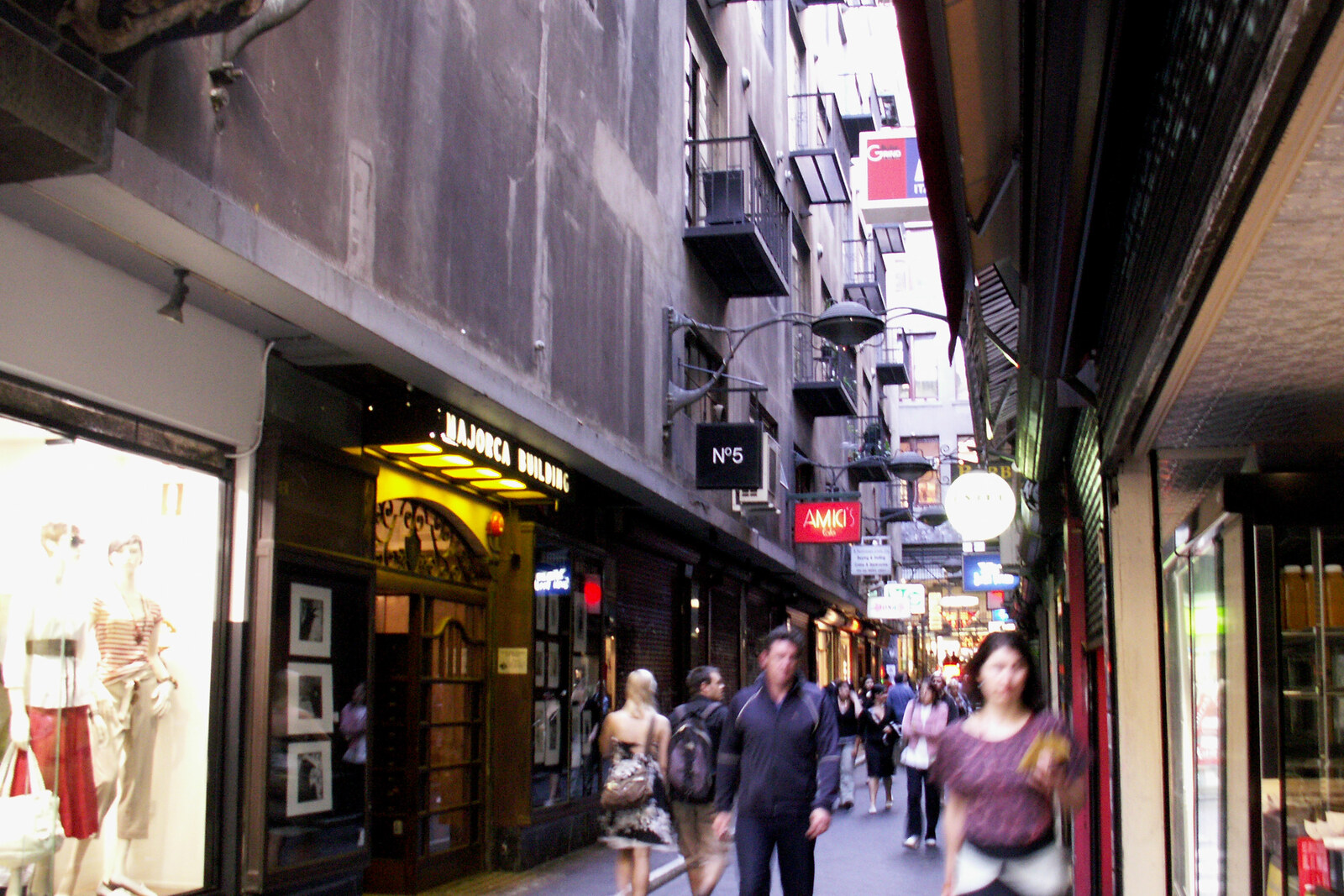
Look around first
What to notice
- Two light boxes
- Bluestone paving
- The bend in the laneway
- Cafe counters
The story of the place
In the early nineties, the artist Andy Mac, then a final-year student, was looking for an inexpensive studio. At the corner of Centre Place and Flinders Lane, he found Centre House, a former warehouse for clothing firms, where about forty artists rented rooms and studios. Floors and shops stood empty in the old buildings, owners agreed to low rents, and Mac needed a place where he could work and live at the same time.
People were already using Centre Place as a shortcut from Flinders Street Station to Collins Street via Centreway Arcade. The bend in the laneway prevented through traffic by car. In the mid-eighties, municipal planners repaved it with bluestone, added lighting, and began urging small traders to open entrances here rather than hide them inside the buildings. Yet in the early nineties, passersby mostly walked straight through: a shoemaker, a key cutter, and a butcher competed for the few customers.
A meter and a half from Mac's studio stood Majorca House. In nineteen ninety-three, developers turned the studios there into apartments. Artists were used to working at night and holding parties; now people who had paid for housing in the city center moved in opposite them. Mac feared that the other inexpensive premises would disappear after Majorca House.
He arranged free temporary use with the owners of vacant shops, invited artists and musicians, and in nineteen ninety-four held an exhibition with a street party. They wanted to show the new residents at once that Centre Place also served as a working courtyard. The city cultural department heard about the event. Officials suggested formalizing the project and applying for funding.
Mac and three of his companions received five thousand six hundred Australian dollars. In September nineteen ninety-six, they fixed four light boxes to the walls of the dead end where rubbish was collected. Such panels usually advertised goods at stops and stations; here, artists' works were placed in them. The gallery was accessible around the clock precisely because it had no door. Mac sat on the steps for several days and counted passersby: by his estimate, about forty thousand people passed by each day.
The inexpensive studios did begin to disappear, and according to Mac, rents for premises quadrupled in five years. Exhibitions in the light boxes continued until two thousand twelve. Renovation of the neighboring building reduced the installation from four boxes to two. These two rectangular frames remained above the former rubbish collection area; below, cafe counters replaced the shoemaker, the key cutter, and the butcher.
Useful on site
Public passage; best experienced in the late morning and during the day, when the cafes and small outlets are open. The mix of tenants changes.
Checked: date not specified. Check the official source before visiting.The passage is very narrow: choose a recess for stopping that does not block doors or foot traffic. Indoor shops and galleries may have their own access conditions.