 Guide On Map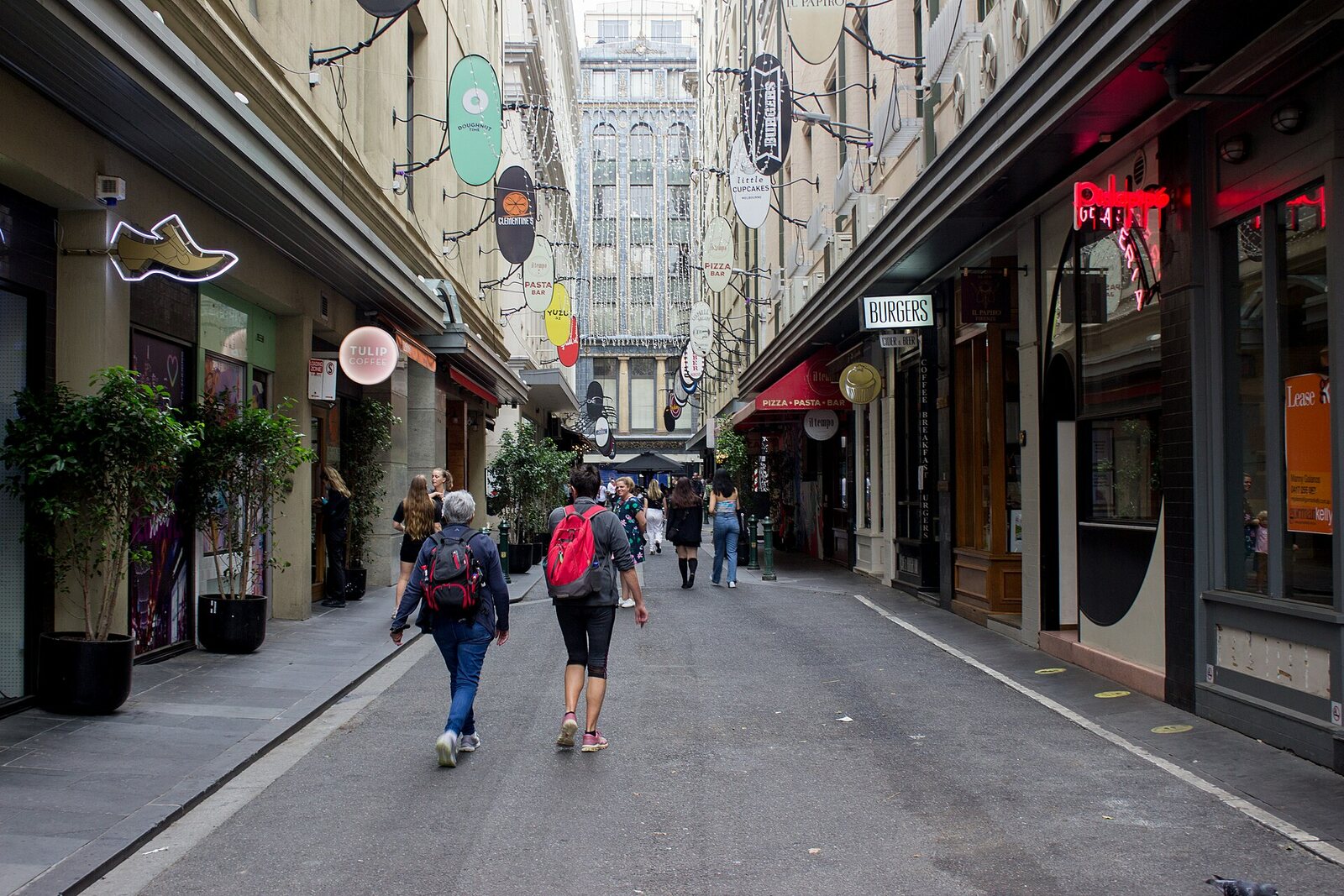
Look around first
What to notice
- Street tables
- The two facades of Degraves Espresso
- The red-brick facade of Thomasetti House
- The street-name sign
The story of the place
In the middle of this short, narrow street, cafes put out tables, and Degraves Espresso occupies two facades at once. The flow of people comes here from the station underpass; in the nineties, a butcher’s shop, a fruit shop, and hair salons still held on nearby, then venues replaced them. Around the corner on Flinders Lane, beneath the later red-brick facade, Thomasetti House conceals a stone warehouse of the former milling firm. When a riverside wharf operated nearby, this block lived on the waterborne delivery of grain and flour; the mill is no longer here.
The surname on the street sign belongs to William Degraves, a miller who arrived from Hobart to establish a business here. In eighteen forty-nine, he was twenty-eight years old. He had already worked at his father’s mill and shipyard, and he and his brother Charles were now looking for a site for their own steam mill.
The brothers paid two thousand pounds for an acre of land between Flinders Lane and the future Degraves Street. Nearby stood the riverside wharf of the time: grain and finished flour could be delivered by water. The site itself proved to be only the beginning of the expense. The mill, launched in eighteen fifty-one, cost ten thousand pounds by contemporary estimates—five times the price of the land. Its steam engine made it possible to grind grain without depending on wind or current.
The business opened in the very year when gold discoveries transformed Victoria. People and goods bound for the goldfields began passing through Melbourne, and the population needed bread. Degraves also took up importing and the purchase of gold and wool. His firm opened mills and warehouses in other cities, and William himself was called the Australian Rothschild. He joined the leadership of a bank and a railway company, and for fourteen years he was a member of the Legislative Council.
Expansion did not bring him a peaceful old age. Charles died in eighteen seventy-four. The very next year, William left Melbourne and returned to Tasmania with a fortune noticeably diminished from his former prosperity. He died there in eighteen eighty-three. By then, his surname had long been separated from its owner: the street’s name had been established before eighteen fifty-six.
The first mill disappeared, but another building of the Degraves firm survives on Flinders Lane. Today’s Thomasetti House grew from a five-story stone warehouse built for the millers in eighteen fifty-three; later owners added floors and enclosed the old core behind a new red-brick façade.
The tables in the middle of the street belong to the next story. In the mid-nineties, restaurateur Con Christopoulos opened Degraves Espresso here. At that time, a butcher’s shop, a fruit shop, and several hair salons were still operating nearby. Christopoulos recalled that after the recession there was hardly any money, so he and his partners fitted out the premises with their own hands. They had to argue with the City Council over the furniture placed outside.
The cafe attracted its neighbors: other venues began opening along the narrow passage, and the flow from the station underpass brought them customers. The City Council, once unhappy with Christopoulos’s outdoor tables, soon began using his cafe in advertising for Melbourne’s laneways. Degraves Espresso still occupies two facades, and the furniture once under dispute now fills the middle of the street.
Useful on site
Public pedestrian lane; cafes and shops keep different hours, with the most reliable daytime period running from morning to early evening.
Checked: date not specified. Check the official source before visiting.Keep to the edge, especially near tables and entrances. The underpass may be explored only where ordinary public access is open; purchases and visits to venues are not required.