 Guide On Map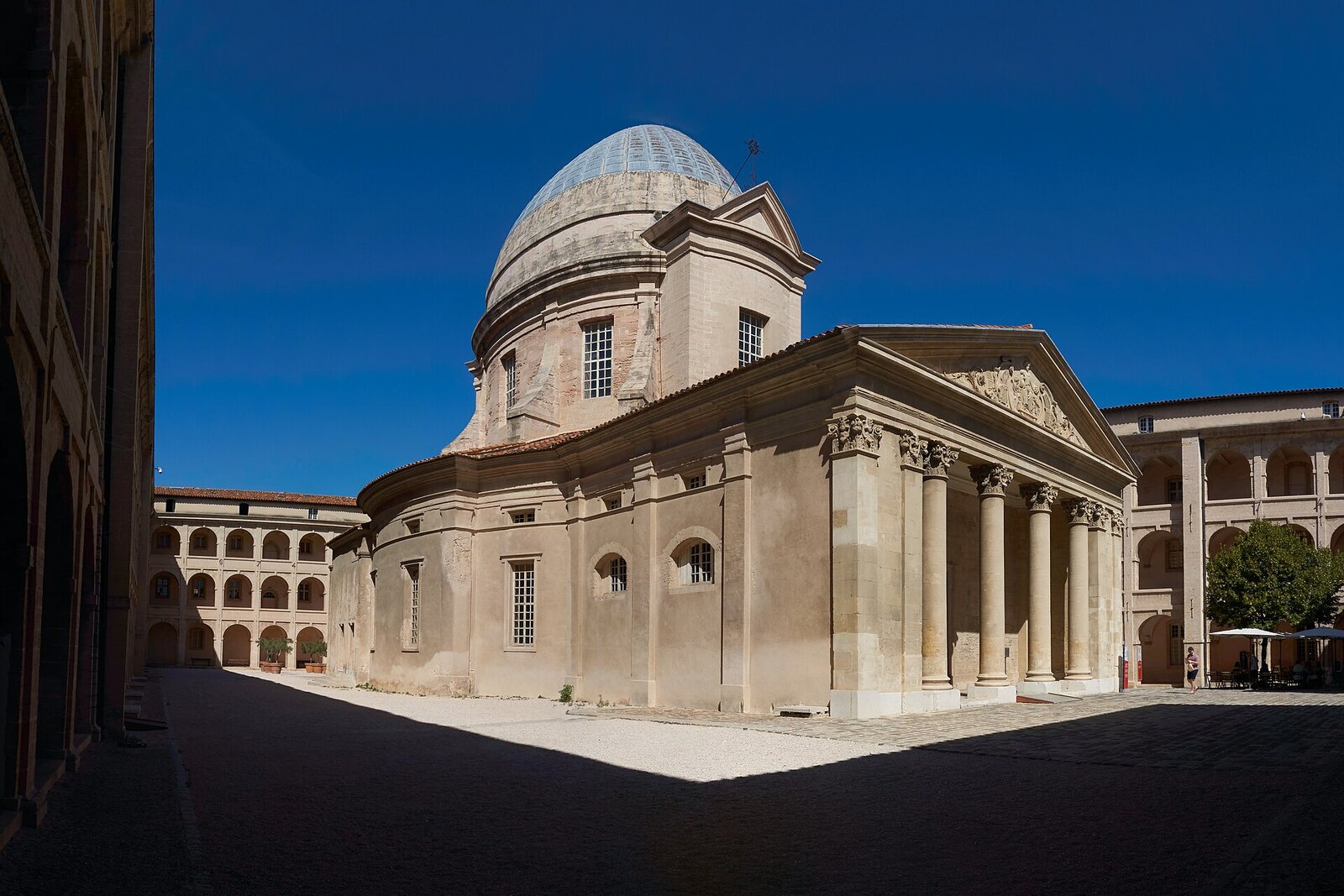
Look around first
What to notice
- The chapel’s oval dome
- Three levels of galleries
- Rows of small cobblestones
- Blank outer walls
The story of the place
Stone galleries rise around the courtyard in three levels, and an oval dome stands above the chapel in the center. Behind the almost blank outer walls, four wings form an enclosed block that long served as a shelter and workplace for its inhabitants: craft workshops operated here. Families later lived in the emptied rooms, and museums, exhibitions, and research centers now occupy them.
In sixteen forty-one, the city council ordered beggars from Marseille to report here and remain, while newcomers were to leave the city within two days. Emmanuel Pachier, a canon of the neighboring La Major Cathedral, campaigned to gather poor people under one roof and support them with donations and their own earnings. He enlisted seventy-two benefactors; with their money, several houses were bought here, on what was then Observance Square. The shelter was named for Our Lady, Mother of Mercy. The French word “charité” means mercy.
Mercy quickly acquired locks and guards. Ten armed guards in red uniforms went through Marseille looking for beggars and vagrants. They were called “beggar hunters.” City residents were promised a reward for informing on them, yet some people from Marseille defended those being persecuted and attacked the guards. Captured natives of the city were locked up in La Vieille Charité, while outsiders were expelled. An attempted escape could be punished by exposure at the pillory or branding with a hot iron.
The inhabitants of La Vieille Charité had to pay for their upkeep through work. Workshops for cobblers, carpenters, masons, and weavers operated inside. Girls were taught sewing; boys, reading, writing, navigation, and vessel handling. The administrators then placed the children as apprentices, sailors, or domestic servants. Those who fell ill were sent to the neighboring Hôtel-Dieu: this “general hospital” was intended primarily to isolate and reform poor people, rather than to treat them. In some years there were more than a thousand people here, and four had to share one bed.
The old houses could no longer hold everyone. In sixteen seventy-one, the administrators commissioned Pierre Puget, a native of this neighborhood and the royal architect, to begin the present building. They gave him a precise condition: benefactors and managers were not to mix with those in their care, while men, women, and children were to be separated into different parts of the complex.
This accounts for the four wings, almost blank on the outside, the three levels of galleries, and the chapel in the middle of the enclosed courtyard. There were grilles inside the chapel itself; separate staircases and passageways allowed the different groups to attend the service without meeting one another. Puget’s oval dome covered a space where even prayer followed routes divided in advance.
After the Revolution, forced labor was abolished, and the institution began admitting mainly orphans and destitute elderly people. In eighteen ninety, they were transferred to the new Sainte-Marguerite shelter. People from Marseille called it the New Charité, and the remaining building La Vieille Charité. Thus the present name marks not the age of the architecture itself, but the relocation of the institution.
Later, housing was set up in the emptied wards. After part of the neighborhoods near the Vieux-Port were destroyed, city residents left without homes were settled here; by the nineteen fifties, one hundred forty-six families lived at La Vieille Charité. When the writer Edmonde Charles-Roux brought the photographer Robert Doisneau here, the residents pelted the visitors with whatever came to hand: they feared the photographs would hasten their eviction. For the same reason, workers were not allowed to begin repairs on the chapel.
At the same time, Jean Cherpin, founder of the Arts et Livres de Provence association, campaigned to turn La Vieille Charité into a house of science and art. Others proposed demolishing the residential wings, building new houses in their place, and leaving only the chapel. The building was preserved in its entirety; the families were rehoused by nineteen sixty-two, and after a long restoration, museums, exhibition halls, and research centers opened here.
The restorers removed the grilles, the double locks at the entrance, and the courtyard partitions. Most of the stones in the arcades had to be replaced one by one. The locations of the former barriers were marked with rows of small cobblestones: visitors to the two museums now cross them freely, but once these lines prevented the inhabitants of La Vieille Charité from meeting even by the central chapel.
Useful on site
Official schedule as of the date checked: Tuesday–Sunday, 09:00–18:00; closed Monday, except Easter Monday and Whit Monday; the ticket office closes 30 minutes before closing. Permanent collections are free, while temporary exhibitions may charge admission.
Checked: June 29, 2026. Check the official source before visiting.It is best to listen to the story in the courtyard, without obstructing passage or the work of the institutions. If the interior is inaccessible, examine the complex from outside; visits to the museum displays should be planned separately.