 Guide On Map
Vieux-Port and Le Panier: from the ancient shore to MuCEM
From the archaeological garden through Hôtel de Ville and Le Panier to Fort Saint-Jean
Guide On Map on your phone
Open the walk like a regular app
It takes about 10 seconds to install. No app store needed.
The whole path
Route map

About the walk
You will walk from the excavated ancient shore to the northern quay of Vieux-Port, climb into Le Panier, and finish at Fort Saint-Jean and MuCEM. Along the way, you will connect places that Marseille first fenced off, then destroyed or planned to build over, and later returned to its residents in a new form.
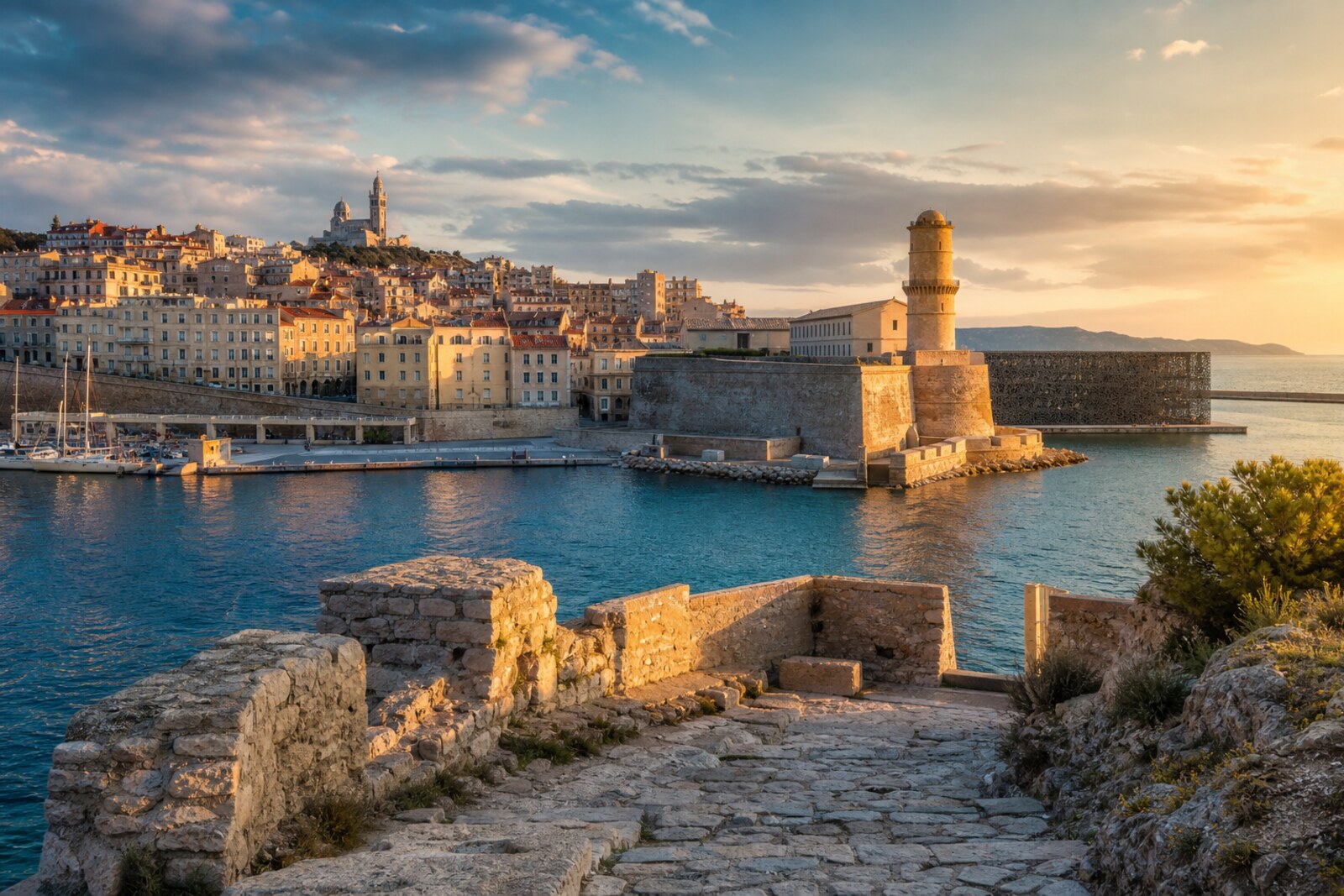
At Jardin des Vestiges, you will notice tracks on ancient blocks and find out why this twentieth-century mark sits beside a Greek road. At Hôtel de Ville, the empty space behind the Baroque facade will make you wonder where dozens of streets went. At La Vieille Charité, the open courtyard still holds the lines of former barriers. By the sea, a royal fortress meets a new museum building on a passage above the water.
The story moves at an unhurried pace, through officials' decisions, residents' fears, and the fate of particular walls. After the walk, you will be able to tell apart the ancient shore, postwar development, and the buildings Marseille gave a new purpose around Vieux-Port.
Why this order
Jardin des Vestiges begins the route on the edge of the ancient city and the bay. From here, today's shoreline leads to Hôtel de Ville, a building that survived while the blocks behind it disappeared. That is why the next stop is the climb into Le Panier: among the surviving buildings, La Vieille Charité shows another outcome—not demolition, but a complete change in layout and purpose. Then the route descends to the water again. At Fort Saint-Jean, an earlier attempt to control the city meets a museum opened to the city by a passage over the sea.
Those who want to understand how old Marseille is put together Those interested in archaeology and urban turning points Those who like connecting museums with the streets around them
Those looking for an easy walk without difficult history Those uncomfortable with Le Panier's stairs and climbs Those seeking only the grand views of Vieux-Port
Before you go
Before setting out, check access to Jardin des Vestiges, the courtyard of La Vieille Charité, the fort spaces, and the museum: these places have different schedules, and some passages may close temporarily. You do not need a museum ticket for the walk itself, but plan exhibitions and interior spaces separately. Wear sturdy shoes; after rain, take your time on the steps and smooth stone. On a hot day, bring water and save some energy for the climb through Le Panier, where there is more shade than along the open waterfront.
When to go
Allow around two hours to cover the four stops in sequence with the audio. If you plan to see the exhibitions, add a separate museum block; the climb is usually easier in the morning, while later in the day it is nicer to linger by the water.
Backup plan
If the archaeological site is inaccessible, view it from the permitted outer edge and focus on the relationship between the ruins and the modern city. Even closed, La Vieille Charité still makes sense as a point in the fabric of Le Panier, but do not try to go beyond the barriers. If access to the fort or museum is limited, end the story outside, at an accessible approach to the bridges and quay. In intense heat, shorten the loops through the neighborhood's upper streets while keeping the four main stops and an unhurried pace.
Route conditions
Surface. Paved — 2 km; unpaved — 313 m (data covers 95% of the route)
Stairs. Flights: 3, 46 m in total
Access. Wheelchair — no; stroller — limited (stairs)
Facilities. Toilets — 6; drinking water — 6
Elevation. Ascent — 30 m; descent — 40 m
OpenStreetMap extract of June 18, 2026: database data, not a check on the ground. Data © OpenStreetMap contributors, ODbL licence
Walk plan
Open in maps ↗- 1
Archaeological Garden of the Ancient Port
Here you will see how a construction pit became an open boundary of ancient Marseille. - 2
Hôtel de Ville and the northern quay of the Vieux-Port
This stop will explain why an old pavilion stands in the middle of a neighborhood rebuilt after the war. - 3
La Vieille Charité
The former shelter shows how architecture separated people and what traces of that order survived after restoration. - 4
Fort Saint-Jean and the museum by the sea
The final stop will bring together the royal fortress, old towers, and the museum building at the other end of the walkway.
Route features
Everything you need stays in the browser
Progress, saves and your trip plan are stored on this device.
Add Guide On Map to your home screen so the walk opens outside the browser.
How we handle sources, maps and corrections: our editorial standards