 Guide On Map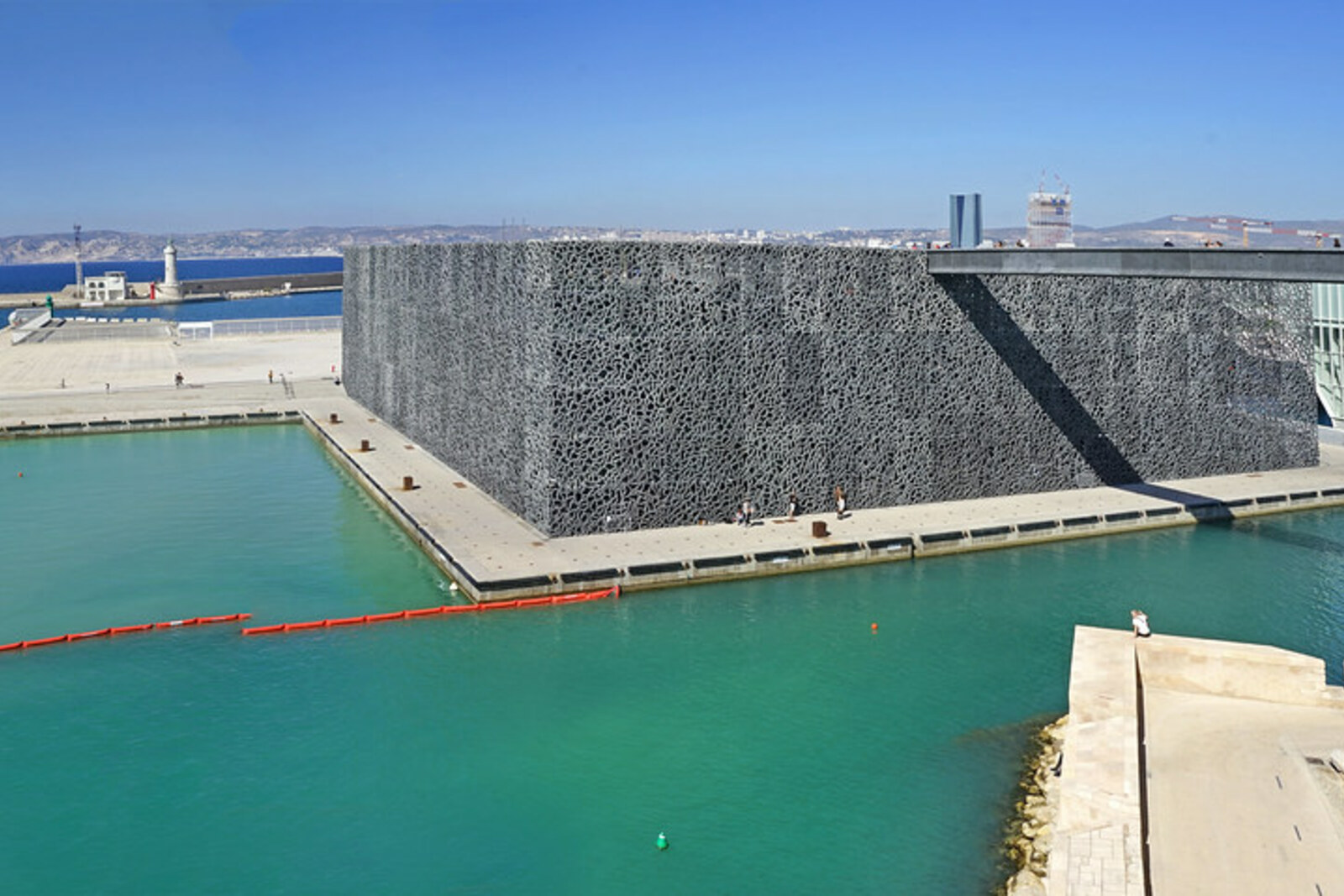
Look around first
What to notice
- Royal walls
- Old towers
- Concrete walkway over the water
- MuCEM's new building
The story of the place
The name Saint-Jean appeared here before the fortress walls. At the end of the twelfth century, the Knights Hospitaller settled on the headland. They established a commandery—a church, a hospital, a residence, and the order's working estate—welcomed pilgrims, and sent ships carrying people to the Holy Land. The Chapel of Ioann the Baptist was the first thing they acquired. The headland inherited the name Saint-Jean from the chapel and the order.
Almost five centuries later, the fortress swallowed up this commandery. The reason was Gaspard de Glandevès-Niozelles's conflict with the French king. Gaspard de Glandevès-Niozelles was a Marseille nobleman, an estate owner, and first consul—the senior of the city's elected leaders. He sought to prevent the consuls appointed by the king from governing Marseille. His position rested on his noble title, land, and municipal office, and he was risking all of them.
In sixteen fifty-eight, Gaspard de Glandevès-Niozelles's supporters seized the Hôtel de Ville by force and stirred the townspeople against the new consuls. The twenty-two-year-old king of France, Louis XIV, intended to deprive Marseille of the ability to resist his orders. Royal troops occupied the city and disarmed its inhabitants. Gaspard de Glandevès-Niozelles was sentenced to death in absentia, stripped of his nobility, his coat of arms was smashed, his property was confiscated, and his house was demolished. He himself managed to flee to Spain.
On March second, sixteen sixty, Louis XIV entered Marseille through a breach in the city wall. He refused to use the ordinary gates: the city was received as conquered. The king then transferred municipal offices from noblemen to merchants and bourgeois, and in sixteen sixty-five ordered two fortresses built at the entrance to the Vieux-Port.
This headland was chosen for the northern one. From here, cannons could block the entrance from the sea and keep the city's neighborhoods under fire. The Knights Hospitaller were forced to leave, and the walls begun in sixteen sixty-eight enclosed their chapel and older towers. Across the water still stands the second royal fort, Fort Saint-Nicolas. The name of the expelled order remained on a fortress built for the people against whom its artillery was directed.
The museum by the sea grew out of an entirely different human undertaking. In nineteen thirty-seven, the museologist Georges Henri Rivière founded the National Museum of Popular Arts and Traditions in Paris. He wanted peasant furniture, festive costumes, craft tools, and objects of everyday life to be studied as seriously as painting and sculpture. His staff traveled around the country and collected objects from a disappearing rural way of life.
At the end of the twentieth century, the French government decided to move the museum to Marseille and expand its subject to the cultures of Europe and the Mediterranean. Between September two thousand twelve and July two thousand thirteen, the collections were transported from Paris on one hundred sixty semi-trailers. In June two thousand thirteen, MuCEM—the Museum of Civilizations of Europe and the Mediterranean—opened. At the same time, restorers prepared the fort for visitors, exhibitions, and open gardens.
A concrete walkway over the water links the new museum building with the royal walls. At one end is the headland from which Louis XIV intended to shell rebellious Marseille; at the other is the museum whose first collections arrived here from Paris on one hundred sixty semi-trailers.
Useful on site
The official website, on the date checked, shows hours of 10:00 — 19:00 for the main building and the fort, daily except Tuesday, 1 May, and 25 December. Outdoor areas are free to enter; a single ticket for the exhibitions is listed at 11 euros, reduced at 7,50 euros. The bridge between the main building and the fort closes 30 minutes before the site closes.
Checked: June 29, 2026. Check the official source before visiting.Check the availability of the bridges and gardens on site, and do not count on every section of the fort being open at the same time. You can walk the exterior route and see the architecture without visiting the exhibitions; the museum galleries require a separate decision.