 Guide On Map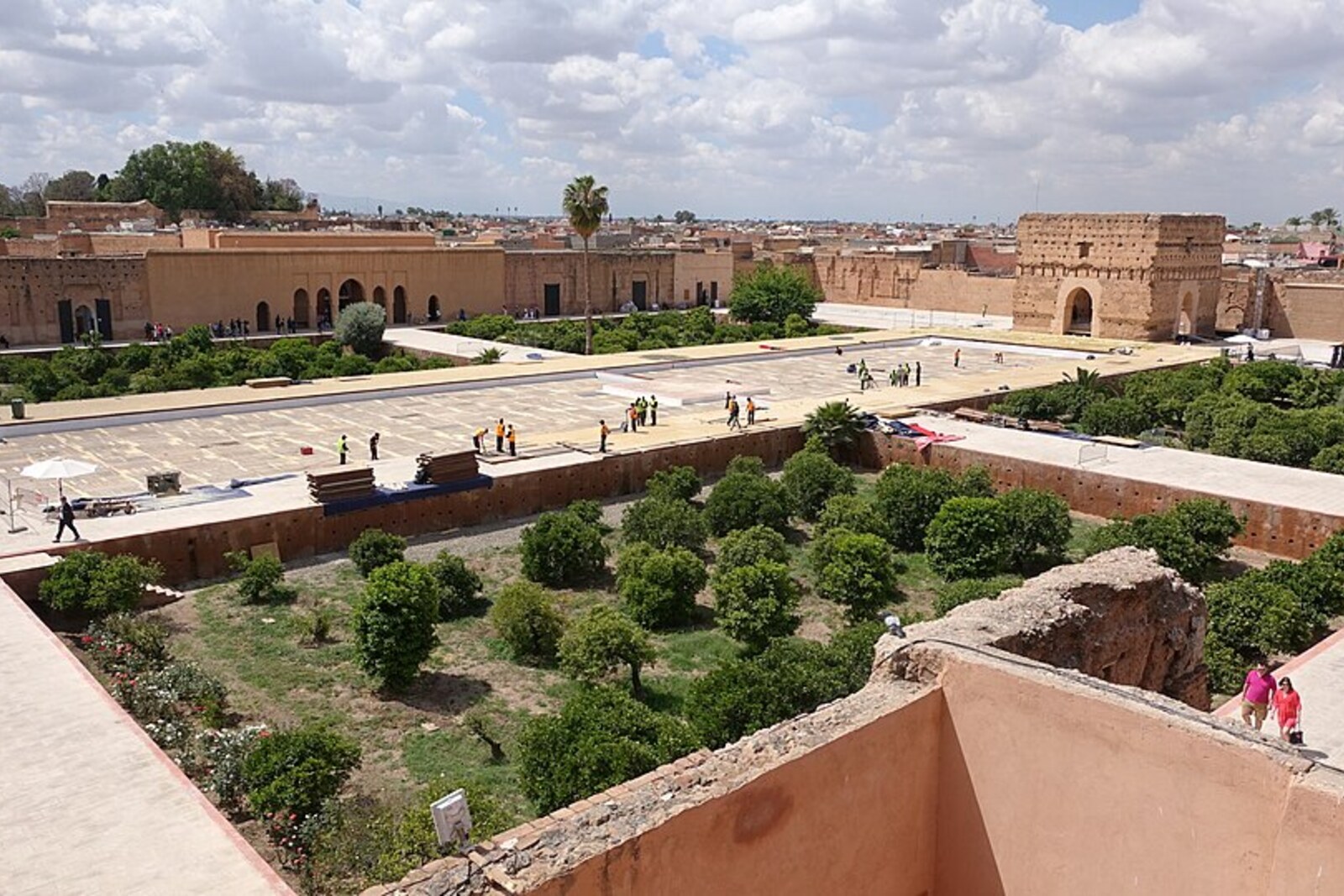
Look around first
What to notice
- Earthen walls
- Large pool
- Sunken garden plots
- Remains of pavilions
The story of the place
At the ceremonial El Badi Palace, Saadian sultans held great festivities and received embassies. Pavilions stood around the edges of the broad courtyard, while a water feature and gardens set below the paths lay at its center, so that the trees would not close off the space. In the early eighteenth century, columns, cedar ceilings, tile, and carved decoration were taken away from here to build the new capital in Meknes. What remained were rammed-earth walls, pools, and low garden squares that could not be dismantled and loaded onto wagons.
The deep rectangles in the middle of the courtyard served as gardens: trees grew below the level of the paths and did not block the pavilions. An enormous pool stretched between the gardens. Bare rammed-earth walls once concealed marble, carved stucco, and colored tile. To understand who paid for this courtyard, we must begin with three deaths.
In the summer of fifteen seventy-eight, the deposed Saadian sultan Muhammad al-Mutawakkil tried to regain the Moroccan throne, which his uncle Abd al-Malik had taken from him. He brought with him Sebastian I of Portugal, who hoped to install an allied ruler in Morocco. Abd al-Malik defended his rule; fighting beside him was his brother and heir Ahmad, another son of Muhammad al-Shaykh, whose death at the Saadian Tombs has already been mentioned.
In one day, all three men whose claims had brought armies to the battlefield died. The ailing Abd al-Malik died during the battle, Sebastian was killed, and al-Mutawakkil drowned while fleeing. Ahmad survived, took command, and after the victory was proclaimed sultan. At the same time, he received the name al-Mansur—the Victorious. The death of childless Sebastian caused a dynastic crisis: two years later, the Portuguese crown passed to the Spanish king and remained with the Spanish Habsburgs for six decades.
Many Portuguese nobles ended up in Moroccan captivity. Their relatives had to pay for their release, and Ahmad al-Mansur directed part of the spoils and ransoms toward building a new ceremonial palace. Work began a few months after the battle and lasted sixteen years; decorations continued to be added almost until the sultan’s death.
The name El Badi is usually translated as “the Incomparable.” It was the ceremonial part of a palace complex, intended for great festivities and receiving ambassadors. Ahmad received guests in pavilions along the sides of the courtyard, while the pool and sunken gardens left the whole of its enormous width open before them. Later, construction was financed by income from Moroccan sugar and trade through the Sahara. Near Pisa, Italian craftsmen carved fifty tall marble columns for the sultan; the marble was paid for in sugar, weight for weight.
After the death of Ahmad al-Mansur, his heirs began a civil conflict, and the Saadian dynasty gradually lost the country. In the early eighteenth century, Moulay Ismail, sultan of the new Alaouite dynasty, was building his capital in Meknes. He needed costly materials, and he wanted the Saadian palace not to rival his own buildings. By his order, marble columns, cedar ceilings, tile, and carved decoration were systematically removed from El Badi. A substantial part was taken to Meknes.
There was no point in dismantling the rammed-earth walls for transport. The pools and the sunken garden plots could not be loaded onto wagons either. They are precisely what now make up the palace that Ahmad al-Mansur called the Incomparable.
Useful on site
A paid monument almost entirely outdoors; current hours and access areas must be checked before visiting.
Checked: June 28, 2026. Check the official source before visiting.Distances matter here: walk along the courtyard and let the scale reveal itself, rather than limiting yourself to a single vantage point.