 Guide On Map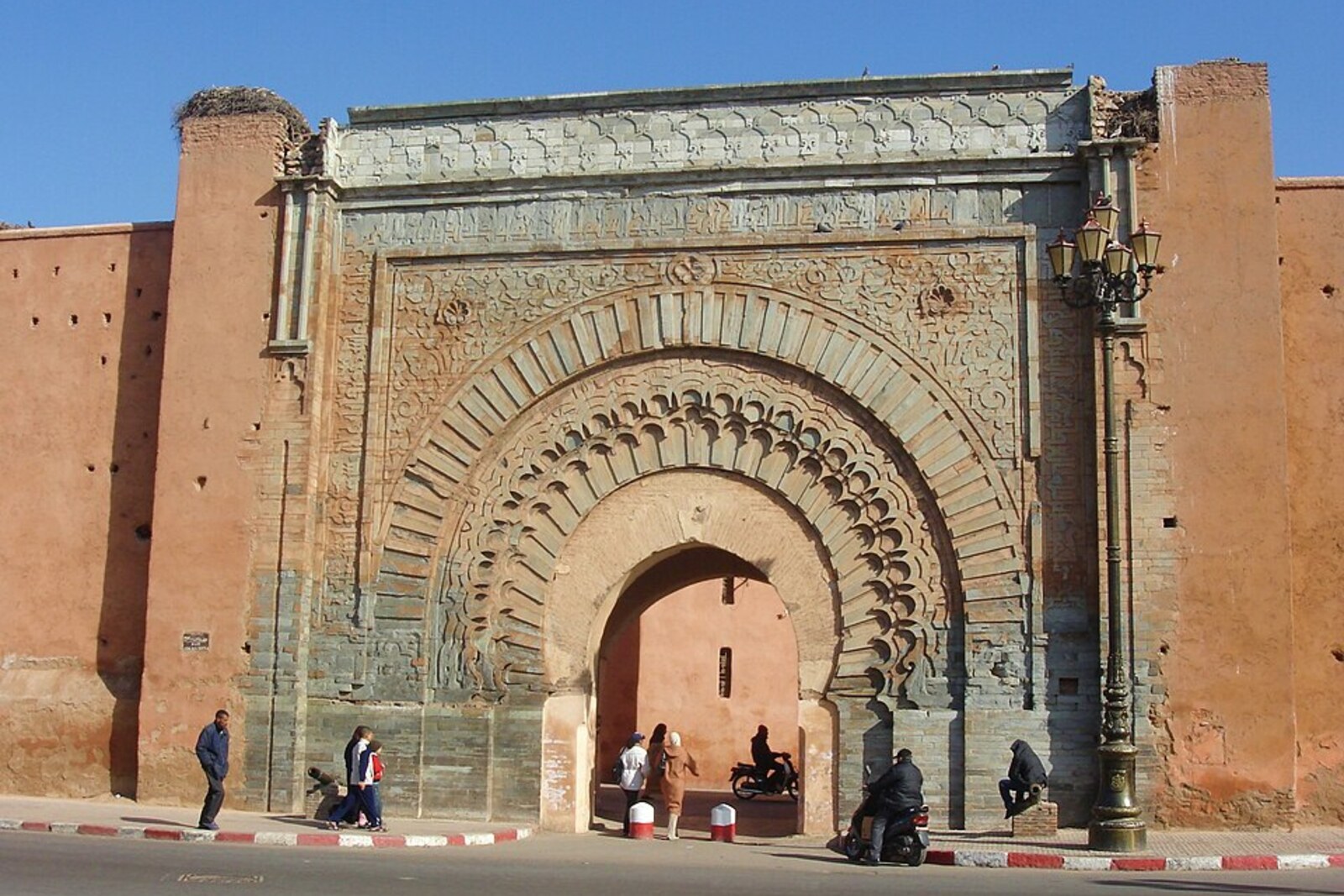
Look around first
What to notice
- Carved stone arch
- Qur'anic inscription
- Brick narrowing of the opening
The story of the place
Medieval chroniclers especially often recalled Bab Agnaou when the bodies and severed heads of the executed were displayed at the gate. The sentence itself could be carried out elsewhere: the remains were brought here after the execution. The rulers needed a passage used by those for whom the warning was intended.
This was the kind of place established at the end of the twelfth century by the Almohad caliph Abu Yusuf Yaqub al-Mansur. South of old Marrakech, he was building a separate kasbah—a fortified district for his family, court, and administration. Townspeople entered it through Bab Agnaou. High-ranking officials and the caliph's relatives used another gate, Bab as-Sadat, the “Gate of the Lords.” It allowed them to ride directly into the palace district, bypassing the city streets.
Bab Agnaou therefore stands within the Medina of Marrakech as a whole. An attacker would first have had to overcome the outer fortifications; this gate divided the city from the ruler's residence. Behind the façade stood the guard, and the covered passage turned at a right angle. Every townsman who needed to enter the kasbah found himself before the guard and then disappeared from sight around the bend. When the executed were displayed here, a visitor could not avoid the scene. The consequence of a sentence was no longer only the condemned person's death: the body continued to serve in intimidating those heading toward the palace.
Under al-Mansur, stonemasons surrounded the arch with carved ornament and a Qur'anic inscription. It instructs the righteous to enter paradise “in peace and safety”; it then says that they will remain there and will no longer be expelled. These words were read above the public entrance to the residence. Above the same passage, later rulers showed what happened to people they considered their enemies. The names of many of the executed have not survived in the brief accounts, but the repetition of the practice itself allowed historians to link it specifically to Bab Agnaou.
The gate's name also separates one group from another, although its origin remains disputed. In Arabic, “bab” means “gate.” The Berber word “agnau” referred to a person whose speech was not understood, and later to Black people from lands south of the Sahara. The name is therefore usually translated as “Gate of the Blacks.” Old texts also contain the Arabic Bab al-Kuhl, “Black Gate,” and Bab al-Qasr, “Palace Gate.” Yet no chronicle names a particular detachment or community after which the name arose. The connection with the palace's Black servants and soldiers remains a likely explanation, not an established fact.
There is another interpretation: “agnau” may have meant a hornless ram. It is linked to two towers that once stood on either side of the façade, like horns. The towers really did exist, but they disappeared several centuries ago; it is impossible to prove that the name arose precisely after their loss.
Now, mainly the stone front remains of the original design. The towers are gone, the covered vestibule has been destroyed, and the broad Almohad opening was later narrowed by a brick arch. No material trace remains from the display of the executed either. Above today's passage, the carved line about a peaceful and safe entrance still runs. Bab as-Sadat, used by the elite, has disappeared completely; the gate for townspeople remains.
Useful on site
Exterior viewing without a ticket; the city passage is open, but it is safer to visit during the day.
Checked: June 28, 2026. Check the official source before visiting.Stand where you can see the entire stone outline, but do not block the active passage.