 Guide On Map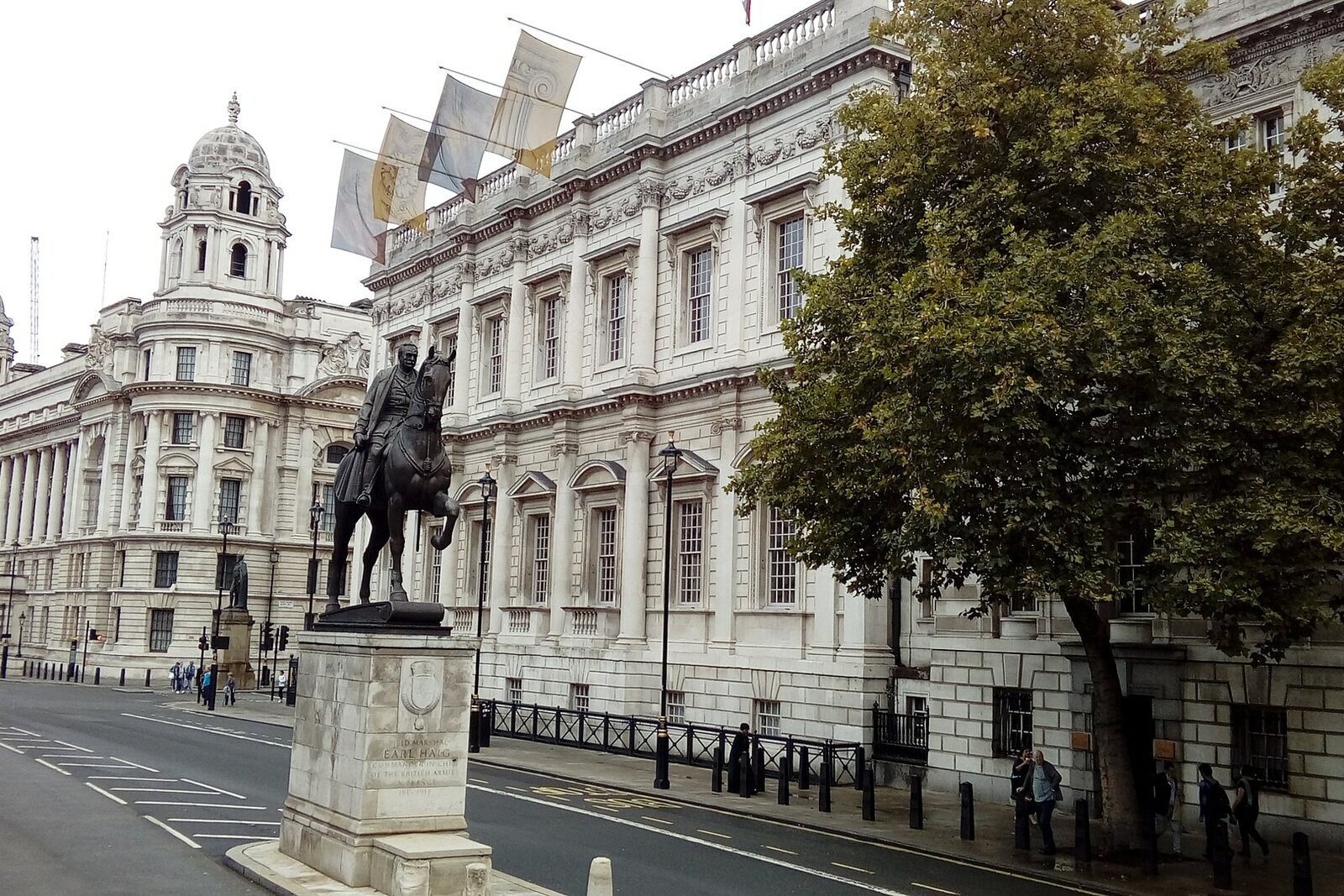
Look around first
What to notice
- The façade of Banqueting House
- The lead bust of Charles I
- Commemorative plaque
- The Cenotaph
The story of the place
At Banqueting House, the surviving part of the former Palace of Whitehall, the story begins on the morning of January thirtieth, sixteen forty-nine: Charles I asked a servant to bring him another shirt. The defeated English king already knew that in a few hours he would be beheaded before a crowd. He might shiver from the cold, and spectators would take the trembling for fear. Until his final minute, Charles wanted to show that the judges would take his life but would not make him acknowledge their right to judge a king.
By that morning, he had lost two civil wars. Charles sought the right to decide matters of taxation, the church, and the army on his own; members of Parliament insisted that the king had to act together with Parliament. After his first defeat, Charles made an agreement from captivity with Scottish leaders, hoping to regain his throne with the help of their army. The parliamentary army won the second war as well. Its senior officers decided that a new peace would last only until Charles's next attempt to restore the old order. The military removed from the House of Commons the members who opposed the trial, and those who remained created a special tribunal.
Charles refused to answer the charge. To recognize such a court would mean accepting that subjects could pass judgment on their sovereign. The judges continued the hearings without his acknowledgment and sentenced the king to death for treason and wars against his own people.
The execution was set beside his former residence. In the seventeenth century, the present Banqueting House was part of the enormous Palace of Whitehall. The building was completed in sixteen twenty-two as a hall for court masques—lavish performances with music, dancing, mythological heroes, and moving scenery. Such spectacles showed audiences a world ordered by a wise monarch chosen by God.
Charles commissioned the Flemish painter Peter Paul Rubens to create nine canvases for the ceiling of this hall. In them, his father James I rules like a biblical king, unites the crowns of England and Scotland, and ascends to heaven among ancient gods. On the morning of the execution, Charles was brought back to the palace and made to wait in his former bedroom. Then the condemned man passed through Banqueting House beneath this ceiling.
Outside, a scaffold was set against the wall at first-floor level so that the king could be seen from Whitehall. A passage to the scaffold was made in the wall. A plaque on the present façade links it to a window almost directly above it, although the exact location of the opening remains disputed. The scaffold was covered in black cloth. Charles removed his cloak, tucked his hair under a white cap, lay down before a low block, and warned the masked executioner that he would give a signal with his hand. After a short prayer, he stretched out his hand. The executioner struck off his head with one blow.
Eight days later, English members of Parliament abolished the title of king; England was then declared a republic. The executed king's son, Charles II, spent years in exile. Eleven years later, Parliament invited him to take his father's throne. Then the death sentence against Charles I became a wanted list: its participants were found by their signatures and seals, ten were convicted and executed, and the bodies of three leaders of the proceedings who had already died were dug up and hanged.
Almost the entire Palace of Whitehall burned down in sixteen ninety-eight. Banqueting House remained the only intact palace building. Rubens's canvases are still inside, and outside, above the plaque, stands a lead bust of Charles I. The plaque marks the condemned man's route through the hall; the block itself stood on the long-dismantled scaffold above the Whitehall sidewalk.
Almost three centuries later, another temporary structure connected with a public farewell was erected on this same street. In the summer of nineteen nineteen, Prime Minister David Lloyd George was preparing the Peace Parade after the First World War and wanted the troops passing along Whitehall to stop for the dead. He asked the architect Edwin Lutyens to design a catafalque. Lutyens proposed a cenotaph—Greek for “empty tomb.”
No names were planned for it. The bodies of hundreds of thousands of British and imperial servicemen lay overseas, and many were never found. The white structure of wood, canvas, and plaster was placed in the middle of the street for just one week. It bore only the dedication “To the Glorious Dead.”
On July nineteenth, nineteen nineteen, the participants in the parade saluted it. Immediately after the procession, people began laying flowers and wreaths at its base. A few days later, the government decided to recreate the design in Portland stone.
The permanent Cenotaph was unveiled on November eleventh, nineteen twenty. The coffin of the Unknown Warrior, selected from among the unidentified dead, was carried past it on a gun carriage. The warrior was then buried in Westminster Abbey. The Cenotaph remained empty. On the Sunday closest to the anniversary of the armistice, two minutes of silence are observed at its foot and wreaths are laid in memory of those killed in the world wars and subsequent conflicts.
Useful on site
The Cenotaph can be viewed from the sidewalk; do not step into the roadway or go behind the barriers during ceremonies. Banqueting House is accessible from outside as a façade stop. Inside: closed as of 2026-06-28; the summer 2026 schedule is listed as 1 August–20 September, Thursday–Monday, 10:00–16:00, last admission 15:00. Verified 2026-06-28.
Checked: June 28, 2026. Check the official source before visiting.At The Cenotaph, stay on the sidewalk and do not go behind the barriers. Rubens's ceiling can be seen only during a separate visit to Banqueting House.