 Guide On Map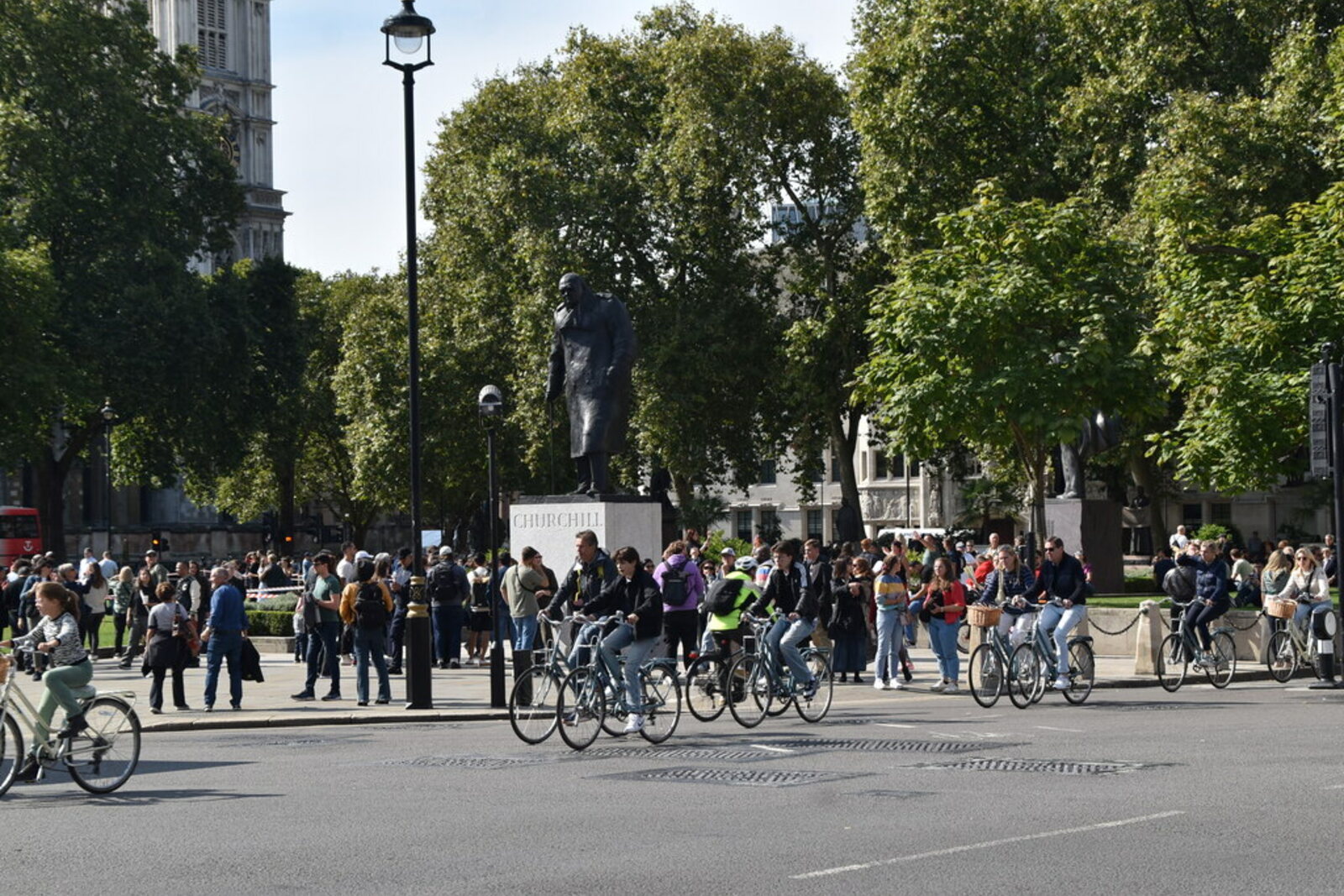
Look around first
What to notice
- Green lawn
- Green commemorative plaque
- Electric traffic lights
The story of the place
The green garden in the middle of Parliament Square is surrounded on all sides by traffic lanes. Roads from Westminster Bridge, Whitehall, Victoria, and Buckingham Palace meet here. The name itself came from the neighboring Palace of Westminster, where Parliament sits. The square was cleared and laid out to provide easy access to it, while the present single lawn was formed during a postwar redesign of the traffic junction.
In the eighteen sixties, there was no lawn island yet. Carriages, cabs, and omnibuses came from the bridge through the square, while pedestrians crossed their flow on the way to Parliament. John Peake Knight made his living preventing trains from colliding: he managed railway traffic and knew semaphores well—poles with movable signal arms. Knight proposed installing such a semaphore on an ordinary London street.
The junction by Parliament’s gates was chosen for the trial. A mistake here could end not in a delay, but with a person beneath a carriage’s wheels. On December ninth, eighteen sixty-eight, a tall cast-iron pole appeared on a pedestrian island. It was the world’s first street traffic light, though a modern driver would hardly recognize it at first glance.
There were no cars yet, and no automation either. By day, a police officer turned a handle and raised the semaphore arms: the horizontal position required people to stop, while the lowered position allowed them to proceed cautiously. At night, a gas lamp with red and green glass was lit at the top. The first traffic light had to be operated by a person standing directly beside the hollow pole, with its gas pipe inside.
The experiment lasted less than a month. In early January eighteen sixty-nine, gas accumulated in the pole and ignited. The explosion badly burned the face of the police officer on duty. The device was removed, and Britain abandoned the idea of traffic signals for several decades. Knight died in eighteen eighty-six and did not live to see electric traffic lights return to London junctions.
The first pole is not here. A green commemorative plaque bearing John Peake Knight’s name and the date of the trial hangs on the corner building between Bridge Street and Parliament Street. Below, at the same crossing, ordinary electric signals now stop traffic heading toward Parliament.
Useful on site
Outdoor stop. The central garden is managed by the city council; hard surfaces are usually accessible, but the lawn and individual areas may be temporarily closed for works, ceremonies, or security. Checked 2026-06-28.
Checked: June 28, 2026. Check the official source before visiting.Stay in pedestrian areas and cross roads only on the signal: traffic around the square is heavy and noisy.