 Guide On Map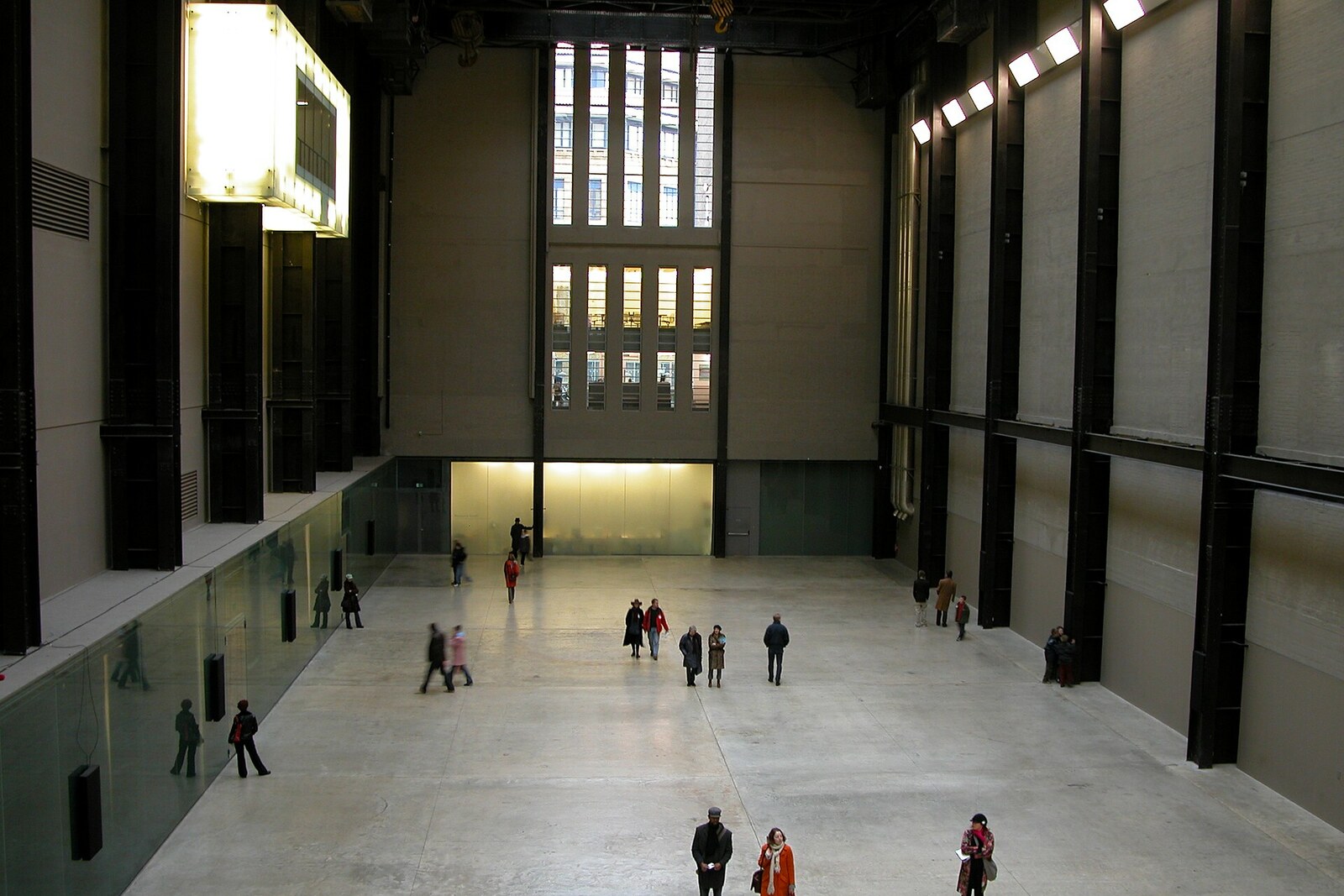
Look around first
What to notice
- The brick power station building
- The Turbine Hall
- The filled seam in the concrete floor
The story of the place
The brick structure by the Thames was built for Bankside Power Station. When the station closed, the architects preserved its enormous Turbine Hall but removed the machinery. In two thousand, a museum of twentieth- and twenty-first-century art opened here—Tate Modern. The former space for generators became the main entrance and a site for works that artists create specifically for its dimensions.
The name Tate comes from the surname of Henry Tate, a sugar industrialist and collector. In the late nineteenth century, he wanted to give his paintings to the state, added money for a separate building, and the gallery that opened came to be called by his name. Later, the collection was divided: British art remained at Tate Britain, while modern art was moved here.
In two thousand seven, the Colombian sculptor Doris Salcedo was commissioned to create another work for the Turbine Hall. Other artists had filled this space with enormous objects. Salcedo decided not to put anything in it. She insisted that the concrete floor be opened up from one end of the hall to the other.
Salcedo came to one of Europe's major museums with the history of people whom the receiving society considers outsiders. She conceived the crack as a boundary: thin at the very entrance, then increasingly wider and deeper. Metal mesh resembling a fence was embedded in its concrete sides. She called the work Shibboleth.
The word comes from a biblical story. Warriors of Gilead seized the crossings over the River Jordan and forced fleeing Ephraimites to pronounce the word shibboleth. The Ephraimites pronounced it differently, revealed their origin, and died. The word came to mean a marker by which insiders are separated from outsiders. Salcedo gave this name to the fissure that crossed the museum entrance.
The idea required actual damage to the building. The curator Achim Borchardt-Hume, responsible for preparing the commission, could not on his own authorize leaving a permanent scar on the floor. The decision had to be taken up to the director of Tate, Nicholas Serota. He supported Salcedo and allowed the concrete to be opened up.
Together with architects and engineers, the artist spent fourteen months preparing the complex parts of the fissure in Bogotá. They were then transported to London. Here, construction workers cut through the floor, removed a long strip of concrete, excavated a recess, and spent another month installing the transported elements. The result was a winding crack one hundred sixty-seven meters long.
Salcedo expected that visitors might not notice it: instead of the usual sculpture beneath the ceiling, the work went down into the floor. But people came specifically for the fissure, examined the mesh inside it, and tried to understand whether the museum had really allowed its own floor to be split.
In the spring of two thousand eight, the exhibition ended. The crack was filled with concrete, but the surface was not completely leveled. The installation is gone, yet a filled seam still runs across the floor of the Turbine Hall—the very section that Serota allowed to be opened up for Salcedo.
Useful on site
The museum is open from 10:00 to 18:00 Sunday–Thursday and until 21:00 on Fridays and Saturdays; admission to the permanent collection is free.
Checked: June 17, 2026. Check the official source before visiting.First, compare the tower with the dome of St. Paul's on the far bank. General admission and special exhibitions may have different conditions, so check your visit plans separately.