 Guide On Map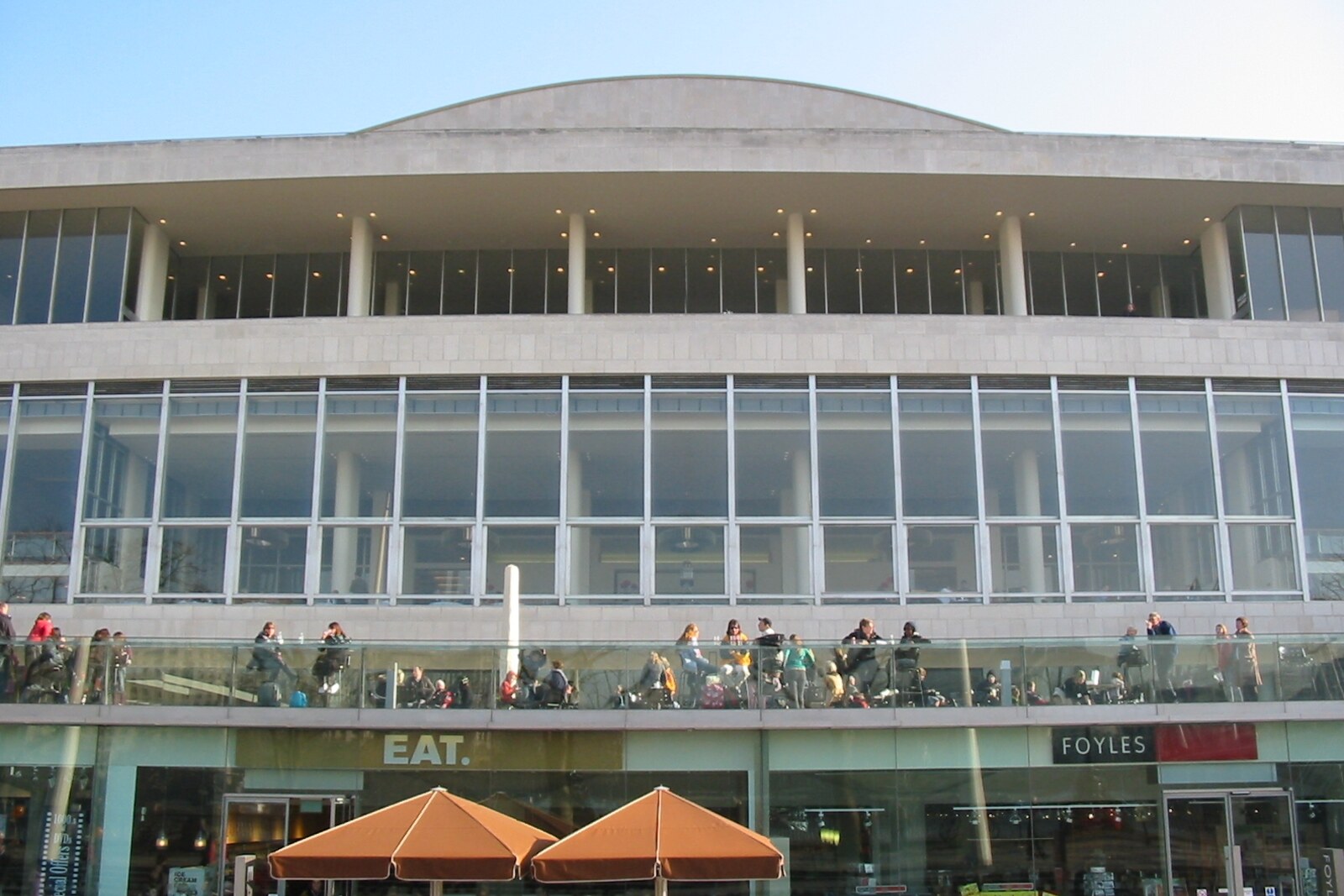
Look around first
What to notice
- The main staircase
- Spacious foyers
- Thomas Beecham’s bronze bust
The story of the place
The Festival Hall by the Thames remains from a postwar exhibition, although the neighboring pavilions were then intended to be dismantled after a few months. The closed Lion Brewery once operated here, and the city council left the festival’s only permanent building for music on the riverbank. Beyond the main staircase stretch broad foyers, which can be entered without a ticket; farther on, behind the outer walls, the auditorium stands on isolated supports. The staircases and foyers between the facade and the hall accommodate people and block out some of the vibration and roar of trains from the neighboring railway bridge.
Thomas Beecham had a direct reason to await the opening of this hall. Five years earlier, the celebrated conductor and impresario had assembled the Royal Philharmonic Orchestra, which needed a permanent large venue in London. Since nineteen forty-one, when a German incendiary bomb destroyed Queen's Hall—the city’s former center of symphonic life—no suitable new hall had appeared. Beecham knew the literal cost of concerts: his family’s fortune had been made through a pharmaceutical company, and for decades he spent that money on opera productions and orchestras.
Yet he hated the future home of London music even before it opened. Beecham called the Festival of Britain a scheme of monstrous foolishness, and described the new building as repellent and ugly. He refused to take part in the celebrations here.
The project that so irritated the conductor was championed by Herbert Morrison, the minister responsible for the Festival of Britain, who wanted the country to see its own achievements in science, industry, and art after the war. Food was still rationed and building materials were scarce, so the cost of the festival seemed outrageous to many. Morrison replied that people needed support after what they had lived through.
They decided to hold the main exhibition on the south bank of the Thames. On the site of the present hall stood the closed Lion Brewery. Most festival pavilions were intended to be dismantled after a few months, but the London County Council allocated money for one permanent feature: a concert hall. That is where the word “Festival” in its name comes from. The Royal part is connected with the opening ceremony: on May third, nineteen fifty-one, George VI unveiled the covering from a commemorative plaque on the main staircase.
The chief municipal architect Robert Matthew assembled a young design team and assigned the work to his new deputy, Leslie Martin. Most members were hired on short-term contracts; this commission would determine whether they remained notable architects or went their separate ways after the festival. Before them lay an awkward site beside a railway bridge, where the vibration and roar of trains could spoil any concert.
Martin and his colleagues raised the auditorium on isolated supports and placed it inside a separate outer shell. They called this arrangement “an egg in a box.” Between the inner hall and the facades, they placed staircases and spacious foyers: these spaces absorb part of the city noise while also accommodating people. The architects rejected separate entrances and bars for expensive and cheap seats. Today, the largest hall at Southbank Centre hosts orchestral concerts, dance performances, and public talks, and the foyers can be entered without a ticket.
The building was completed on time and within budget. Two years later, Leslie Martin became chief architect of the London County Council. Later, the hall became the first postwar British building to receive the highest grade of state protection.
At the opening, Adrian Boult and Malcolm Sargent conducted instead of Beecham. But the boycott lasted only a few weeks. Beecham agreed to conduct four concerts here the following winter, and by nineteen sixty he had conducted ninety-two. In nineteen fifty-eight, he came to Royal Festival Hall to unveil his own bronze bust. The bust of the conductor who refused to open this building is still inside.
Useful on site
The foyer is open daily from around noon until late evening; the box offices operate from 10:00 to 20:00 on weekdays and Saturdays. Concerts and exhibitions have their own schedules.
Checked: June 17, 2026. Check the official source before visiting.If the public spaces are open, you can enter the foyers without attending a concert. Admission to the hall and to events is subject to separate conditions, which are worth checking in advance.