 Guide On Map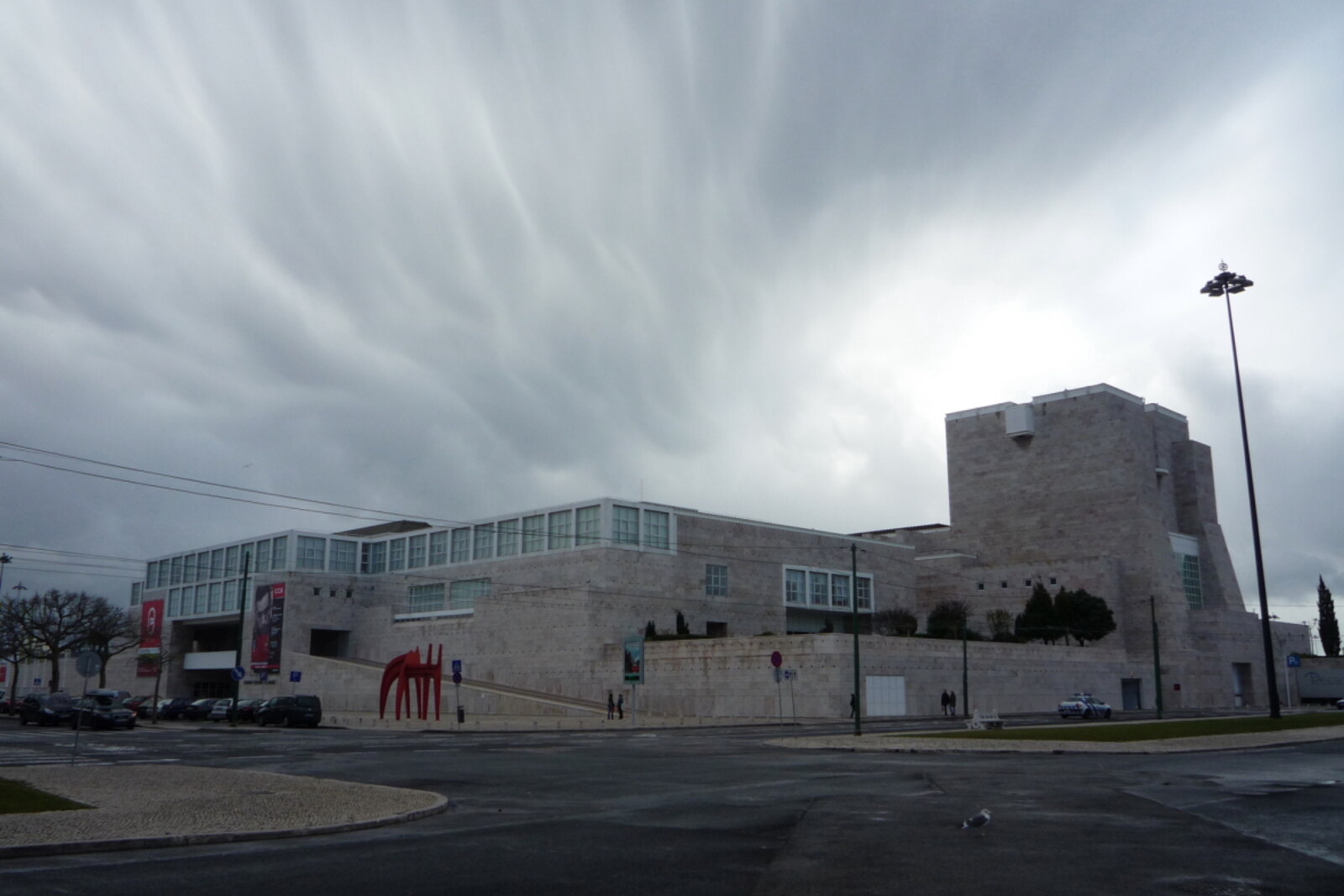
Look around first
What to notice
- Three stone buildings
- Pedestrian street between the buildings
- Inner courtyards
- Cultural centre square
The story of the place
A pedestrian street runs between three stone buildings; nearby are inner courtyards and a square. The cultural centre’s original design had five separate parts, but only three were built. Participants in congresses and working meetings gather in one building; performances, opera productions, and symphony evenings take place in the neighboring ones. The exhibition halls are occupied by the Museum of Contemporary Art and the Architecture Centre.
In December nineteen eighty-seven, the government of Prime Minister Aníbal Cavaco Silva decided to build a new centre in Belém. Four years later, Portugal was to chair the European Economic Community for the first time—an association of twelve countries from which today’s European Union emerged. A dedicated headquarters was needed for six months of international meetings. Cavaco Silva wanted it to remain in the country after the delegations had left, as a complex for concerts, exhibitions, and congresses.
Belém was chosen deliberately. Along Empire Square, Portugal had already presented its history at the exhibition of nineteen forty. Now the government was placing, beside Jerónimos Monastery, a building for a country that had joined the European Community only in nineteen eighty-six and was soon to lead its meetings.
Fifty-seven designs were submitted to the international architectural competition. The winners were the Italian architect Vittorio Gregotti and the Portuguese architect Manuel Salgado. They envisioned five large modules, separated by internal streets: a meeting centre, concert halls, exhibition spaces, a hotel, and a service building. The requirement was strict: the first module had to be delivered by January nineteen ninety-two, before the cultural section opened to the public.
The construction project was called a white elephant, a bunker, and a devourer of public money. The original estimate was exceeded by almost six times; spending and the huge new complex’s proximity to the monastery were especially disputed. Criticism was directed personally at Cavaco Silva, but the prime minister did not stop the project. If the first building had not opened on time, his government would have had to find another venue for the chairmanship for which the whole project had been undertaken.
From January first, nineteen ninety-two, the offices of the chairmanship were housed in the still unfinished centre. On June twenty-sixth and twenty-seventh, Cavaco Silva chaired a meeting here of the leaders of twelve countries. They instructed that preparations begin for negotiations on admitting Austria, Sweden, Finland, and Switzerland. The first three countries joined the European Union in nineteen ninety-five. The Swiss government suspended its application after voters rejected further integration in a referendum.
After the chairmanship ended, the centre was closed: its spaces still required alterations. On March twenty-first, nineteen ninety-three, the general public entered here for the first time—for the exhibition “Triumph of the Baroque.” The complex for which Cavaco Silva had risked his political reputation moved on to the work for which it was meant to be preserved after the European meetings.
Of Gregotti and Salgado’s five modules, three were initially built. Congresses and meetings still take place in the first; the neighboring halls host opera productions, symphony concerts, and performances, while the exhibition building is occupied by the Museum of Contemporary Art and the Architecture Centre. The internal streets between the three buildings have retained the original layout. The Belém Cultural Centre received its name while European delegations were still inside and the first public exhibition was only being prepared.
Useful on site
Exhibitions and the MAC/CCB Museum are open Tuesday through Sunday 10:00–18:30 (last entry 18:00); closed Mondays.
Checked: June 17, 2026. Check the official source before visiting.To understand the architecture, it is enough to walk between the buildings; a ticket for an exhibition or concert is not required for the stop itself. Check access to individual spaces and events separately.