 Guide On Map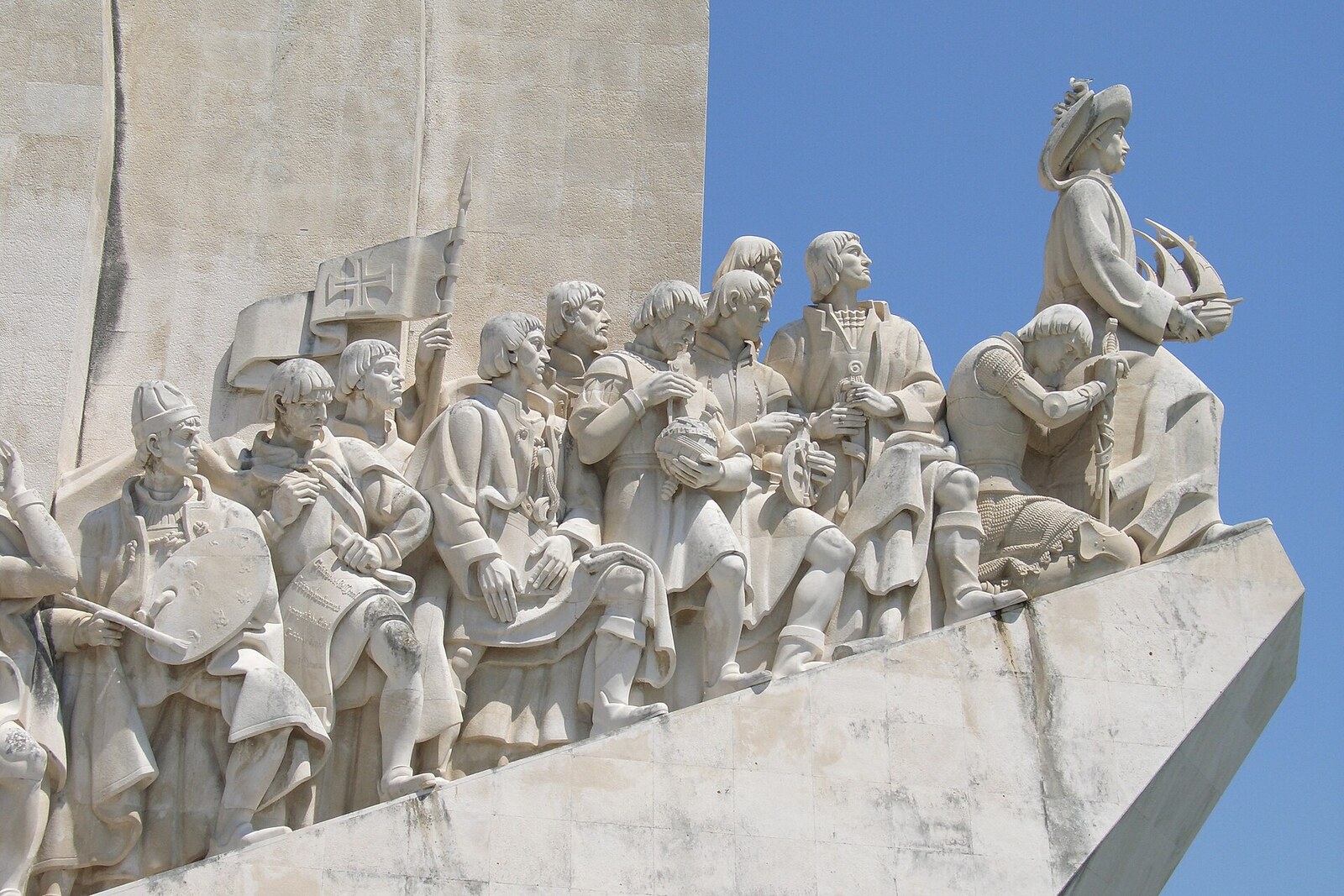
Look around first
What to notice
- The figure of Henry at the caravel’s bow
- Two slopes with stone figures
- A stone padrão on ropes
- The jubilee date on the northern wall
The story of the place
On the banks of the Tagus, on the axis of Empire Square, rises the pale limestone silhouette of a caravel; stone figures stand tightly along both sides of its bow. This procession brings together rulers, navigators, a mathematician, chroniclers, missionaries, an artist, and a poet connected with different stages of Portuguese maritime enterprises. Its name preserves the word “padrão”: this was the name for pillars bearing a coat of arms and a cross that navigators left on African shores, declaring the land a possession of the Crown. Several figures here pull one such pillar on ropes, and it retains the meaning of the old marker: to place a sign on a foreign shore in the name of authority.
The stone people on the two slopes of this giant caravel never formed a single crew. Generations lie between them. At the front stands Henry the Navigator. He himself made none of the long voyages for which he is remembered. Henry controlled vast land revenues, headed the wealthy Order of Christ, and received a monopoly on trade south of Cape Bojador. These resources allowed him to equip expeditions along the western coast of Africa. During his patronage, Gil Eanes rounded Cape Bojador, and the Portuguese became acquainted with about two thousand kilometers of coastline farther south.
Behind him, the sculptor placed people who continued the work after Henry’s death: Bartolomeu Dias, who rounded the south of Africa; Vasco da Gama, who discovered the sea route to India; Pedro Álvares Cabral, who reached the shores of Brazil; and Ferdinand Magellan, who began the first circumnavigation. Nearby are a king, pilots, the mathematician Pedro Nunes, chroniclers, missionaries, the artist Nuno Gonçalves, and the poet Luís de Camões. They explored, conquered, described, and mapped lands in different decades.
The name “Monument to the Discoveries” means “Monument of Discoveries.” A padrão was a stone pillar bearing a royal coat of arms and a cross. Navigators set such markers on African shores, declaring the land a possession of the Portuguese Crown. Here Diogo Cão, Bartolomeu Dias, and António de Abreu are depicted pulling one such pillar on ropes.
The architect Cottinelli Telmo and the sculptor Leopoldo de Almeida created this procession for the Portuguese World Exhibition of nineteen forty. Telmo was responsible for the architecture of the entire exhibition and had to erect a convincing stage set of national history on the banks of the Tagus in eight months. That is why the monument appeared in Belém, on the axis of Empire Square, where the organizers could link the exhibition with the river and the old point of departure for ships.
From the beginning, Telmo designed the structure as temporary. Inside stood a light iron framework; outside, the figures were modeled from fiber-reinforced plaster over wooden and metal armatures. After the exhibition, a cyclone in nineteen forty-one damaged the buildings on the waterfront; two years later, the monument was dismantled.
The minister of public works, Duarte Pacheco, wanted to restore the monument that had pleased the public permanently. Telmo opposed his own client. He explained that spectacular exhibition architecture was suitable for a short celebration, while this procession could not become a solemn memorial. Pacheco’s death, wartime shortages, and rising material costs stopped the project. As late as nineteen forty-seven, Telmo said proudly that he had helped prevent a stone repetition. A year later, the architect died.
After his death, the government returned to the rejected plan. In nineteen fifty-eight, it ordered the nineteen-forty model to be repeated on its former site—for the five-hundredth anniversary of Henry’s death. The architect António Pardal Monteiro adapted the design for reinforced concrete, and Leopoldo de Almeida modeled the figures anew, now for carving in Sintra limestone.
The list of people depicted was not yet final. Pêro da Covilhã, a land-based scout of routes to India, was added to fill an empty space and balance the composition. The names of the others were officially announced only after the opening: before the ceremony, the figures were left unnamed, out of fear of disputes over whom they had included and whom they had forgotten.
On August ninth, nineteen sixty, the now-stone monument was inaugurated. Its northern wall retained the jubilee date: “fourteen sixty–nineteen sixty.” The plaster procession that Cottinelli Telmo defended as temporary is gone. Before the Tagus stands its enlarged permanent repetition—the very thing whose creation the author tried to prevent.
Useful on site
March–September: 10:00–19:00 (last entry 18:30); October–February: 10:00–18:00 (last entry 17:30). Closed January 1, May 1, December 24, 25 and 31.
Checked: June 17, 2026. Check the official source before visiting.The entire key story is visible from outside. Treat the climb inside and up to the viewing platform as a separate visit; for the audio guide, it is enough to walk around the base and examine both sides.