 Guide On Map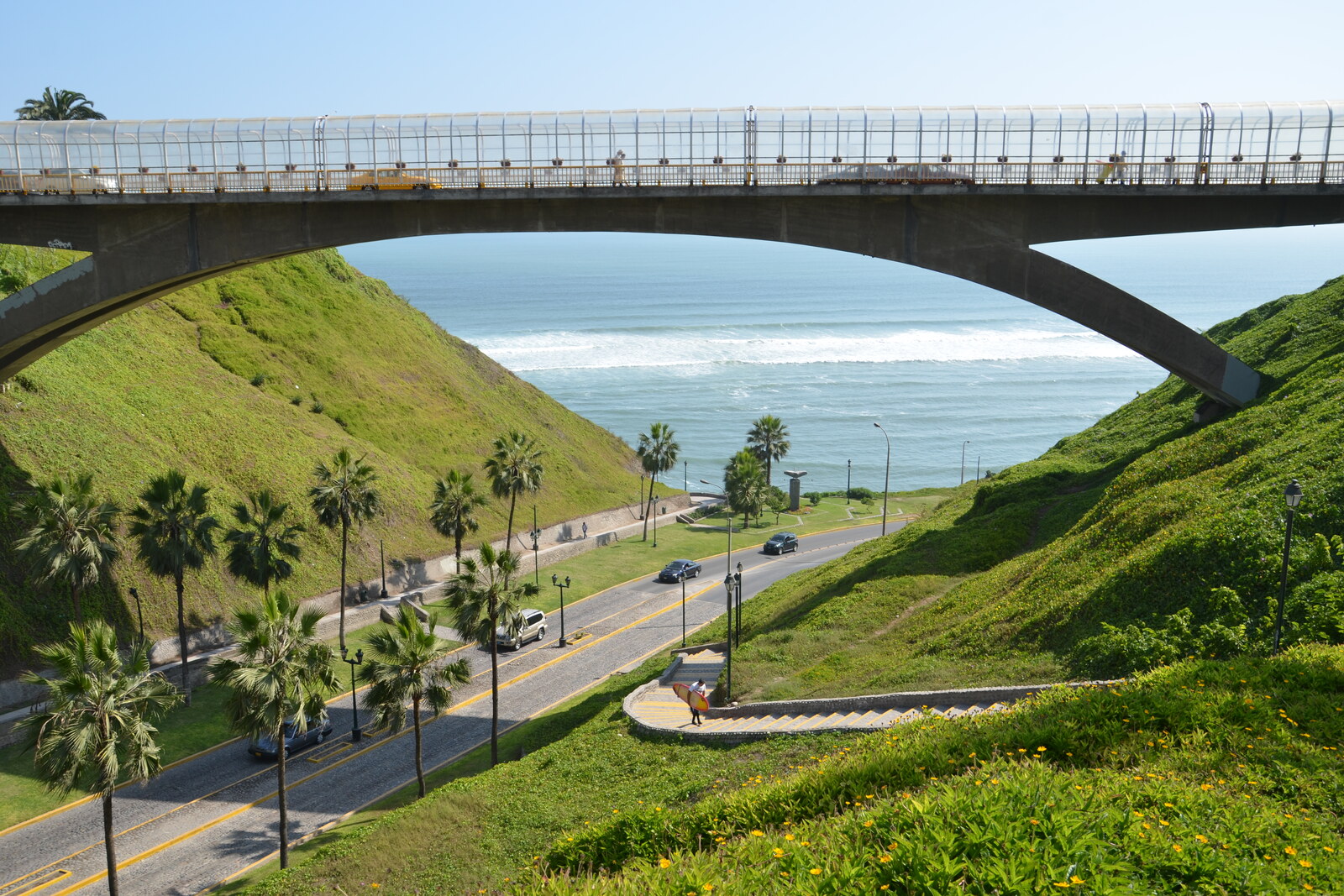
Look around first
What to notice
- Concrete arch
- Transparent panels
- Steel fastenings
- Parallel twin bridge
The story of the place
The name on the sign refers to Eduardo Villena Rey, who led Miraflores during a period of food-market reorganization and rising municipal revenues. The municipal council gave the crossing his name much later, then clarified its official title. Tall transparent shields run along the edges of the concrete span, held by steel profiles and fastenings. In ordinary city traffic, they form an almost continuous wall along the road.
The concrete arch does not span a river. Bajada Balta runs below—a historic descent from Miraflores’s upper terrace to the coast. The bridge made it possible to link Malecón Cisneros with Malecón de la Reserva without blocking the road to the beaches. Construction began in nineteen sixty-seven, and a year later President and architect Fernando Belaúnde Terry opened the crossing together with Mayor Rafael Sánchez Aizcorbe. In twenty sixteen, a similar twin bridge appeared beside it: two parallel spans now carry traffic in opposite directions.
The inscription “Eduardo Villena Rey” looks like the signature of the project’s author, but Villena neither designed nor opened the bridge. He led Miraflores from nineteen thirty-four to nineteen thirty-seven, and then for another two years. The municipal council credited him with developing the district, doubling municipal revenues, and reorganizing spaces in the food market. The crossing was named in his honor nearly thirty years after his last term. In twenty fourteen, the council clarified its full official name: “Mayor Eduardo Villena Rey Bridge.”
At first, ordinary low railings stood along the edges. Later, people in crisis began coming here from all over Lima. Doctors studied municipal records from September first, nineteen eighty-eight, through August thirty-first, two thousand three. During that time, sixty-five attempts occurred here: thirty-two people died, and thirty-three were saved. The final two years of observation were particularly alarming—they accounted for more cases than the preceding thirteen years combined.
In two thousand three, municipal employees declared the bridge a controlled-traffic section: security guards stood watch around the clock, and passersby were forbidden to linger on the span. At the beginning of the following year, workers secured one hundred sixty tall transparent panels along both sides. Later, psychiatrists noted that by twenty eighteen, after their installation, not a single completed suicide by jumping from the height of the bridge had occurred here.
The barrier bought time, but people still needed help. Early in the morning of June thirteenth, twenty twenty-one, a man climbed over the panels and ended up on the outer side of the span. Neighbors called emergency services. Two officers from the police rescue unit secured safety harnesses on themselves and went beyond the barrier. One grabbed the man, and the other held both of them; the rescuers then put a safety harness on him and brought all three back by extension ladder. The man was taken to Casimiro Ulloa Hospital.
The transparent sheets along the old bridge are no longer those installed in two thousand four. In June twenty twenty-six, workers replaced them with impact-resistant polycarbonate, reinforced the fastenings, and fitted stainless-steel profiles into the frames. Behind such a wall, on the outer side of the concrete span, the two police officers worked in their safety harnesses.
Useful on site
Open bridge; temporary restrictions are possible during maintenance or city work.
Checked: June 29, 2026. Check the official source before visiting.The panels are a safety feature, not viewing equipment: do not lean on them or try to bypass the barriers. On the walkway, watch for pedestrians and cyclists.