 Guide On Map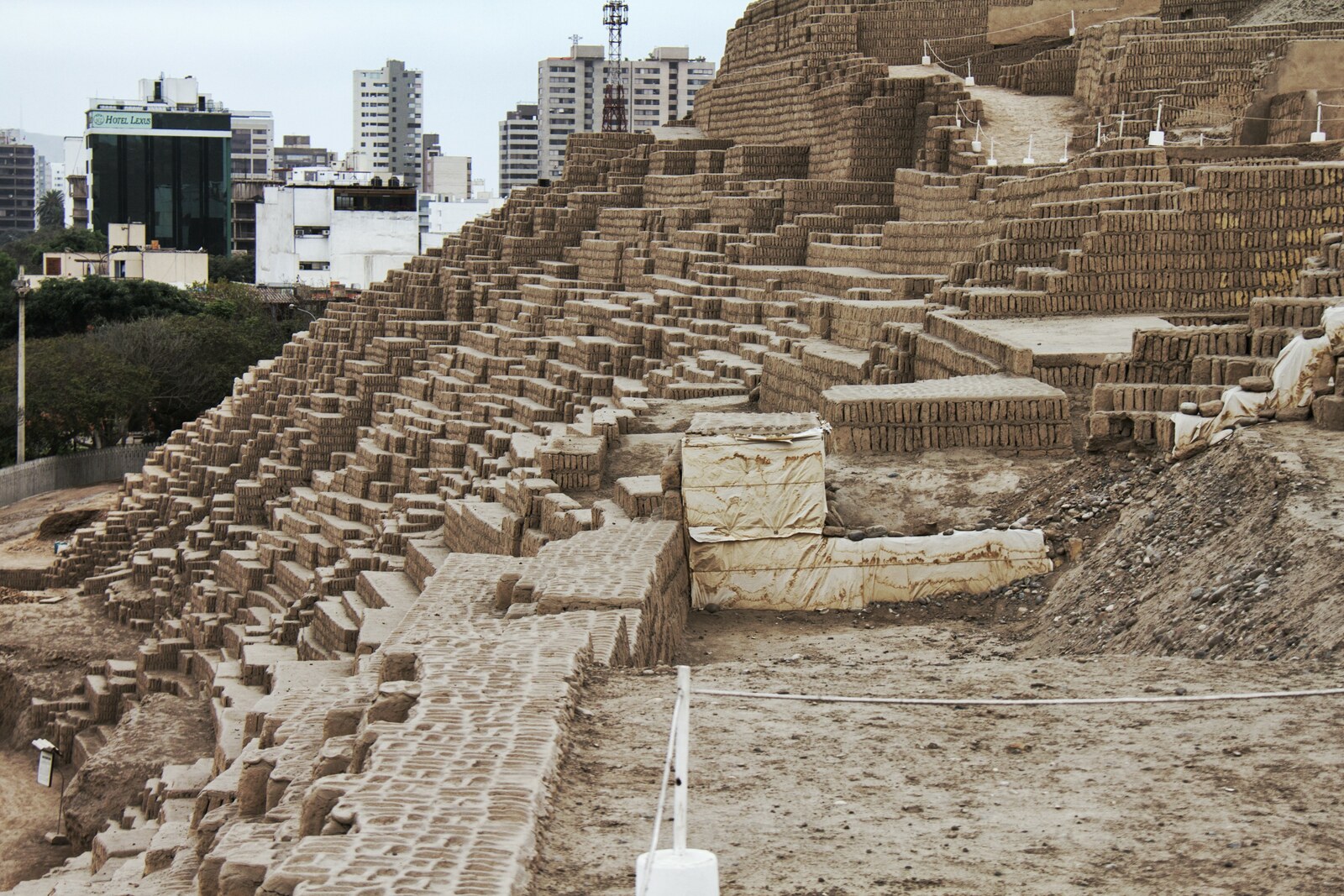
Look around first
What to notice
- Clay pyramid
- Tiered platforms
- Vertical rows of bricks
The story of the place
Huaca Pucllana rises twenty-five meters between the farmland of the Rímac Valley and the ocean, which is only two kilometers from here. Its clay tiers grew one on top of another: former courtyards, passageways, and walls ended up beneath new fills. The vertical rows of small bricks visible on the platforms conceal spaces from different periods. Spacious places for a large community later gave way here to rooms for a much narrower circle.
Around the middle of the sixth century, priests and leaders of the local community decided to close off the large square in the northeastern part of this complex. Their aim was to complete another sacred cycle and build new rooms on top of the former ones. Archaeologists use the name Lima culture for a pre-Inca society of Peru's central coast; what these people called themselves is unknown.
The rebuilding required gathering fishers, farmers, craftspeople, and merchants, on whom both supplies and labor depended. The fishers brought sea fish and shellfish collected along the rocky shore. The farmers gave maize, chili peppers, peanuts, fruit, and coca leaves. Stonecutters made knives and scrapers for preparing food. The finest pottery was made by artisans who, judging by the quality of their work, did this continually and lived by their craft.
First, the participants pierced the floor of the square with wooden rods, placed beads, pieces of quartz, and plants in the holes, then covered the surface with clay again. After that, a communal feast began. The square covered about two thousand square meters; from the number of fish bones, archaeologists calculated that at least one thousand people could have eaten here at one time.
Researchers suggest that the feast helped the priests gather those whose products and labor were needed for the next construction project. What was at stake was quite tangible: fishers gave up part of their catch, farmers part of their harvest, and potters vessels that no one took home after the feast.
Large jars, bowls, and plates were deliberately broken. Workers threw the food remains and pottery down from above onto the only entrance ramp. They then burned the temporary structures, dismantled part of the walls, filled in the square, and built rooms of a different layout on top of it. Fragments from three successive dumps were later fitted together into the same vessels. This is how archaeologists established that they were looking at traces of one short sequence of actions, rather than an ordinary dump accumulated over several generations.
After the spacious square was closed, the builders made smaller rooms here. The former courtyard with long benches could hold a huge community; the next tier was intended for a much narrower circle. The feast, which gathered about one thousand participants, was the last event in the old space.
Huaca Pucllana stood between the farmland of the Rímac Valley and the ocean, about two kilometers away. Yet the remains of ceremonial meals contain especially large amounts of seafood. Waves, sea lions, and sharks were depicted on the vessels. Archaeologists therefore cautiously link the local cult with the sea and a female deity whose name the builders did not leave behind.
The twenty-five-meter pyramid grew out of such decisions. Again and again, people buried courtyards, passageways, and walls beneath new fills, stacking millions of small bricks vertically, like books. The square where that feast ended is no longer visible from the surface: its entrance ramp remained beneath the next tier, together with the broken pottery and the bones of fish brought here.
Useful on site
Daytime visits are usually 09:00–17:00; closed Tuesday; night visits follow a separate schedule. Official pages differ in details; check before setting out.
Checked: June 29, 2026. Check the official source before visiting.The scale of the complex is visible from the accessible perimeter, but the main archaeological areas are inside. Do not go beyond the barriers; plan a separate visit according to the complex's rules.