 Guide On Map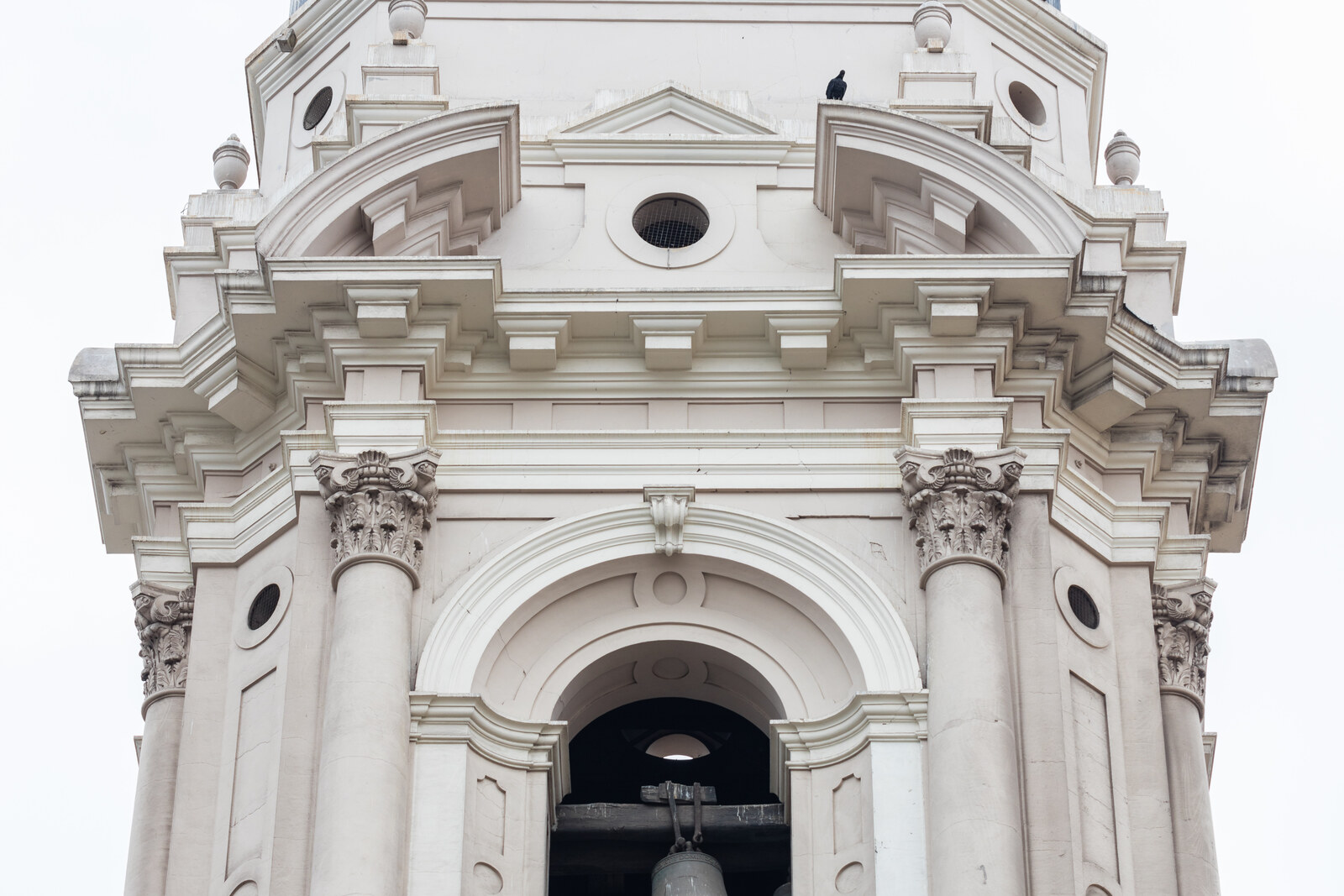
Look around first
What to notice
- The coffin in the first chapel on the right
- Facial reconstruction
- Copy of the skeleton
- The chapel mosaics
The story of the place
For nearly ninety years, Lima Cathedral honored the wrong dead man. In eighteen ninety-one, the city council decided to mark the three hundred fiftieth anniversary of Francisco Pizarro's death. A mummified body was removed from the cathedral burials, doctors identified it as the remains of the founder of Spanish Lima, and the mummy was displayed at the entrance in a glass sarcophagus. Attendants showed it to visitors, and priests blessed it during rounds with a censer.
Pizarro was buried here for a very specific reason. After the founding of the city already described, he set aside a place by the main square for the first city church. A church is called a cathedral because of the archbishop's cathedra: the principal services of the Archdiocese of Lima are held here, the cathedral clergy gather here, and a burial vault for archbishops was built beneath the main altar. Pizarro ordered that he too be laid at the foot of the steps to this altar.
In fifteen forty-one, Pizarro was still governor of New Castile. The office gave him income, land, and the right to distribute estates; his opponents wanted to transfer it to the son of the executed Diego de Almagro. Almagro's supporters killed the governor in a house on the other side of the square. Pizarro's friends feared that the attackers would cut off his head and display it in the square, so that same day they secretly moved the body behind the church and buried it in the courtyard. Three years later, when Pizarro's supporters regained the upper hand, they removed the remains and transferred them beneath the main altar with honors.
The cathedral was enlarged, parts damaged by earthquakes were dismantled, and burials were moved. During another reburial in sixteen sixty-one, the canons separated Pizarro's skull and placed it in a lead box; the remaining bones were put in a wooden box lined with velvet. The niche was then bricked up, and its exact location was forgotten.
A document about this transfer was found in nineteen thirty-five. It did not fit well with the intact mummy in the glass sarcophagus: the real Pizarro's head should have lain separately. But no one had seen the lead box, and the cathedral continued to display the old body. Ten years later, a Peruvian doctor even received a national medical prize for a study in which he argued that the mummy was authentic.
In June nineteen seventy-seven, four workers were sent to rebuild the cathedral crypt. They opened an adjacent wall that they were not supposed to touch under their instructions. Behind the bricks was a niche. Inside lay the lead box with the skull and the wooden box lined with velvet. The inscription on the lid named Francisco Pizarro and listed his services to the Crown of Castile. The box contained too many bones: the remains of a man, an elderly woman, and two children.
Hugo Ludeña, an archaeologist and head of the state department responsible for preserving historical valuables, set out to establish the man's identity. No money was allocated for the research. For seven years, Ludeña assembled volunteers from universities, hospitals, and museums: anthropologists, pathologists, radiologists, and chemists. They joined the skull to the male skeleton, determined the age of the bones, checked the time of burial, and found traces on the skull of prolonged contact with lead.
The main evidence was the injuries. The arm bones retained traces of attempts to shield against blows, while the head and neck bore numerous wounds from bladed weapons. One blow split the right side of the jaw and struck the cervical vertebrae. These injuries matched the testimony of witnesses to Pizarro's murder, recorded by Spanish judges. The researchers identified the discovered man as Pizarro and the displayed mummy as an unknown person who had probably died considerably later. After the discovery, the priests stopped blessing the old sarcophagus.
In nineteen eighty-five, the remains identified by the researchers were moved to the first chapel on the right from the entrance. Their coffin is there, alongside a facial reconstruction based on the discovered skull and a copy of the skeleton. The chapel's mosaics had appeared as early as nineteen twenty-four—at a time when another person lay in the cathedral under Pizarro's name.
Useful on site
Official museum page: Mon–Fri 09:00–20:00, Sat 10:00–22:00, Sun 13:00–19:00; tickets are selected by time slot.
Checked: July 1, 2026. Check the official source before visiting.During services, remain in the area open to visitors. If the interior entrance is closed or requires separate arrangements, the story of the restoration can be understood from the exterior appearance.