 Guide On Map
Power and Law in Lima’s Historic Center
From Plaza Mayor through Jirón de la Unión to the convents
Guide On Map on your phone
Open the walk like a regular app
It takes about 10 seconds to install. No app store needed.
The whole path
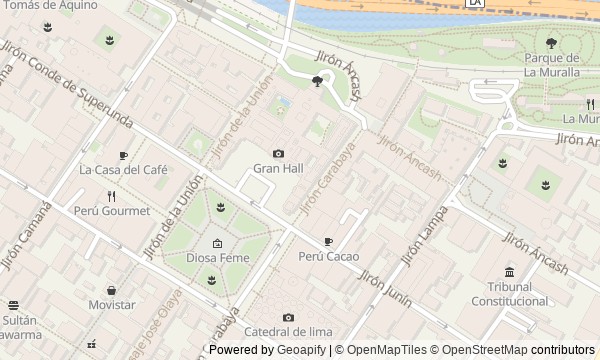
Route map
About the walk
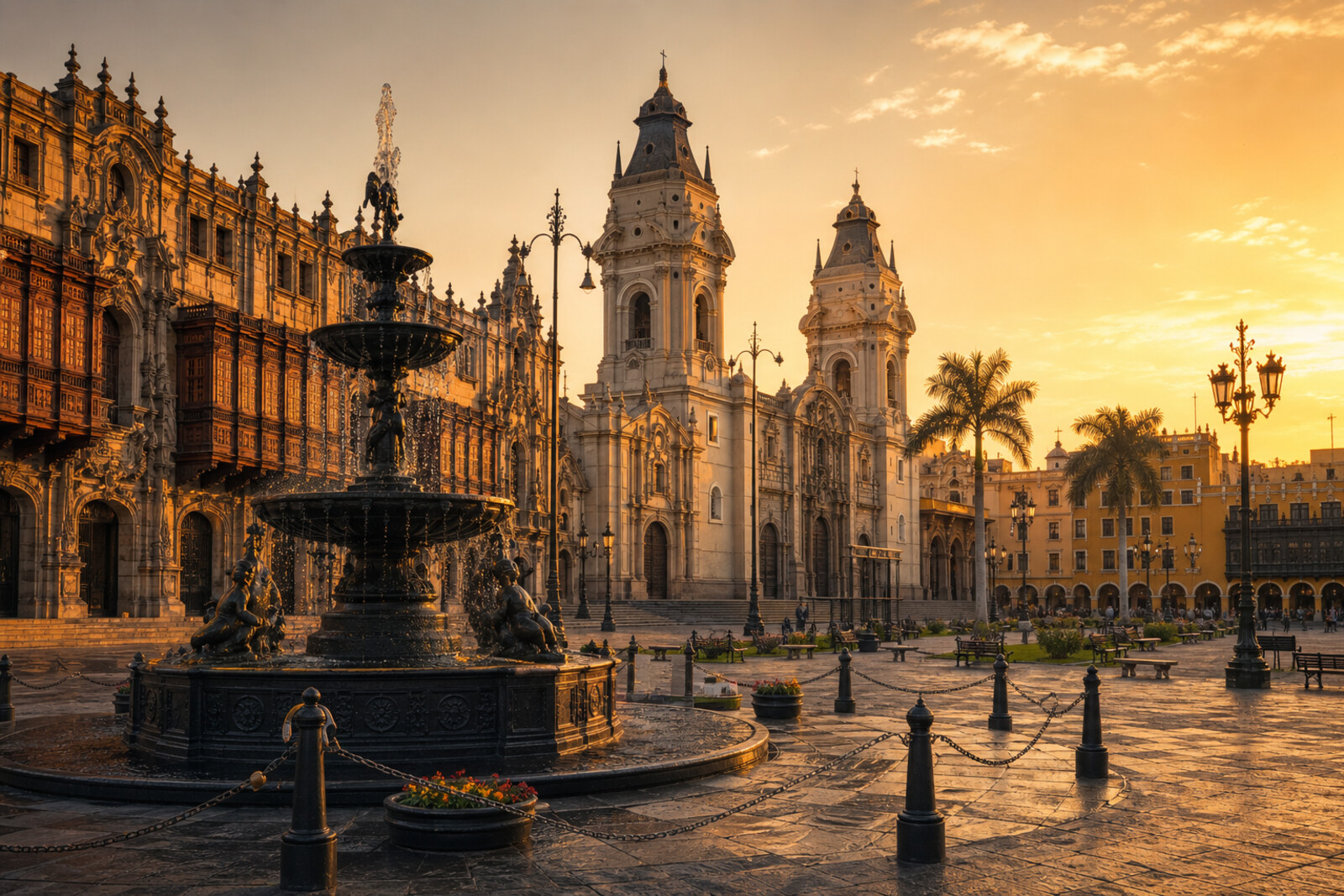
You will begin at Plaza Mayor. Around a single fountain, you will see a cathedral, a palace, and the city council. Then you will move from ceremonial facades to a private home, a commercial street, and 2 convents. This is not a walk through “colonial beauty,” but through places where the right to land, an office, a name, an address, and a burial had to be secured—or could be lost.
Instead of a broad survey of the era, there will be a wooden post, a forgotten niche, 1 respectable cape shared by several conspirators, notarial maps, and a contract for a private underground entrance. Each object raises a brief question: who could call a decision lawful, and who was left to obey?
You will hear a clear-eyed account of documents, urban rules, and human loopholes, without the conquest’s ceremonial version. By the end, you will read central Lima through its boundaries of access: from the square’s grid to the passages cut beneath Basilica and Convent of San Francisco.
Why this order
Plaza Mayor establishes the original layout: the cathedral and palace stand on opposite sides of the square, so after the division of land come 2 institutions that secured the new order. First, Lima Cathedral shows how official memory was made; then the Government Palace shows how an office was pursued together with a house. Casa de Aliaga comes next: beside the ruler’s residence, the fate of his private ally comes into view. Leaving the estate brings you straight to Jirón de la Unión, where a private address gives way to a citywide system. After the street, the route moves to Santo Domingo Convent, where order in names yields to the question of a person’s standing within a community. Basilica and Convent of San Francisco carries this line further—not a dispute over 1 person now, but over an entire brotherhood’s right to its own place and entrance.
Those who want to understand how a colonial city worked Lovers of documentary stories and urban details Those interested in law, property, and struggles for status
Those looking for a light overview of the main sights Those uncomfortable with accounts of violence and burials Those who prefer walks without visits to religious complexes
Before you go
Decide in advance which interiors truly matter to you: access to Lima Cathedral, the private home, and convent spaces should be checked separately, and a visit to Casa de Aliaga should be arranged as entry to private property.
Bring clothing appropriate for active churches, and be ready to put away your camera where photography is restricted. Follow security instructions at the Government Palace and do not cross barriers. For the catacombs, wear closed, sturdy shoes; if you feel unwell, stay in the above-ground part of the complex.
When to go
Start earlier if you want to combine the walk with several interiors: their opening access may not line up. If you start late, choose 1 main visit and read the remaining stops from the street—the sequence of the story will still hold.
Backup plan
If Lima Cathedral is closed, compare its facade and towers with the account of destruction and rebuilding. View the Government Palace from public space in any case, and keep Casa de Aliaga as an exterior stop unless your visit is confirmed.
If convent spaces are inaccessible, do not change the order: at Santo Domingo Convent, focus on the complex itself and the story of Martin de Porres’s recognition; at Basilica and Convent of San Francisco, focus on the above-ground ensemble and the thought of the cemetery beneath it. If you are not ready to descend to the remains, finish the route above ground.
Route conditions
Surface. Paved — 1.5 km (data covers 87% of the route)
Stairs. Flights: 1, 6 m in total
Access. Wheelchair — no; stroller — limited (stairs)
Facilities. Toilets — 1
Elevation. Ascent — 13 m; descent — 10 m
OpenStreetMap extract of June 18, 2026: database data, not a check on the ground. Data © OpenStreetMap contributors, ODbL licence
Walk plan
Open in maps ↗- 1
Plaza Mayor
Here it will become clear why the division of the new city began from the center of the square. - 2
Lima Cathedral
This stop will show how a document, an accidental discovery, and damage to bones changed an official identification. - 3
Government Palace
Here, the occupation of a private home will become a bid for the governorship. - 4
Casa de Aliaga
This stop connects the price of loyalty to the losing side with the way an estate was kept in one family. - 5
Jirón de la Unión
Here, a unified address system meets the familiar block-by-block names. - 6
Santo Domingo Convent
This stop traces how a service position within the community gave way to full membership. - 7
Basilica and Convent of San Francisco and the Catacombs
The final stop will explain why separate brotherhood burial vaults became a shared network of catacombs.
Route features
Everything you need stays in the browser
Progress, saves and your trip plan are stored on this device.
Add Guide On Map to your home screen so the walk opens outside the browser.
How we handle sources, maps and corrections: our editorial standards