 Guide On Map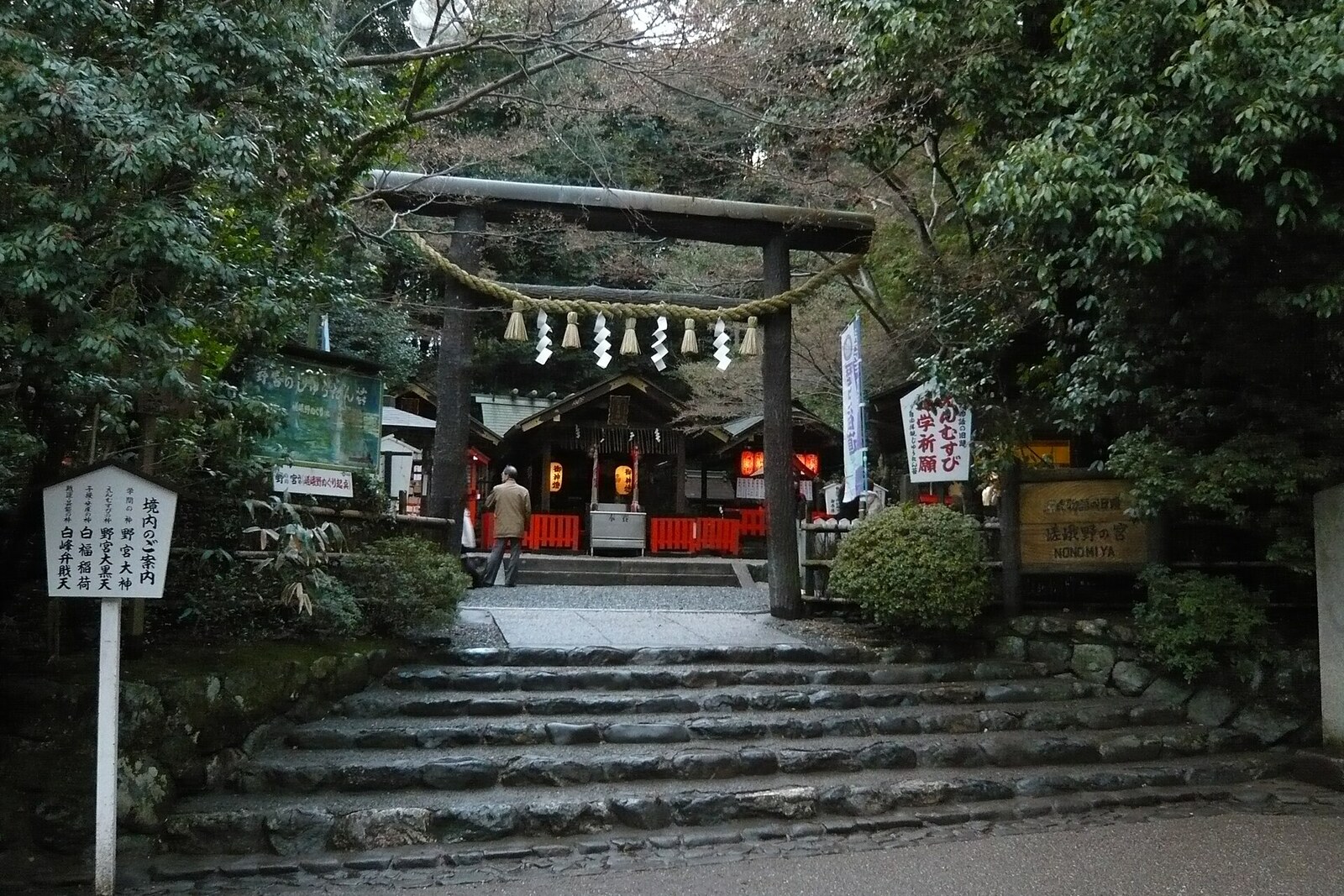
Look around first
What to notice
- Black torii made from unbarked trunks
- Woven fence
- Main shrine
- Side altars
The story of the place
The shrine's name preserves the memory of a country palace where court women were temporarily moved before serving far from the capital. Such a home was not intended to be permanent: when power changed, another site was chosen for the next woman assigned to serve, which is why several possible Nonomiya are remembered around Kyoto. The wooden buildings disappeared, but the black torii of oak trunks with bark and the fence woven from branches repeat their old appearance. Behind the fence, Amaterasu is now worshipped, and at the side altars people pray for family happiness and children.
In eight hundred nine, the new Emperor Saga had to appoint a woman who would represent him before Amaterasu at Ise Shrine. The choice was made from among the emperor's unmarried female relatives, and the decision was taken from the cracks in a burned turtle shell. The choice fell on his daughter, Princess Yoshiko.
She became a saio, the sacred princess of Ise. Marriage and ordinary court life were forbidden to her. First, Princess Yoshiko spent a year in a special room inside the imperial palace. Then a pure piece of land beyond the capital, chosen by divination, was set aside for her, and a temporary residence was built. Such a country palace was called Nonomiya—“palace in the field.”
The princess remained here for another year. Before moving in, she underwent ablution in a river, and beginning in the eighth month, the prescribed period of abstinence began. She was not alone: more than one hundred courtiers and officials served inside the enclosure. They provided for the woman being prepared to leave her family and travel to Ise for the entirety of her father's reign.
Nonomiya was not intended for permanent residence. Under a new emperor, a new saio was chosen, and the site of the country palace was determined anew for her. That is why several sites around Kyoto are known as former Nonomiya. The tradition of the present shrine connects this particular land with Princess Yoshiko and the princesses who followed her, but historians cannot determine whose temporary residence stood here in each individual case.
In eight hundred eleven, Princess Yoshiko's preparation was complete. After the final purification, her father placed a boxwood comb in her hair and told her to go without looking back toward the capital. Accompanied by several hundred people, she set out on a journey about one hundred thirty kilometers long. The road to Ise took five nights and six days.
Princess Yoshiko remained the saio until eight hundred twenty-three. When Emperor Saga abdicated the throne, her service ended: his daughter's appointment was tied specifically to his reign, and she returned from Ise. The new emperor chose another princess, for whom a country palace was once again needed.
The wooden residence of the ninth century has not survived. The black torii at the entrance and the low fence reproduce its old form: oak trunks are used for the gate without removing the bark, and the fence is woven from branches. Behind them now stands a shrine to Amaterasu, and at the side altars visitors pray for marriage and the birth of children. The name Nonomiya remains from the temporary home where a woman selected at court spent a whole year preparing to leave Kyoto.
Useful on site
Free admission; the shrine office is usually open 9:00–17:00, with no days off. Checked 2026-06-30.
Checked: June 30, 2026. Check the official source before visiting.There is little space here, so do not stand in the gateway or disturb those who are praying. Approach the wishing stone unhurriedly, observing the customary order on the grounds.