 Guide On Map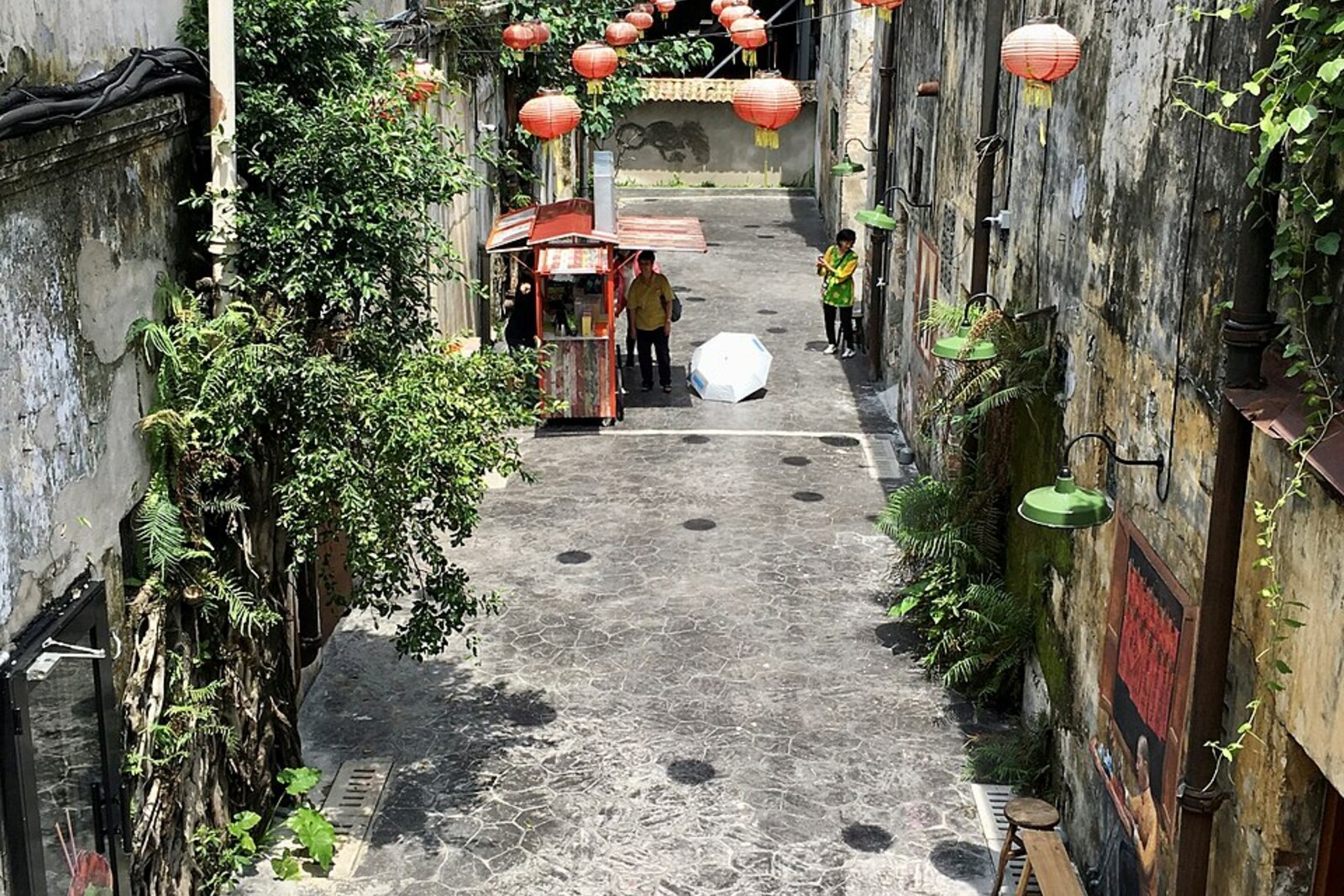
Look around first
What to notice
- Red wooden bridge
- Six wall scenes
- Old bridge boards
- Prewar shop houses
The story of the place
A red wooden bridge leads into a narrow passage between old façades; its Cantonese nickname is translated as “alley of little devils.” There is no exact explanation for the name: some residents linked it to children playing in the passage, others to visitors to gambling dens or a local gang. Six wall scenes bring the Chinese quarter of the nineteen sixties to life: there is a barber, a letter writer, children, and traders lowering goods from the second floor in baskets. Cafés, restaurants, and bars operate behind the façades, while art installations in the passage change from time to time.
In nineteen eighteen—no, in two thousand eighteen—the five founders of Bai Chuan signed a twelve-year lease for ten prewar shop houses: six faced Petaling Street, four faced Lorong Panggung. This abandoned service passage lay between them. The calculation was straightforward: renovate the premises, find tenants, and collect an income.
Shin Chang, a co-founder of the project, later admitted that the idea changed during the work itself. The owners of neighboring shops and former residents told them how Chinese families had lived here, what they traded, and how they used the alley. The five entrepreneurs decided to lease out the houses together with the restored passage, which was meant to attract people and keep them here longer.
That decision cost about one and a half million ringgit. A grant from the city fund Think City covered only a small share of the expenses; the founders paid the rest themselves. The houses stood in a protected historic zone: the façades could not be altered at will, old elements had to be preserved, and materials had to be approved by specialists. In six months, builders reinforced the ten houses, removed unusable wooden parts, and cleared the alley.
Shin Chang commissioned five local artists to paint six scenes from life in the Chinese quarter of the nineteen sixties. The walls acquired a street barber, a calligrapher writing letters for illiterate migrants, children, and traders lowering goods from the second floor in baskets. One scene was devoted to the alley's former vice activities. Chang refused to remove it for the sake of a respectable picture: former residents recalled gambling dens, drunkenness, and prostitution here as well. Professional radio actors recorded voices for the characters. This is not a surviving street from the nineteen sixties, but an account of it created in two thousand nineteen.
The name, too, came from oral memories. Officially, the street is called Lorong Panggung, while the Cantonese name “Kwai Chai Hong” means “alley of little devils.” There is no document explaining the nickname. According to the most widespread version, adults used it for restless children playing in the passage. Other residents linked the “devils” to regulars at the dens; there is also a legend about members of a local gang whom their leader was said to call by the same word. No version has been proven, so the founders kept the nickname together with its uncertainty.
In April two thousand nineteen, the alley was opened to the public. Cafés, restaurants, and bars now operate behind the restored façades, while changing art installations are set up between them. The red bridge at the entrance is assembled from wood removed during the renovation of those same ten houses: the old boards lead into the passage that the five lessees had originally intended simply to lease out profitably.
Useful on site
Daily 09:00–24:00 according to the official website; restaurants, bars, and installations may vary.
Checked: June 26, 2026. Check the official source before visiting.The alley is narrow and popular for photography; do not linger on the bridge or block the way for other visitors.