 Guide On Map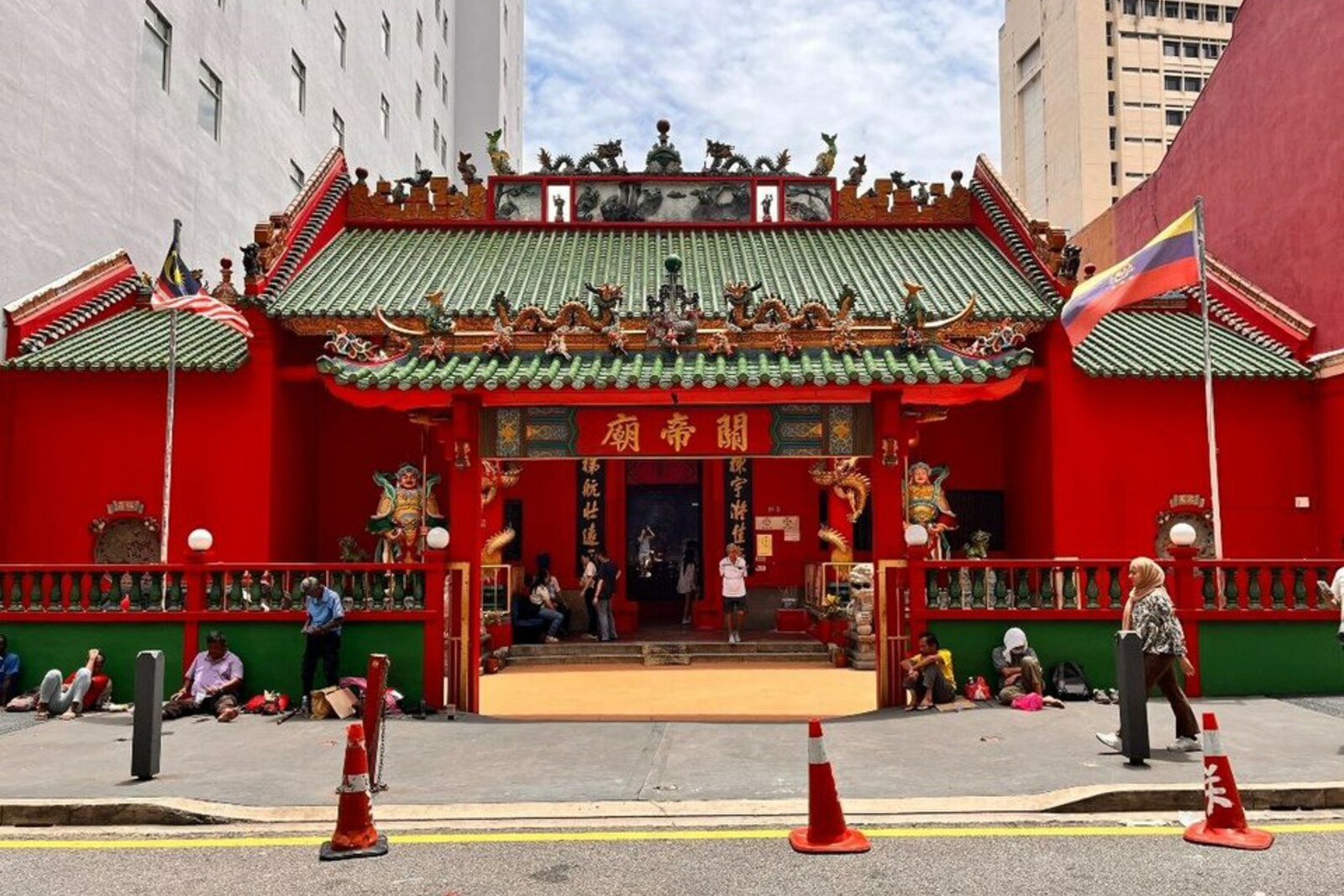
Look around first
What to notice
- Guan Di altar
- Open courtyard
- Incense burner on the right side of the courtyard
The story of the place
This temple grew out of a common house for immigrants from the districts of Guangzhou and Zhaoqing: they raised money for it, transported materials, and worked with their own hands. A Guan Di altar was set up at the back of the hall, and the open courtyard became a place for hearings about debts, trade, and family quarrels. Before the deity associated with keeping one's word, a promise to tell the truth helped the community judges obtain the agreement of those in dispute. Now people pray at the altar, while the incense burner on the right side of the courtyard stands where the defendant's side was once assigned a place.
In eighteen ninety-four, Mrs. Xu, née Huang, came here to settle the fate of her money. She gave fifty silver dollars to Fang Bian. He was to open a prepared-food business and help her son, Xu Guang, enter the trade. For the mother, the money represented her son's future earnings.
Less than two months later, the capital had disappeared. The business was left with debts on a loan, for the premises, and to local suppliers. Fang Bian explained that customers had taken food on credit and had not paid. Mrs. Xu wanted to recover what she had invested, and Fang Bian had to decide who would pay the resulting obligations.
The hearing took place in this courtyard. Members of the association sat before the Guan Di altar; the plaintiff and defendant stood on opposite sides of the open space. Before it began, the participants and witnesses swore before the deity to tell the truth. After that, the judges divided the loss: the shop's property, valued at fifty dollars, was handed over to Mrs. Xu; she agreed to pay the loan and the rent debt, while Fang Bian took responsibility for the debts to suppliers. Both accepted the decision, and the compilers of the temple record marked the case as closed.
This arrangement explains the temple's name. Guan Di is the posthumous name of the military commander Guan Yu, who lived in China at the turn of the second and third centuries. Later tradition turned him into a deity associated with keeping one's word and honesty in business dealings. An oath before his image replaced coercion for the local judges: to break an agreement meant deceiving both one's opponent and the revered witness.
The building itself began as the Kwang Siew Association—an association of immigrants from the districts of Guangzhou and Zhaoqing in Guangdong Province. In eighteen eighty-six, the community elders Zhao Yu and Wang Chunlin began raising money for a common house. Zhao Yu contributed a large sum, craftspeople worked without pay, and other fellow natives transported materials. By eighteen eighty-eight, the hall was ready; a Guan Di altar was placed in its front section, and access was opened to anyone who wished to enter.
Zhao Yu later settled disputes here himself. Between eighteen ninety-eight and nineteen oh two, members of the association resolved four hundred eighty-six cases involving debts, trade, and family quarrels. People called the entire complex Guan Di Temple, and the name outlasted the court hearings.
Today, people pray and leave offerings before the altar. Judges no longer sit at the altar table, and the incense burner on the right side of the courtyard was installed later, on the spot where defendants once stood.
Useful on site
Daily operation confirmed by Kwong Siew; third-party guides indicate 07:00–19:00, and festivals may affect access.
Checked: June 26, 2026. Check the official source before visiting.Do not enter the space before the altar during prayer, and do not touch the weapons, vessels, or offerings; the interior is partly visible from the entrance.