 Guide On Map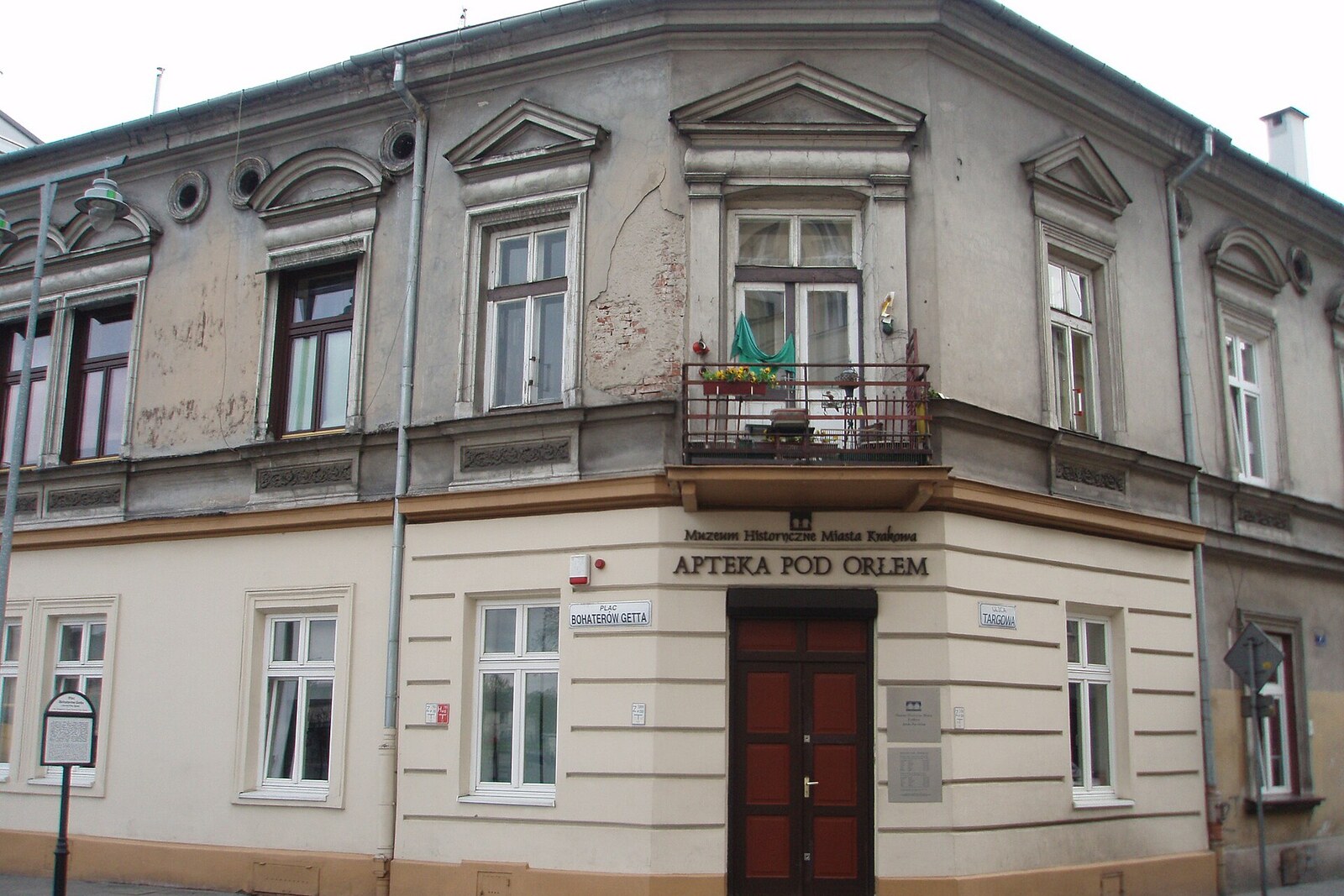
Look around first
What to notice
- The sign “Apteka pod Orłem”
- Pharmacy cabinets
- Scales and vessels
- Photograph of the ceremony
The story of the place
The word “Eagle” in the name is connected with a carved bird that once crowned the pharmacy furniture. After the pharmacy closed in the nineteen sixties, the old furnishings were destroyed, and museum staff reconstructed the present cabinets, scales, vessels, and counter from photographs and testimonies. For a long time, the only pharmacy in the enclosed district operated in this small room, where people came for medicine.
In March nineteen forty-one, the German occupiers enclosed the family pharmacy of Tadeusz Pankiewicz within the boundaries of the Krakow Ghetto. The pharmacist was ordered to leave and was offered management of a pharmacy in the city center that had been taken from its Jewish owner. Pankiewicz refused. Later, he wrote plainly in his memoirs that he did not want to lose the family property: his father Józef had owned the establishment since nineteen oh nine, and the son made his living as a pharmacist.
Pankiewicz began seeking permission to stay. A German pharmacy adviser supported his petition: there was no other pharmacy in the enclosed district, and officials feared an epidemic. Under Nazi racial rules, Pankiewicz had to prove his non-Jewish origin, hire only non-Jewish female employees, and promise in writing that they would speak with customers exclusively about treatment. Permission was granted for a short term and had to be renewed each time.
This made Pankiewicz the only Pole permitted to remain in the ghetto permanently. At night, he slept in the on-call room. His three employees passed through the gates on work passes; they brought food and hard-to-obtain medicines and carried letters and news to people on both sides of the wall. Pankiewicz hid people threatened with nighttime arrest or deportation. The occupiers punished such help with death.
In early June nineteen forty-two, the Germans carried out the first mass deportation from the ghetto to the Belzec extermination camp. Irena Halpern, a ghetto resident, tried to avoid being sent away. Pankiewicz hid her in a special cache beneath the pharmacy counter, which he had commissioned from a carpenter he knew. Irena did not go on that transport and later survived the war.
She remained in contact with her rescuer and nominated Pankiewicz for the title Righteous Among the Nations. In nineteen eighty-three, a representative of Yad Vashem presented him with the medal in his Krakow apartment. An olive tree was planted in his honor in Jerusalem; a photograph of the ceremony became part of the pharmacy's exhibition.
The name “Under the Eagle” came from a carved figure of an eagle with spread wings that crowned the pharmacy furniture. During the war, the exterior sign bore only the words: “Józef Pankiewicz’s Pharmacy.” The familiar name was placed on the facade only after the museum was established.
The old counter is no longer there. After the pharmacy closed in the nineteen sixties, its furnishings were destroyed, and museum staff reconstructed the present cabinets, scales, vessels, and counter from photographs and testimonies. The cache where Irena Halpern waited out the roundup was in the lost furniture of this same retail room.
Useful on site
On the day of checking, the Museum of Krakow listed Wednesday–Sunday 09:00–17:00, free admission on Wednesday, and separate closed dates; check the current schedule.
Checked: June 26, 2026. Check the official source before visiting.You can listen to the history of the place from outside, but the museum inside reveals it in greater detail. Plan a visit separately and check accessibility in advance; at the entrance, do not obstruct the museum queue or the passage.