 Guide On Map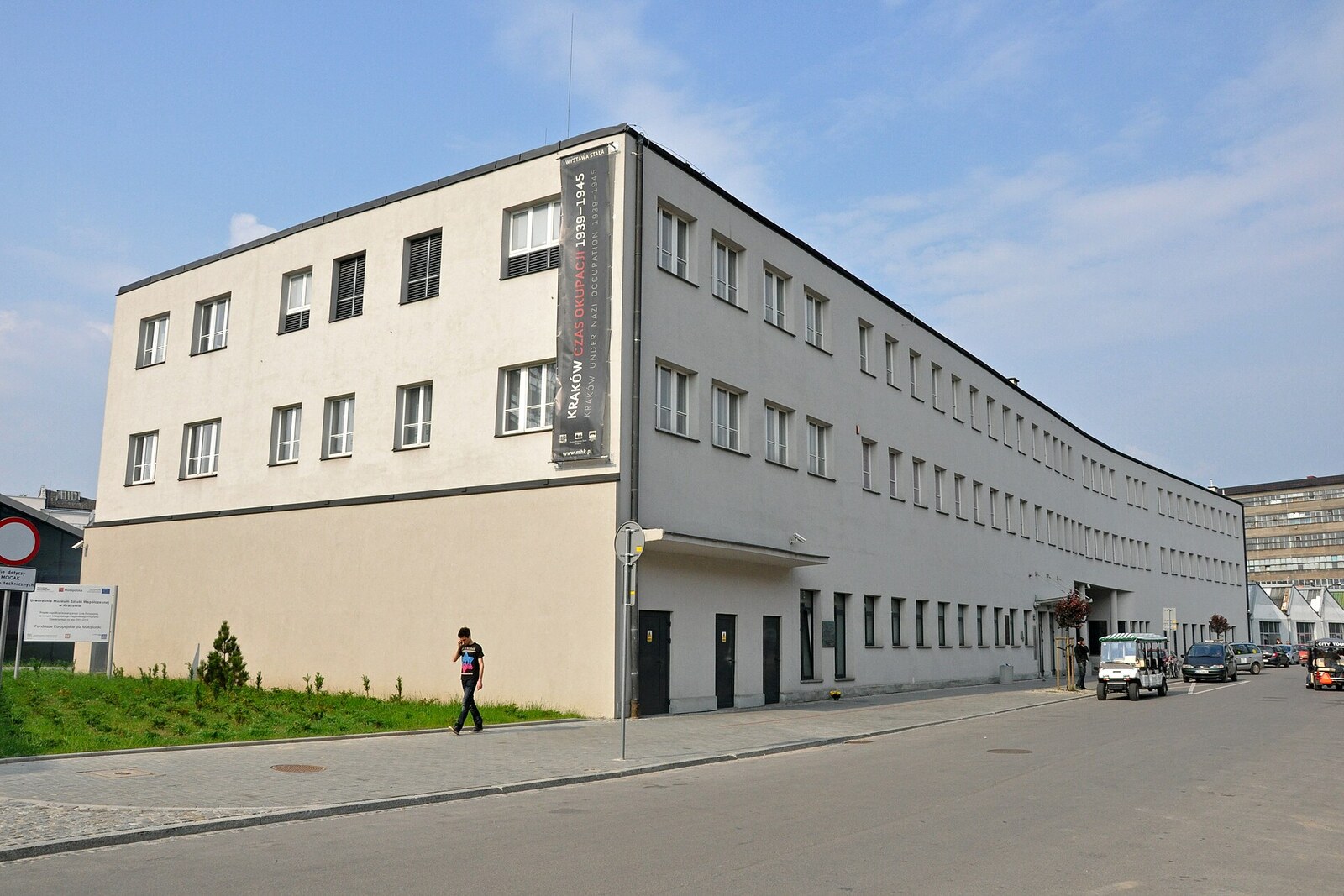
Look around first
What to notice
- The gate bearing Oskar Schindler's name
- The facade of the administrative building
- The gabled roofs of the workshops
The story of the place
Oskar Schindler's name stands above the gate. He did not found the factory itself. In nineteen thirty-seven, three Jewish entrepreneurs opened the Rekord Enamelware Factory here. The enterprise went bankrupt even before the war, and after the occupation of Krakow it was taken over by Schindler—a member of the Nazi Party and an agent of German military intelligence, who had come to make money in the conquered country. He leased the buildings, used the capital of Jewish businessmen, expanded production, and named the factory the German Enamelware Factory (DEF).
Schindler quickly became rich from kitchenware and orders for the German army. At first, he hired Jewish forced laborers because they cost less than Poles: they received no wages, and the factory owner paid the SS a set sum for each person. The workers labored at furnaces and in acid baths, producing mess tins, shell casings, and ammunition parts. Military orders gave Schindler connections, money, and the right to convince officials that the people he needed were employed in important production.
After the liquidation of the Krakow Ghetto in March nineteen forty-three, the surviving workers were sent to Płaszów. They were now marched under guard to Lipowa, several kilometers away, and in the camp they could die at any moment. Schindler needed to bring them back under his supervision. He befriended Amon Göth, the commandant of Płaszów, on whom permission depended, entertained him, and gave him bribes. As a result, Göth allowed a separate subcamp to be set up directly behind the factory.
Barracks, watchtowers, and barbed wire were erected on a plot purchased by Schindler, and a square for roll calls was left between the barracks. Prisoners who worked for Schindler and at three neighboring enterprises were housed here; by the summer of nineteen forty-four, there were about one thousand four hundred fifty of them. It remained a guarded forced-labor camp. However, Schindler and the owners of the neighboring factories obtained extra food on the black market, Polish workers passed on provisions from the city, and random killings occurred here less often than in Płaszów. Schindler was arrested and interrogated several times for fraud and for helping Jews. Each time, his connections among German officials got him out.
In the summer of nineteen forty-four, the Germans began closing Płaszów and its subcamps. Hundreds of prisoners were taken from Lipowa back to the main camp and then to Mauthausen; Schindler could no longer reach them. About three hundred men were left in his charge and ordered to dismantle the equipment before the enterprise was evacuated. He then obtained permission to move military production to Brünnlitz—today's Czech town of Brněnec—and demanded workers from Płaszów.
There was no single famous “Schindler's list.” Separate transport lists of men and women were compiled by camp clerks, the names changed several times, and the final word belonged to the SS. Schindler secured the transfer of the factory itself and the inclusion in its workforce of people, many of whom had not previously worked for him. About seven hundred men were sent through Gross-Rosen, and about three hundred women through Auschwitz. The women spent three weeks there; in all probability, Schindler secured their release through an intermediary. They arrived in Brünnlitz in mid-November.
To keep the new camp from being closed, Schindler continued to present it as a necessary military enterprise. Two Jewish prisoners helped him falsify production reports. Over its entire existence, the factory produced only one railroad car of ammunition. Oskar and his wife Emilie Schindler bought food and medicine for the prisoners, gradually spending the fortune earned in Krakow. In April nineteen forty-five, one thousand ninety-eight names remained on the list of prisoners in Brünnlitz. These people were liberated in May. Before Schindler fled west, they gave him a ring and a signed testimony about his actions—a document meant to protect the former Nazi factory owner from arrest. After the war, those whom Schindler had taken out of Płaszów helped the impoverished Schindler with money.
Today, the museum occupies the administrative building, where the owner's office and apartment were located. Its permanent exhibition tells the story of Krakow during the German occupation; Schindler's story makes up only one part of it. What remains of the former enterprise are the facade of building number four, the gabled roofs of the workshops, and the distinctive gate. The subcamp barracks behind them have disappeared. In the autumn of nineteen forty-four, the factory equipment was taken out through this gate, and with it people were able to leave Płaszów—people whose names would later be referred to as Schindler's list.
Useful on site
On the day of verification, the Museum of Krakow listed Mon 10:00-15:00, Tue–Sun 09:00-20:00, closed on the first Tuesday of the month, last entry 1,5 hours before closing; check current closures and tickets.
Checked: June 26, 2026. Check the official source before visiting.The exhibition is devoted to occupied Krakow more broadly than to one biography and requires separate time. If you want to go inside, arrange a reservation in advance; without a ticket, view the buildings from outside and continue the route.