 Guide On Map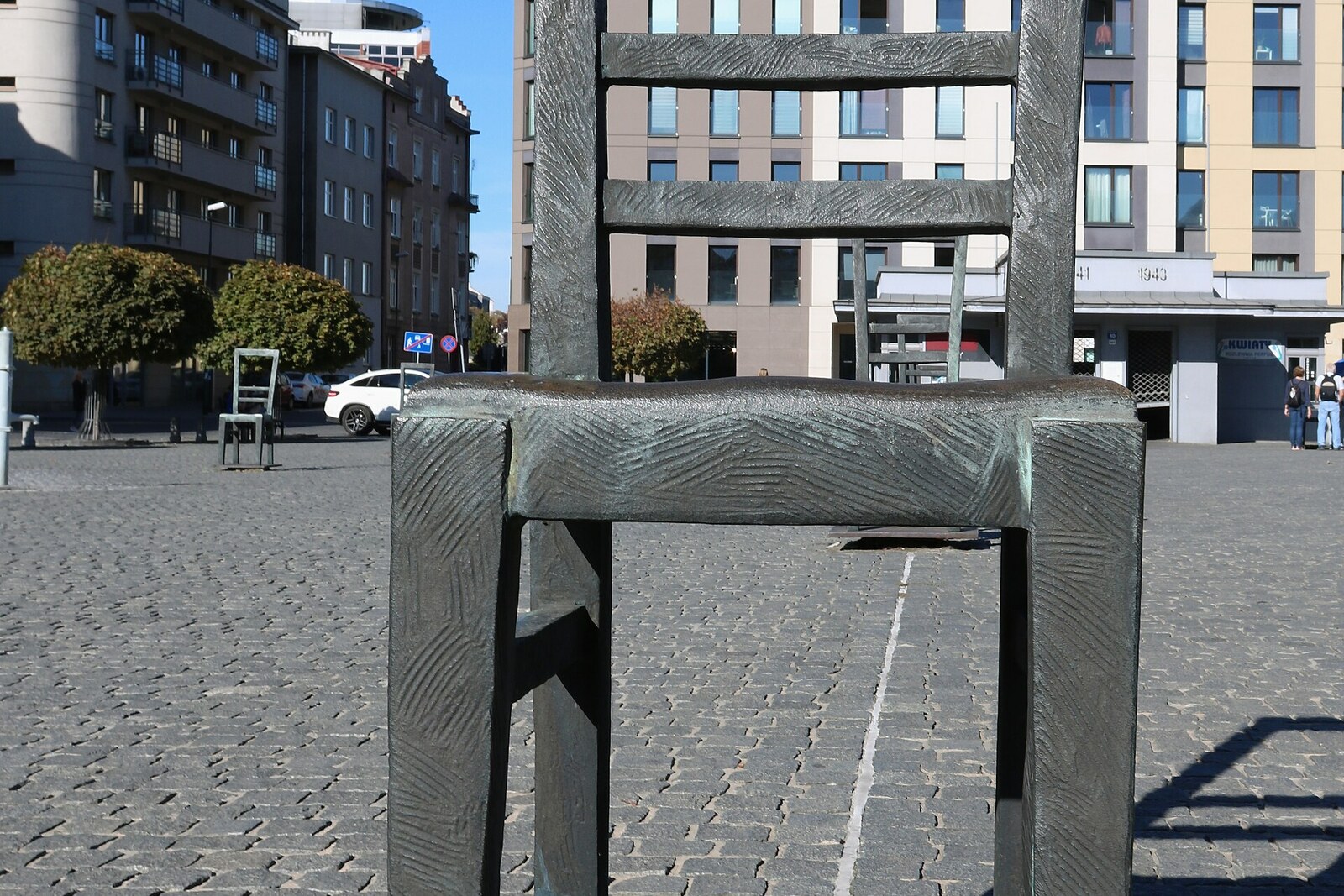
Look around first
What to notice
- Rows of metal chairs
- The one-story building at the northern edge
- The square's paving
The story of the place
On March thirteenth, nineteen forty-three, Roman Ferber, a boy from the Krakow Ghetto, tried to stay close to his father. German guards ordered all Jews who still remained to gather here, in Zgody Square. The children were to be separated from the adults and sent to a children's home on nearby Józefińska Street. Roman and his brother realized that the promise to bring the children to their parents later was a deception.
The main open area of the ghetto was chosen for this assembly. One of the two main gates stood at the square's northern edge; work columns were taken out through it every day. During the deportations in June and October nineteen forty-two, people had already been taken from here to the Belzec extermination camp. Here, decisions were made about who would still be allowed to live for forced labor. German guards looked for healthy specialists; the rest were loaded into automobiles. A profession could give an adult a few extra months. A child had nothing to offer.
Roman and his brother did not go to the children's home. They hid among the belongings on carts being taken from the emptied ghetto to the Płaszów forced labor camp, and in this way passed through the gates. In the evening, the brothers found their father there; all three were placed in one barrack. Most of the children left in the ghetto were killed the next day. Hiding among other people's possessions saved Roman then, but did not preserve the family: his father and brother died later. Roman survived the camps and the war, and after liberation told how they got out of the square.
In July nineteen forty-eight, the city council renamed Zgody Square Ghetto Heroes Square—in memory of the victims of deportations and liquidation. The name contains no closed list of fighters. It is dedicated to the Jews of Krakow who were gathered here, separated from their families, sent to camps, and killed in the square itself and in neighboring courtyards.
The present metal chairs appeared in two thousand five. The architects Piotr Lewicki and Kazimierz Łatak, who were turning the square into a memorial, drew on an account by the pharmacist and eyewitness Tadeusz Pankiewicz. After the liquidation of the ghetto, he saw countless wardrobes, tables, and sideboards here, taken out of homes and left to rot. The chairs signify this abandoned household furniture and the people to whom it belonged. They refer to the same luggage among which the Ferber brothers hid.
The ghetto gates are no longer there. They stood between a small one-story building at the square's northern edge and the corner of Kącik Street. Prisoner columns passed through this opening, and carts carrying belongings drove out through it; now empty chairs stand before its line.
Useful on site
Open city square and memorial; access depends only on municipal works or temporary closures.
Checked: June 26, 2026. Check the official source before visiting.Give yourself time to walk among the chairs without rushing. This is a memorial, not street scenery; keep a respectful distance from other visitors when talking and taking photographs.