 Guide On Map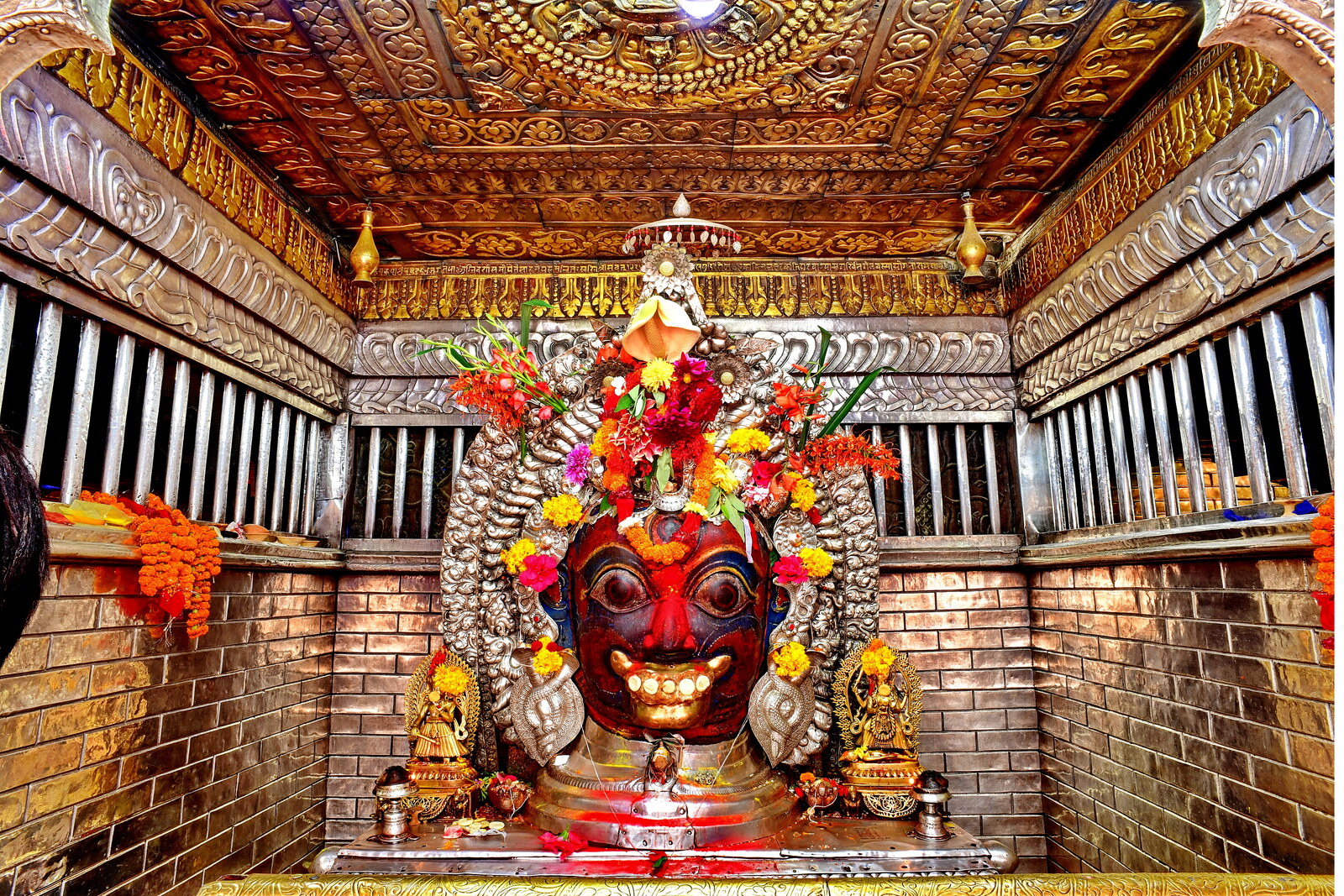
Look around first
What to notice
- Ground-floor shops
- Carved windows
- The enormous metal face of Akash Bhairav
The story of the place
On the western side of Indra Chowk, shops occupy the ground floor of a building with a temple above them. Inside is kept the enormous metal face of Akash Bhairav. For most of the year, it remains behind carved windows, but during Indra Jatra, attendants display it outside, facing the square.
The name of the square is explained by a legend, not by a confirmed historical event. Indra, the god of rain, wanted to obtain Parijata flowers for a rite performed by his mother, Vasundhara. He descended into the Kathmandu Valley disguised as a man and began picking them. A farmer caught the stranger at it and took him for a thief. The residents seized Indra and tied him to a post in front of Akash Bhairav Temple for seven days.
These people depended on the harvest, while the captive—whose true identity they did not yet know—controlled the rain. On the eighth day, Vasundhara came looking for her son and revealed whom they had detained. The local king turned the release into a bargain: Indra would return to the valley every year and bring the summer rains and winter mists needed by the fields. Indra agreed and left with his mother on a white elephant. Thus, according to the legend, the captivity ended in an agreement, and the crossroads received Indra's name.
During Indra Jatra, a figure of Indra is set up here even now, with its arms outstretched—a gesture meaning that the god denies the theft. After the festival ends, the image is carried to Akash Bhairav Temple and kept there until the following year. So the temple is literally part of Indra's story: it holds the figure of the former captive.
The displayed face nearby has its own legend. The Newars call this god Aju Dyo—“ancestor god”—and identify him with Yalambar, the first king of the Kirats. Yalambar was considered a warrior of such strength that he set out for the war described in the Mahabharata, intending to fight for whichever side began to lose.
Krishna, adviser to the Pandavas and a supporter of their victory, understood that Yalambar could repeatedly change the balance of power and prolong the war until both armies were destroyed. According to legend, Krishna cut off Yalambar's head with a war discus. In one version, before his death Yalambar asked to be allowed to watch the battle to the end. His head remained above the battlefield and, after the Pandavas' victory, moved to the Kathmandu Valley. Here it came to be venerated as Akash Bhairav—the Heavenly Bhairav, a fierce manifestation of Shiva.
During the festival at Indra Chowk, the figure of Indra, whom the residents once mistook for a thief, and the enormous face of the king who never entered the battle appear at the same time. On ordinary days, the first is kept inside the temple, while the second is above the shops.
Useful on site
Open market crossroads; crowds and street closures are possible during festivals.
Checked: date not specified. Check the official source before visiting.The head is not displayed continuously; during the festival, keep away from the procession and do not block the offerings.