 Guide On Map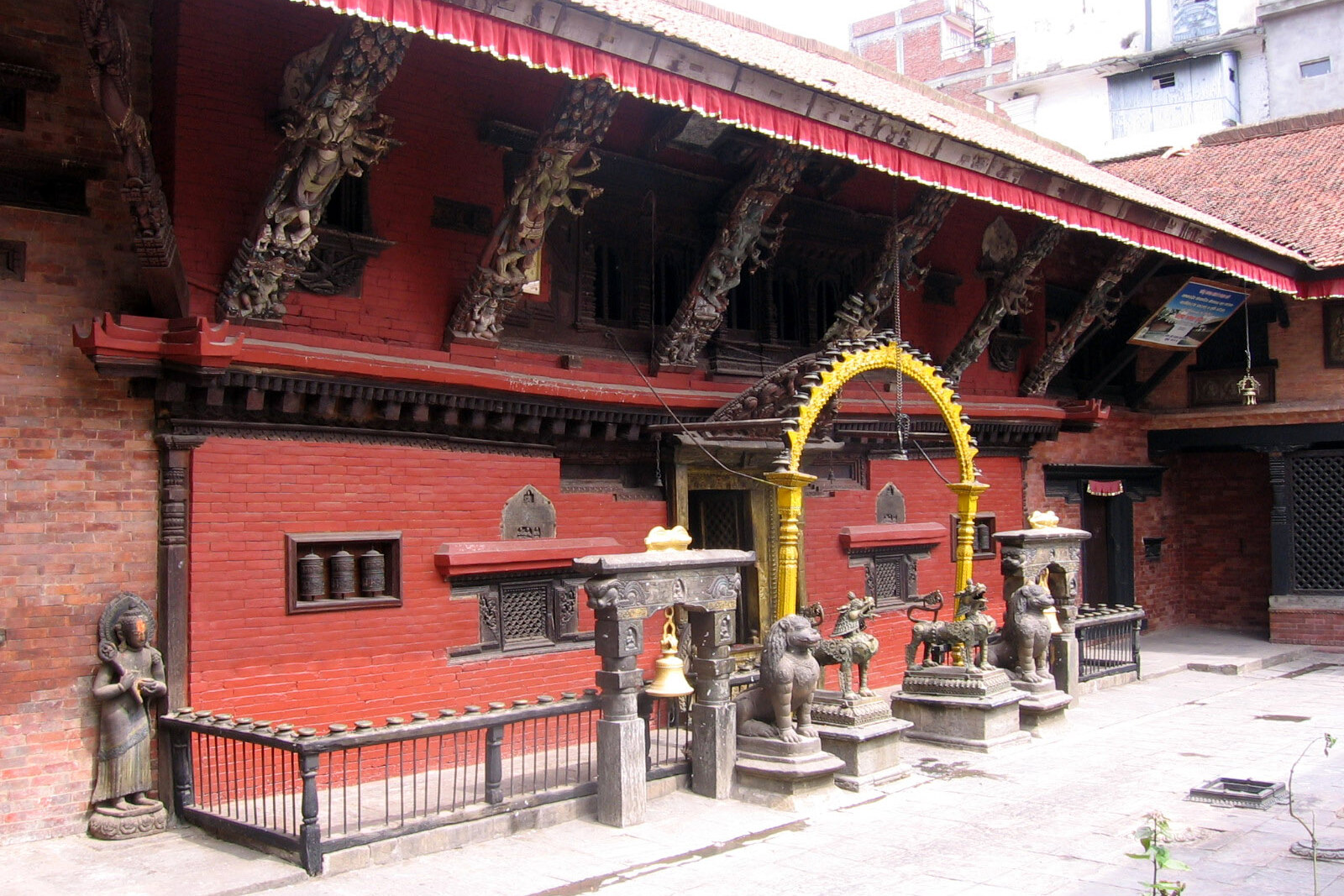
Look around first
What to notice
- Golden doors
- Embossed plates with Gurumapa
- Northern wing
- Bhutu Keba kitchen
The story of the place
Behind the golden doors lies the enclosed courtyard of a Newar Buddhist monastery, and an old kitchen has survived in the northern wing. Here, men from Shakya and Vajracharya families undergo a brief initiation, then live ordinary family lives while retaining their membership in the religious community. The shrines and inherited customs are maintained by guthis, associations of members of this community. Locals connect the name Itum with a well in the neighboring courtyard of Tara Nani, which they consider the deepest.
On the embossed metal plates to the right of the golden doors is Gurumapa, a giant holding a child. He is the hero of a local legend through which the community here explains the founding of the monastery and a rite that still begins in this courtyard.
A bahal is a monastic courtyard of Newar Buddhists. Men from Shakya and Vajracharya families undergo a brief initiation, then return to family life, but remain members of the Sangha—the religious community. Guthis, associations of its members, maintain the shrines and perform inherited rites. Locals connect the short name “Itum” with the I-tum well, “the deepest,” in the neighboring courtyard of Tara Nani.
Kesh Chandra, the legendary founder of the monastery, was a gambler trying to recover his lost fortune. When he had no money of his own left, he lived at his relatives’ expense. His sister fed him and at first served food on precious dishes. Kesh Chandra stole the plates and gambled them away again. At last, wanting to stop the thefts, his sister placed rice directly on the floor.
Humiliated, Kesh Chandra wrapped the rice in cloth and went into the forest. While he slept, pigeons pecked at the food, and their droppings, according to the legend, turned into gold. The treasure was too heavy. Then Gurumapa appeared and was about to eat Kesh Chandra himself. The gambler called the giant uncle and offered him rice and buffalo meat for the rest of his life if he would carry the gold to the house in Itum.
Gurumapa brought the load here and settled nearby. Kesh Chandra fed him, but the giant began abducting children. In one version of the legend, Kesh Chandra’s only son was among the dead. The residents demanded that Gurumapa be removed from the neighborhood and made a new agreement with him: he would leave for Tundikhel field, and once a year the community would bring him a large portion of rice and buffalo meat. The giant agreed and left Itum.
Kesh Chandra used the gold he found to create a Buddhist monastery. Inscriptions do not confirm his biography, so the story of the gambler and the giant remains a legend. However, the medieval Sanskrit name really does call Kesh Chandra the builder: it can be translated as “The Great Pigeon Monastery, created by Kesh Chandra under King Bhaskaradeva.”
Under the northern wing, the Bhutu Keba kitchen has survived, where the promised food is prepared for Gurumapa. A large figure of the giant that stood at the entrance was stolen; the embossed plates remain on the wall. Every year, on the night of the full moon that ends Holi, members of the guthis, associations of the religious community, cook rice here, prepare buffalo meat, and carry the offering without stopping from Itum Bahal to Tundikhel.
Useful on site
Residential and religious courtyard; quiet, unrestricted viewing, with respect for closed areas.
Checked: date not specified. Check the official source before visiting.This is an active community space: speak quietly and make way for residents and worshippers.