 Guide On Map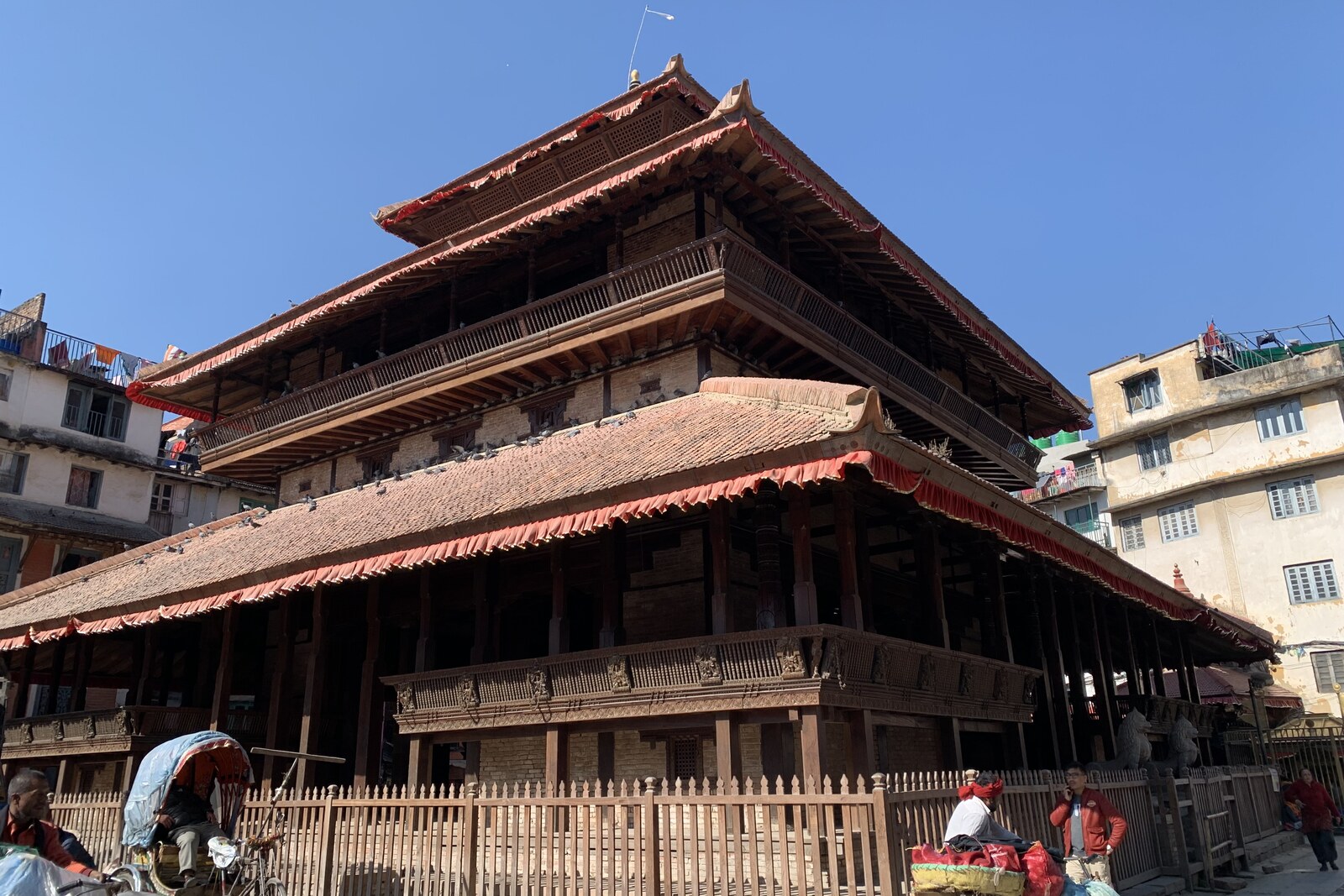
Look around first
What to notice
- Three-tiered wooden pavilion
- Dark old beams
- Pale new timber
- Stone statue of Gorakhnath
The story of the place
On April twenty-fifth, twenty fifteen, the Nimbus Credit Cooperative held a blood donation drive at Kasthamandap. Fifty-four employees and shareholders gathered beneath the open lower tier: some were already seated with needles in their hands, while the others were preparing for a group photo. At four minutes to noon, the earthquake began.
Those standing at the edge of the pavilion managed to run out. Bricks and heavy wooden beams covered the people in the middle. Amit Awale, an employee of the cooperative, made it outside, then returned to the rubble and pulled three people out alive. Ten of his colleagues died.
The blood donation was held here not contrary to the building's purpose. Kasthamandap was built as a sattal—a covered public shelter. It stood where the road between India and Tibet crossed the city's main street. Merchants spent the night under its roof and stored their goods, while city residents gathered for councils and ceremonies. Later, a rare stone statue of the yogi Gorakhnath was installed in the center of the lower tier; a large shared space still remained around the shrine. On the day of the earthquake, it was put to a modern use—as a temporary blood-donation station.
The name translates from Sanskrit as “wooden pavilion,” and Kathmandu's name also derives from Kasthamandap. A legend explains this wood through a bargain. During the festival of Machhindranath, a tantric priest supposedly recognized Kalpavriksha among the people—the divine wish-granting tree—and would not let it leave until it promised timber for the shelter. Kalpavriksha sent a single huge trunk, people built the pavilion from it, and the captive tree was granted its freedom. Historians treat this story as a legend: written references to Kasthamandap appeared several centuries before the king during whose reign the chronicles place the miraculous construction.
The former above-ground structure collapsed completely. The present three-tiered pavilion was completed in twenty twenty-two. Craftsmen returned surviving old posts, beams, and bricks to their places; among the pale new timber remain the dark details of the Kasthamandap beneath which Amit Awale and his colleagues gave blood.
Useful on site
Exterior stop; after reconstruction, access inside may be closed or disputed.
Checked: June 25, 2026. Check the official source before visiting.If you cannot go inside, examine the structure from the square: its main story can be read in its wood and silhouette.