 Guide On Map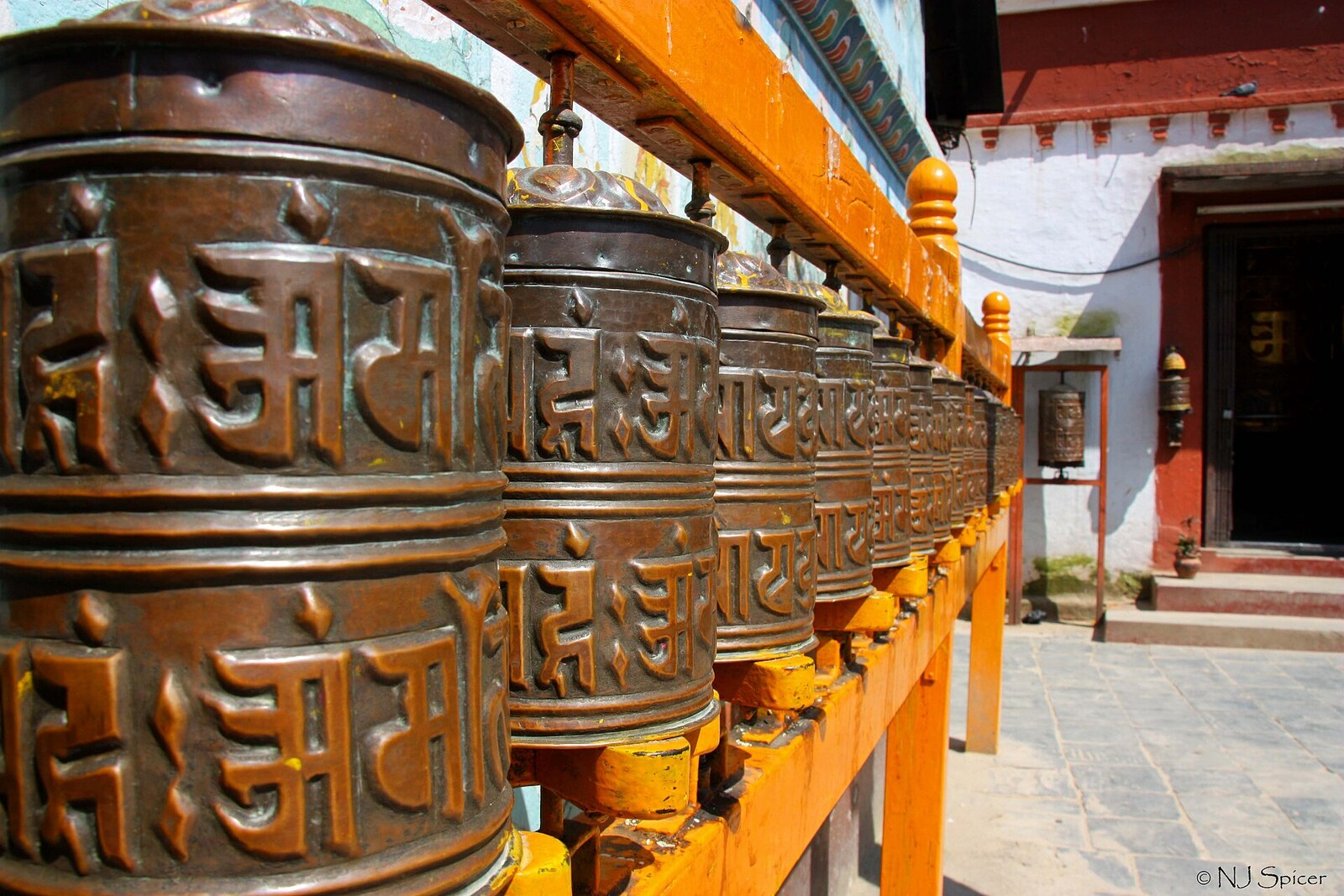
Look around first
What to notice
- A row of copper prayer wheels
- The stupa's outer wall
- The white dome
The story of the place
Along the outer wall of the white dome of Boudhanath Stupa runs a row of seven hundred thirty-five copper wheels, closing into a ring around the sacred shrine. Inside each, paper strips bearing the mantra printed repeatedly are tightly rolled; a turn of the palm unrolls the scroll together with the wheel. Wooden wheels once stood in this place, then metal replaced them, but the circle of daily movement itself remained the same.
Kora is the ritual circumambulation of a sacred shrine clockwise, so that the stupa remains on the right. Pilgrims do not enter Boudhanath Stupa: its main body is solid, like a reliquary. Here, prayer is performed by moving around it.
In the middle of the nineteenth century, this kora was seen every day by Taipo Shing (Tephi Sim), a pilgrim from Sichuan and a lama of the Nyingma school, one of the traditions of Tibetan Buddhism. He came to the Kathmandu Valley to worship at sacred sites and decided to stay. According to the account of his descendants, he first lived in a cave near Pashupatinath Temple and meditated. The Nepalese-Tibetan War of eighteen fifty-five to eighteen fifty-six was underway, and at court the foreign monk was suspected of espionage.
Prime Minister Jung Bahadur Rana was looking for an intermediary for negotiations. Taipo Shing could read and speak Tibetan and Chinese. Family tradition maintains that the prime minister sent him twice to the participants in the war and that the lama helped bring the negotiations to peace. This part of the story has survived from the words of his descendants. Documents reliably record its consequence.
In October eighteen fifty-nine, a royal decree was issued: Taipo Shing, recorded in the papers as Tephi Sim, was appointed a cleric of Boudhanath Stupa and the monastery in Melamchi. He was ordered to marry, settle in Nepal, and open a Chinese-language school. The post came with lands from a religious fund—their income supported the sacred shrine and the abbot's family. The pilgrim once taken for a spy became the first Chiniya Lama (Chinese Lama), and his son inherited the post.
In the early years of this line, the object along which the kora runs also changed. An old register of works records that the wooden prayer wheels in the outer wall were replaced with copper ones. The present wheels have been repaired and renewed, but the row of metal cylinders itself appeared here under the first Chiniya Lamas (Chinese Lamas).
Each wheel serves as a sealed container for a text. Inside are tightly wound paper scrolls bearing the mantra “Om Mani Padme Hum,” printed repeatedly, where “padme” means “in the lotus.” Tibetan Buddhists consider turning the wheel a way to read this text through action and accumulate spiritual merit. Thus, the pilgrim simultaneously walks around the stupa, recites the mantra, and sets the scrolls in motion with a hand. Seven hundred thirty-five such wheels are installed in the wall of Boudhanath Stupa.
The copper cylinders stand where wooden ones once turned. The kora follows the same circle that the former foreigner Taipo Shing, who received land, a family, and a new name here—Chiniya Lama (Chinese Lama)—was obliged to oversee.
Useful on site
The path around the stupa is open around the clock; there are the most pilgrims at dawn (5:30–7:00) and at sunset (17:00–19:00).
Checked: June 17, 2026. Check the official source before visiting.The stupa must remain on your right. Turn the wheels in the direction of travel, and leave enough room for those making the circuit with prostrations.