 Guide On Map
Boudhanath Stupa and Boudha’s Tibetan Quarter
From Boudhanath South Gate to Shechen Tennyi Dargyeling Monastery
Guide On Map on your phone
Open the walk like a regular app
It takes about 10 seconds to install. No app store needed.
The whole path
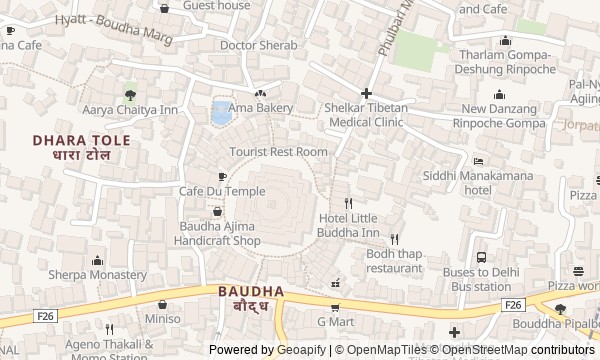
Route map
About the walk
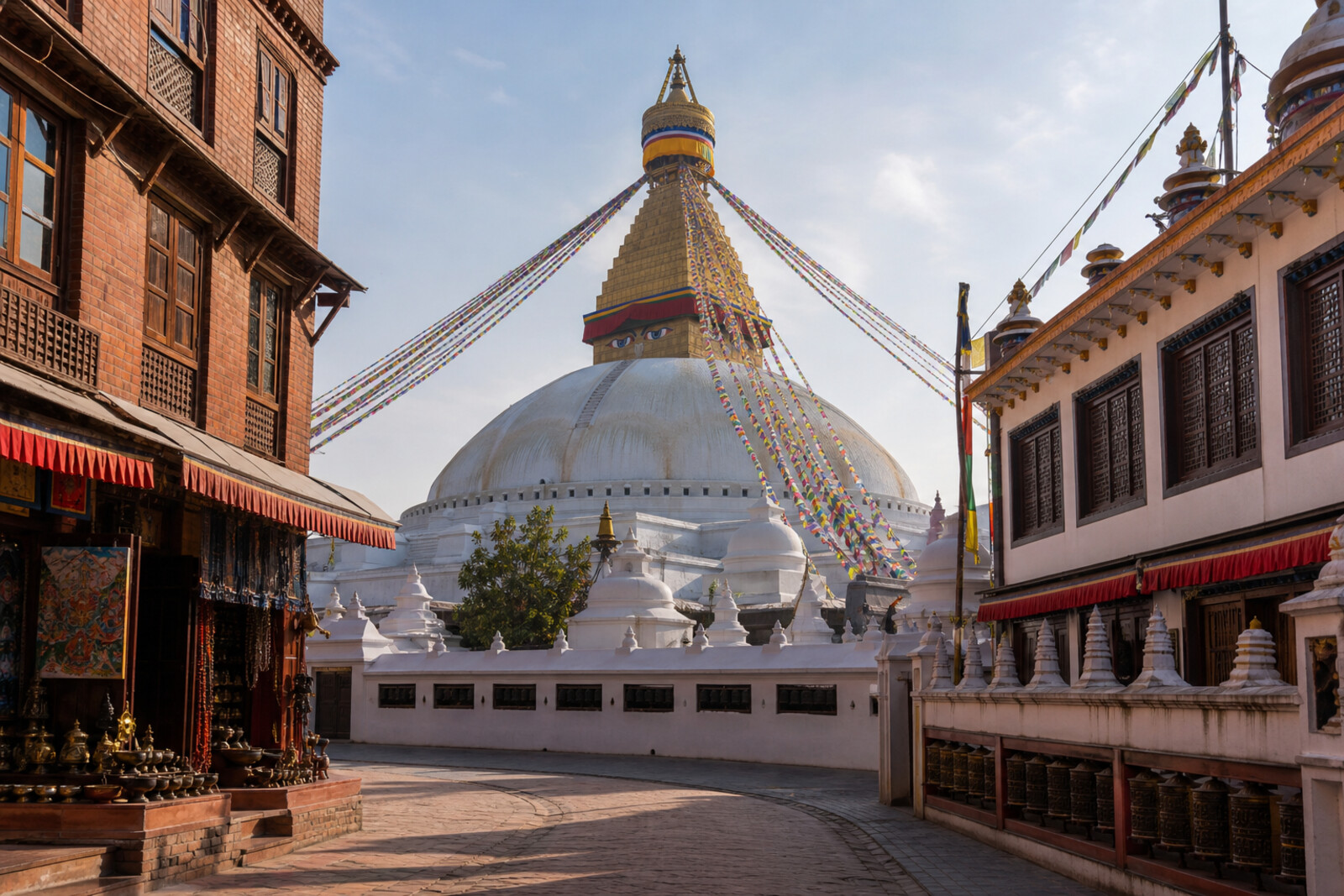
You will enter Boudha through the painted southern gate and almost at once find yourself among people circling the white dome. At first, the road closes into a loop: prayer wheels, a small shrine by the northern entrance, a raised platform. Then it opens out and leads into the Tibetan quarter—to a temple hall, a family eatery on Phulbari, and Shechen Tennyi Dargyeling Monastery.
This is not a walk through a checklist of Kathmandu’s headline temples. You will see one sanctuary together with the people who built it, maintained it, restored it, and made a life around it. Why could a royal permission not be taken back? How did a suspicious outsider end up with the duty of safeguarding the stupa? Why do letters from a completely different business remain on an old eatery sign?
The story will separate legend from documents while staying close to human choices. By the end, you will see Boudhanath Stupa as the center of Boudha, where ritual, family work, and monastic learning meet in one shared circuit.
Why this order
The route first passes through the southern arch and immediately joins the kora: the founding legend gives way to the practice of circling the sanctuary. Moving clockwise, you will reach the northern shrine of Ajima (Hariti), where a distinct local tradition appears within the larger circuit. From there, a climb to the platform brings you closer to the structure itself and to traces of its restoration. The descent to Guru Lhakhang shifts the story from brick and gold to the families who have carried out duties at the stupa for generations. The route then reaches Phulbari, where the history of monastic and family livelihoods continues in an eatery. The final walk to Shechen Tennyi Dargyeling Monastery brings both threads together in a working monastery: here, the community passes on knowledge alongside the art needed to restore temples.
Those who want to understand Boudhanath Stupa beyond the postcard view Those interested in living religious traditions and the neighborhood’s family history Those who enjoy compact routes with monasteries and local food
Those looking for an overview of all of Kathmandu’s major sanctuaries Those who only want a quick circuit around the stupa without longer stories Those who do not want to enter active religious spaces
Before you go
Choose modest clothing that is comfortable for a long walk and easy to remove if needed before entering a temple room. Keep clockwise around the stupa, and do not cross the path of people making prostrations. Cash is useful for donations and small purchases, but joining the ritual does not require spending money. At monasteries, read the situation first: a service, class, or closed door matters more than the route. It is best to ask before photographing people, prayers, or interiors.
When to go
Morning shows the kora at its most everyday: regular visitors come before work, acquaintances meet, and tea appears. A later walk suits quiet observation of the square and side streets, though access inside monasteries may depend on services and classes in progress.
Backup plan
If the platform or the inside of a gompa is closed, do not try to interrupt a ceremony: look at the accessible details from outside and continue the circuit. In rain, linger beneath the sheltered gallery by the prayer wheels or in an open shop on Phulbari without blocking the passage. If Shechen Tennyi Dargyeling Monastery is occupied by a closed event, finish in its outer courtyard and consider how monastic life continues behind doors you cannot enter.
Route conditions
Elevation. Ascent — 6 m; descent — 3 m
OpenStreetMap extract of June 18, 2026: database data, not a check on the ground. Data © OpenStreetMap contributors, ODbL licence
Walk plan
Open in maps ↗- 1
Boudhanath South Gate
The legend of a poor woman builder explains the stupa's Tibetan name and the power of a permission once granted. - 2
Kora and Prayer Wheels
The daily circuit connects a pilgrimage ritual with the fate of a foreigner entrusted with caring for a sacred shrine. - 3
Ajima Shrine
The small temple will show how, in a local legend and an annual procession, a protector of children leaves her place and returns to it. - 4
The Stupa Platform
The story of the restoration will explain what had to be dismantled, preserved, and reassembled after the earthquake. - 5
Guru Lhakhang
The temple hall reveals how the duties of its first custodian survived land reform, the rebuilding of the structure, and a change in management. - 6
Phulbari Street
The letters still left on the sign will tell you how one table of Laphing changed a family business and the whole street. - 7
Shechen Monastery
The finale follows what happened to the Shechen tradition after the loss of the Tibetan monastery and the murals here.
Route features
Everything you need stays in the browser
Progress, saves and your trip plan are stored on this device.
Add Guide On Map to your home screen so the walk opens outside the browser.
How we handle sources, maps and corrections: our editorial standards