 Guide On Map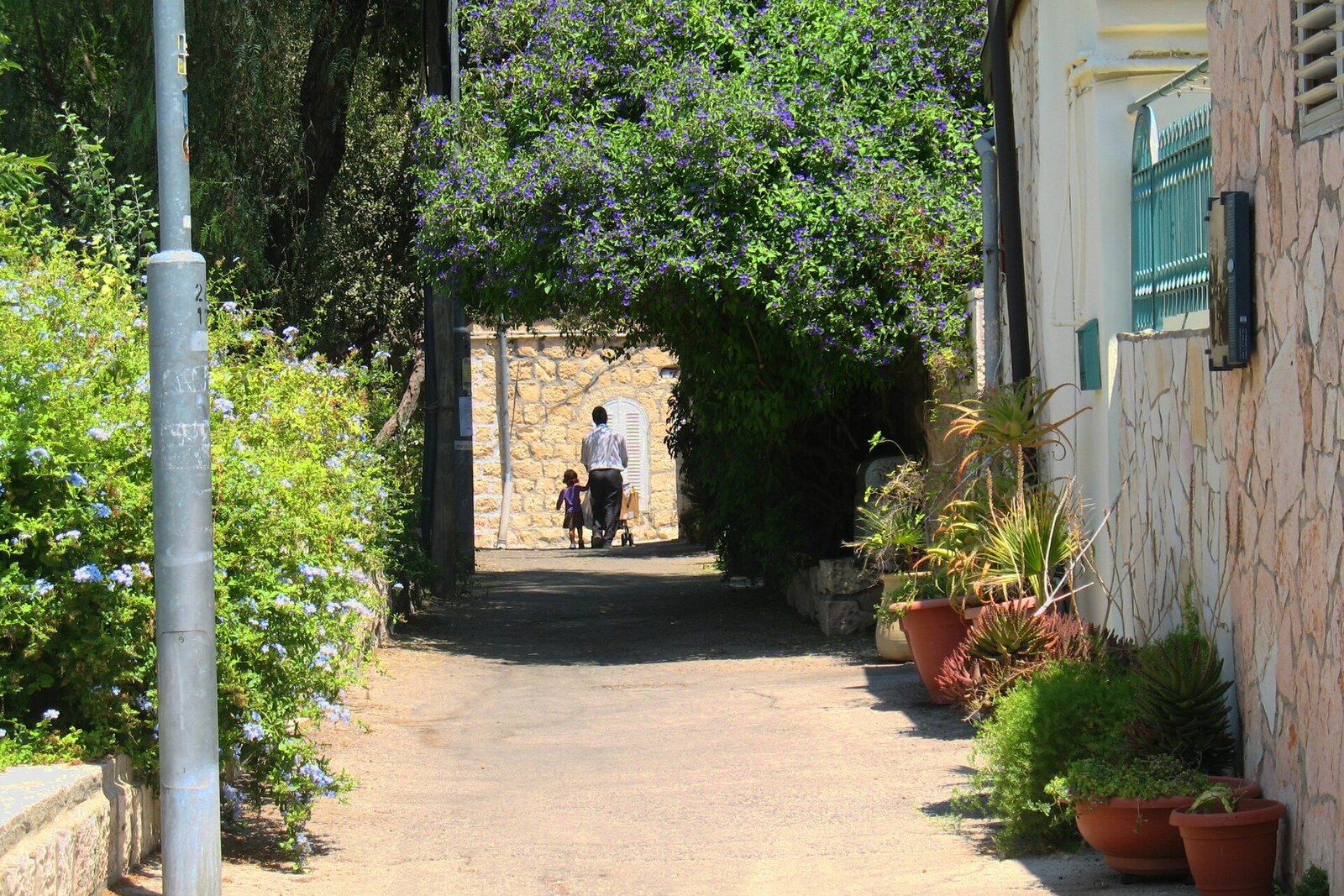
Look around first
What to notice
- Dense stone houses, inner passageways, and the two levels of prayer rooms at Beit Avraham Synagogue.
The story of the place
Dense stone houses form inner passageways, and in one of the local synagogues prayer took place on two floors at once. The upper room was made for those who gathered by sunrise, while the lower one was left to another community: cramped conditions here were resolved with new masonry, not by neighbors leaving. The neighborhood grew through the shared contributions of its future residents, and the residents took on not only the houses but also the streets around them. Heavy stone rollers were stored nearby, and together with horses they were lent to the city when a new road needed to be compacted.
At first, this neighborhood had far more future than houses. In eighteen seventy-seven, a nearly promotional announcement appeared in a newspaper: one hundred forty “large and good” houses would rise here—with verandas, basements, and everything needed for life. Not a cramped shelter hastily put together, but a real new town beyond the walls of old Jerusalem.
Forty-four houses were built.
The gap between the plan and the result was enormous, but the vacant land did not go to waste. Wheat was sown on it. So Mishkenot Yisrael was at once both a neighborhood and a field: stone walls were already rising, while ears of grain still swayed between them.
Yosef Rivlin, one of the leading figures in the construction of Jerusalem’s new neighborhoods, came here once during the harvest. He later described the scene in a letter. Rivlin addressed the reapers with words from the Book of Ruth: “The Lord be with you.” They answered as they do in the biblical story: “May the Lord bless you.”
Perhaps, spoken amid an ordinary urban wasteland, these words might have seemed too solemn. But a real harvest was taking place all around. Behind the reapers, poor people gathered the ears of grain left behind—just as Ruth once did in Boaz’s field. And for Rivlin, the distance between the biblical land and this unfinished neighborhood suddenly disappeared.
He wrote that tears came to his eyes with joy. In several dozen houses, in the dusty field, and in the people picking up ears of grain, he could already see an entire people living on its own land. He imagined a festive procession: first fruits being carried to the sound of flutes, in golden baskets. Where anyone else might have noticed a lack of money and forty-four houses instead of one hundred forty, Rivlin saw the beginning of a great return.
But it was impossible to live on vision alone. Stones, beams, and roofs required money, and the allocation of houses required rules. So the community established an administration with almost accountant-like thoroughness. The participants were divided into seven groups, called “banners.” Each “banner” had an elder: he collected contributions, listened to neighbors, and passed their shared opinion onward.
The society promised to build no fewer than ten houses a year. Each new batch of housing meant a moment of hope—and a lottery. The lottery itself decided who would receive a completed house. The lucky ones first moved in as tenants: the neighborhood was not yet complete, so no one received final ownership rights. When construction was supposed to be completed, a second lottery was planned—for permanent allocation. If one person received a house more valuable than another’s, the difference was to be paid additionally.
So the dream of owning a home rested on three things at once: patience, regular contributions, and luck. A person could take part in the common undertaking for years, vote through their “banner,” pay for construction—and still wait for the right lot to be drawn. Yet the house arose not as a gift from a wealthy patron and not as an order from the authorities. It was gradually put together with shared money by people who themselves were to live here.
The same mixture of calculation, duty, and hope determined the fate of the first synagogue. It was begun under the lofty name “Mishkenei Elyon”—“Higher Dwellings.” The name already promised heavenly height, while construction meanwhile became bogged down in thoroughly earthly debts.
Salvation came from London. Avraham Zussman sent one hundred pounds sterling—a sum that made it possible to complete the work. In gratitude, the synagogue was named after him: “Beit Avraham Synagogue,” “House of Abraham.”
The dedication took place during Passover in eighteen seventy-seven. From morning, people streamed here. Rabbis, cantors, townspeople, and Torah scrolls moved in a solemn procession; psalms were sung. For several hours, the unfinished neighborhood acquired the very festive image Rivlin had seen in the wheat field: a people, a procession, hymns—and a new holy place where bare ground had stood only recently.
Then ordinary life began, and it turned out that even prayer can have a scheduling problem. Two minyans gathered in the synagogue. The first prayed very early, following the vatikin custom, trying to join the main prayer to sunrise. But it did not manage to finish by the time the room was already needed by the second minyan.
The disagreement dragged on for several years. The solution was truly Jerusalemite: if two communities are cramped in one synagogue, another synagogue is needed. In eighteen ninety-five, a room was built one floor above for the early minyan, while the second remained downstairs. No one had to leave. Some prayed above the others, each at its own time, and the dispute became another floor.
Even the road here was a shared undertaking. Ten enormous stone rollers were stored beside the neighborhood. Before a street was laid, the ground was leveled, stones were crushed, holes were filled, and then horses pulled the heavy wheels again and again until the surface became compact. These rollers were called the “returning wheel”—it passed over the same place countless times.
Everyone took on the work: adults, old people, and children. The Mishkenot Yisrael committee lent both the rollers and the horses to the municipality free of charge. So the neighborhood built not only its own houses. It helped lay the streets around itself.
The grand plan was fulfilled only in part. One hundred forty houses never appeared. Yet the wheat field became a biblical scene, debt became the House of Abraham, a dispute over prayer time became a new floor, and the heavy wheel, again and again, turned a scatter of stone into a road. New Jerusalem did not arise here all at once. It was slowly rolled out of the ground.
Useful on site
The courtyard is open at any time; entry is free, but please respect the residents
Checked: June 22, 2026. Check the official source before visiting.View the synagogue from outside if it is closed or a service is taking place inside. Do not expect to see the objects and rooms mentioned in the story: part of the history can be read only from the neighborhood’s surviving structure.