 Guide On Map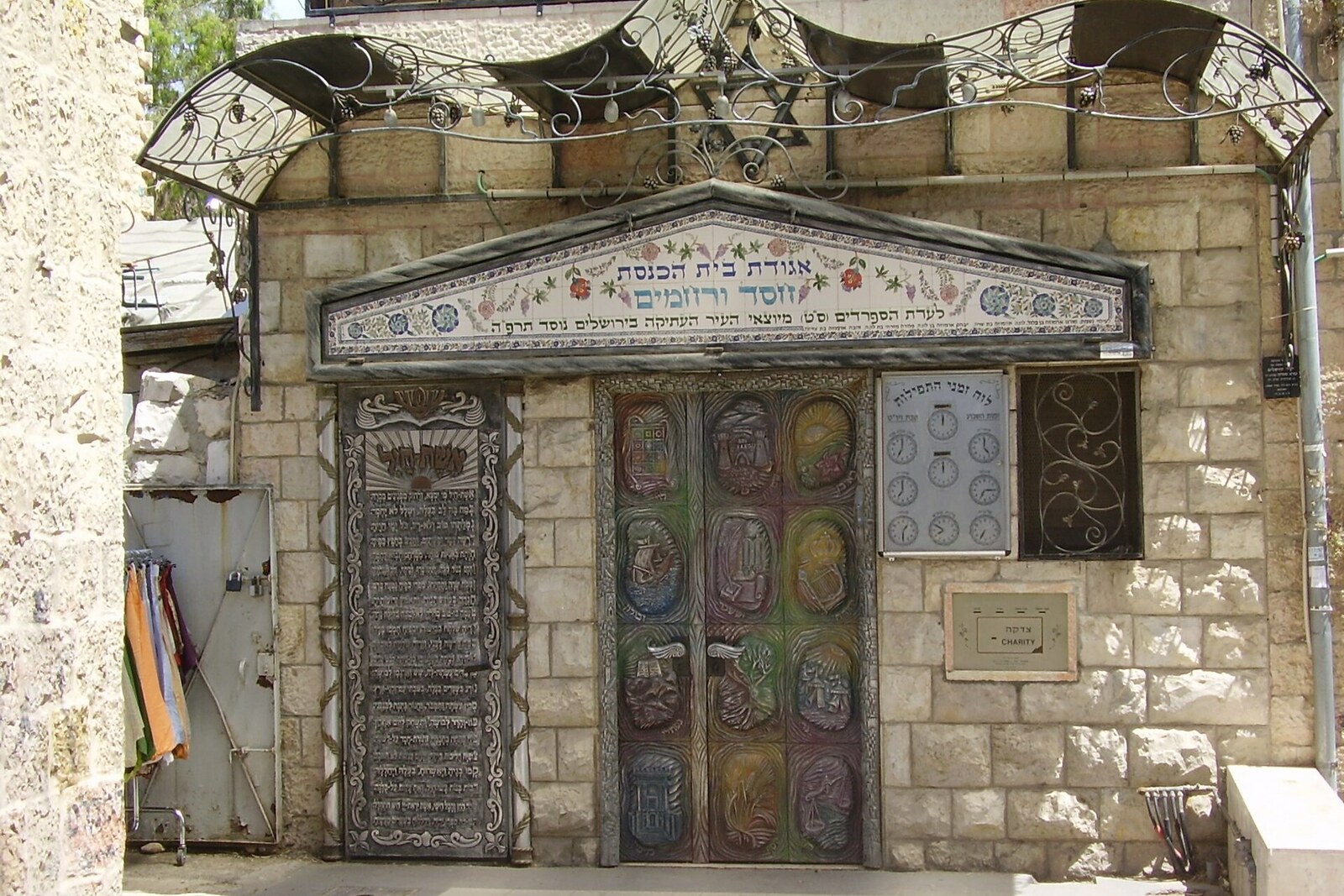
Look around first
What to notice
- Modest stone facades and silver plaques with the Twelve Tribes of Israel by the doors of the Hesed VeRachamim Synagogue.
The story of the place
In the crowded Old City, a family had to share overcrowded rooms and fight for every new corner. Beyond the walls, in Mazkeret Moshe, stand small stone houses with courtyards, and residents could pay for them little by little over many years. The quarter was first intended for Ashkenazi Jews, the neighboring Ohel Moshe was set aside for Sephardi Jews, and later Sephardi families predominated here. Silver plaques with the Twelve Tribes of Israel remain on the doors of the present-day synagogue.
A gift to a wealthy person is usually meant to be conspicuous: an equestrian statue, a ceremonial arch, at the very least a bronze plaque bearing a name. For Moshe Montefiore's ninetieth birthday, they did things differently: his memory was turned into housing.
Eighty-three houses were built here with funds from the Yehudit and Moshe Montefiore Fund. That is how the name Mazkeret Moshe appeared—“memory of Moshe.” The houses were sold cheaply, and the money could be repaid gradually, over many long years. The result was a monument where people do not stand motionless before a pedestal, but open shutters, argue over noise, dry laundry, and put children to bed.
For residents of the cramped Old City, such a house meant more than simply a new address. Behind the fortress walls, rooms were overcrowded, the air was heavy, and housing had to be fought for. Here there was a chance to begin a separate life—modest, perhaps, and burdened with debt, but with a doorstep and courtyard of one's own.
Charity, however, also followed the structure of Jerusalem at the time. Mazkeret Moshe was intended for Ashkenazi Jews, while the neighboring Ohel Moshe was for Sephardi Jews. People were led out of overcrowding, but settled according to origin, language, and prayer tradition. The two quarters stood side by side, both bore Montefiore's name, and both came into being through the same philanthropic idea—yet from the start, they were given different voices.
The boundaries between communities proved less solid than the walls of the houses. Over time, Mazkeret Moshe became more Sephardi. This change is heard most clearly in the story of the Hesed VeRachamim Synagogue—“Mercy and Compassion.”
There was once a pub in its premises. In the late 1920s, a local butcher persuaded the owner to give the establishment over for use as a synagogue. Everything about this story is wonderful: the persistent butcher, the owner who agreed, and the premises, which did not have to move anywhere to change their life completely. Yesterday, people came here to drink and talk; soon, prayers were already being heard here. The same walls, the same doorway, but a different rhythm of time.
By the doors of the present-day synagogue are silver plaques depicting the Twelve Tribes of Israel. Behind them lies an almost literal portrait of the quarter: many families and traditions gathered in one small space. The name “Mercy and Compassion” also seems to answer the whole history of Mazkeret Moshe. First came cheap houses and long loans, then a pub that yielded its place to prayer, and later an attempt to save children to whom the city promised no easy future.
Before that future, the quarter lived by hard daily work. In nineteen forty-two, the photographer Tim Nachum Gidal photographed it. In an archival inventory, beside the photographs, there remained an almost ready-made cast list: traders, shoemakers, shoe shiners, and a baker.
Mornings here could begin not with the lovely silence of old lanes, but with work. A shoemaker's hammer tapped on a sole. A shoe shiner's brush rustled quickly over a shoe. The baker was already taking out bread while others were only unlocking their doors. Traders laid out their goods and waited for the first customers. Conversations, calls, bargaining, the smell of dough and leather—the quarter sounded like a workshop where everyone earned a little and almost no one could afford to stop.
Today, old neighborhoods easily turn into scenery: stone becomes picturesque, a worn door becomes photogenic, and the poverty of the past becomes cozy “atmosphere.” But for those caught by Gidal's camera, that atmosphere meant a long workday, a tight budget, and constant anxiety about tomorrow's earnings. Mazkeret Moshe was built as a way out of the city's overcrowding, yet one house was not enough to escape hardship forever.
It weighed especially heavily on children. Later, a club for street and disadvantaged children appeared in the quarter. It began in a simple barrack, then moved into a one-story house. Children from five to eighteen came here—an age span almost as long as a whole life: one was still learning to play, while another already had to decide what they would become and whether they could remain in the city at all.
Social workers and students worked with the children, organized games and excursions, and staged performances. They worked not only with the children themselves, but with their parents as well. The club was led by the psychologist Avraham Nadad-Probolovsky. Eliezer Shmueli prepared the older teenagers for service in the Haganah. Thus, a small neighborhood institution connected the courtyard, the family, and the larger history of the country.
No one promised a fairy-tale rescue here. A few games, a trip, an amateur performance, or a conversation with an adult could not erase poverty in one stroke. But they gave a child a place where their name was known and their future was considered important. In a quarter created to help adult families, the next generation again needed help—not only a roof, but attention, an activity, and a chance not to become superfluous.
That is why Moshe's memory here lies not so much in the name. It is repeated in the very way the quarter exists. A house becomes affordable through a long loan. A pub becomes a synagogue through a conversation between a butcher and an owner. A barrack becomes a children's club thanks to people who come here to work after their own work. Montefiore's monument did not turn out solemn and immobile. It kept changing the purpose of its rooms—as though every door here could one day open onto a different life.
Useful on site
Access through the quarter is free; the synagogues are open according to prayer and holiday schedules
Checked: June 22, 2026. Check the official source before visiting.Do not mistake the picturesque old buildings for scenery: the passages are used by residents and worshippers. Enter the synagogue only with explicit permission, and do not take photographs during prayer.