 Guide On Map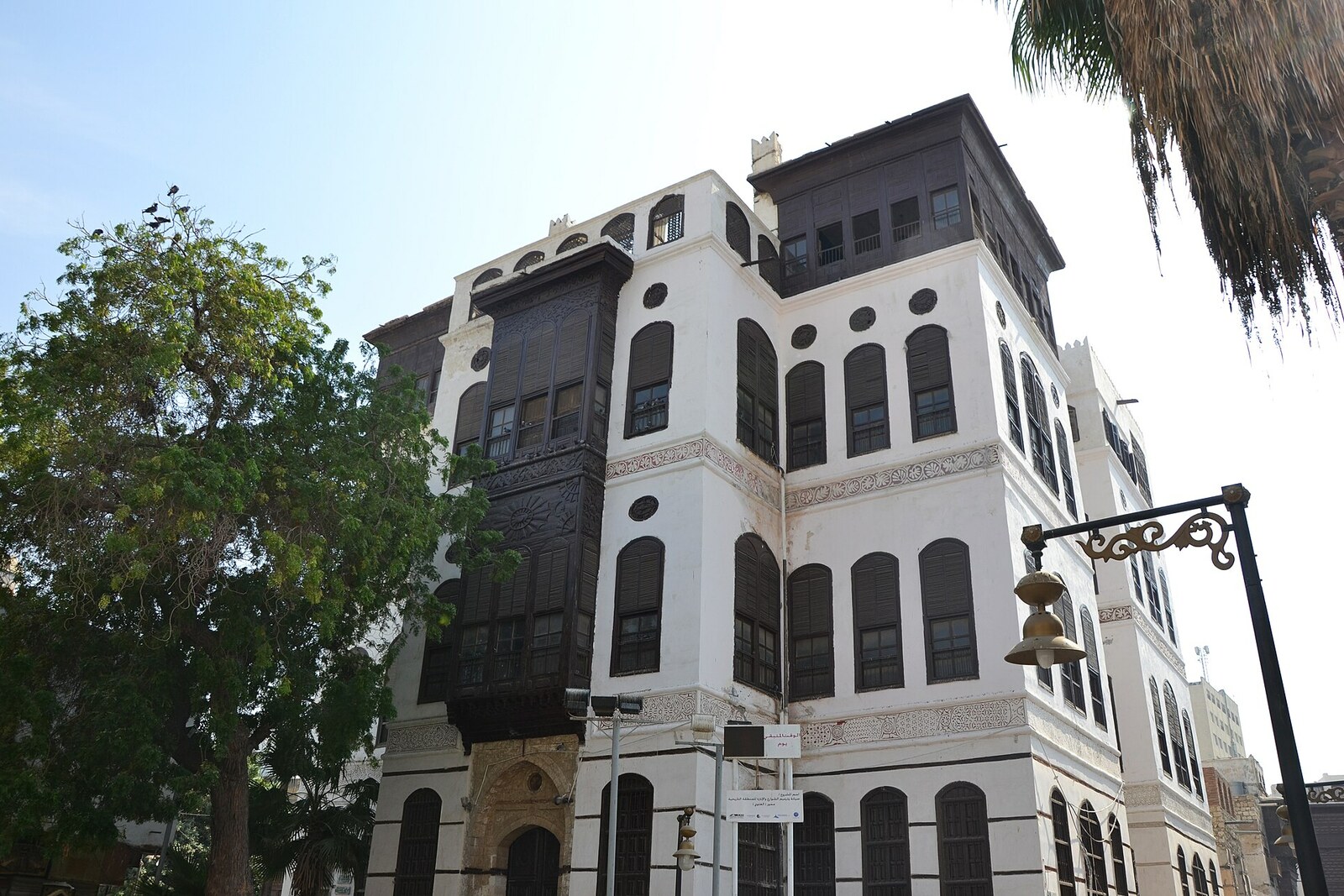
Look around first
What to notice
- Main entrance
- Second-floor windows
- Upper floors
- Majlis
The story of the place
Nassif House bears the surname of a family for whom receiving guests was part of the business. The Nassifs acquired their wealth through the grain trade, essential to Jeddah during the pilgrimage season, and then invested in transport and maritime trade. Omar Effendi Nassif became the head of the city's merchants and the commercial representative of the Sharifs of Mecca—the name for the rulers of Hejaz before the arrival of the House of Saud.
This position was expensive. When a Sharif came from Mecca to the port, Omar had to accommodate his entourage and business partners at his own expense. The Ottoman governor also stayed here: foreign consuls could not travel to him in Mecca, so negotiations had to be conducted in Jeddah. In eighteen seventy-two, Omar began building a house designed precisely for such a life. The first floor was set aside for receptions, the second for guests to stay overnight, and the family lived above. Kitchens, rooms for servants, and private water cisterns were added. Construction was completed by eighteen eighty-one.
Omar's grandson, Muhammad Hussein Nassif, inherited the house and its duties—a wealthy city notable, book collector, and participant in local politics. In nineteen twenty-four, he joined the Hejaz National Party. It was founded by influential residents of Jeddah and Mecca who sought the abdication of King Hussein ibn Ali after military defeats. Hussein yielded the throne to his son Ali, but the war continued, and Ali held besieged Jeddah for almost a year. The party split; several of its figures were arrested, while the merchants had to preserve their property and status whatever the outcome.
In December nineteen twenty-five, Ali signed an agreement to surrender the city and left. When the victorious Abdulaziz ibn Saud entered Jeddah, Muhammad Hussein Nassif declared his loyalty to him and received him here. Residents came to the house to welcome the new ruler and swear allegiance. For Abdulaziz, it was a ready-made urban court: halls for petitioners, rooms for his entourage, and a place to receive diplomats. For about ten years, during his visits to Jeddah, he stayed with the Nassifs, heard the requests of city residents here, and concluded agreements with foreign representatives.
For Muhammad, the choice ended with preserving his former role under the new ruler. He continued to be entrusted with foreign and scholarly guests, including when Abdulaziz was not in the city. The house effectively served as a state guesthouse, while its owner expanded his circle of acquaintances and his library; everyone who came to him was allowed to read its books.
Now the majlis—the reception room of Abdulaziz—is shown inside. Muhammad Hussein Nassif's library itself is no longer here: the thousands of books and manuscripts he collected were transferred to the King Abdulaziz University Central Library.
Useful on site
The facade is accessible from the street; the public interior, exhibitions, and events depend on the current program. A permanent official schedule had not been confirmed as of the verification date.
Checked: date not specified. Check the official source before visiting.Even if the rooms are closed, linger in the square: the scale of the building and its wood explain its public role. Check interior access separately.