 Guide On Map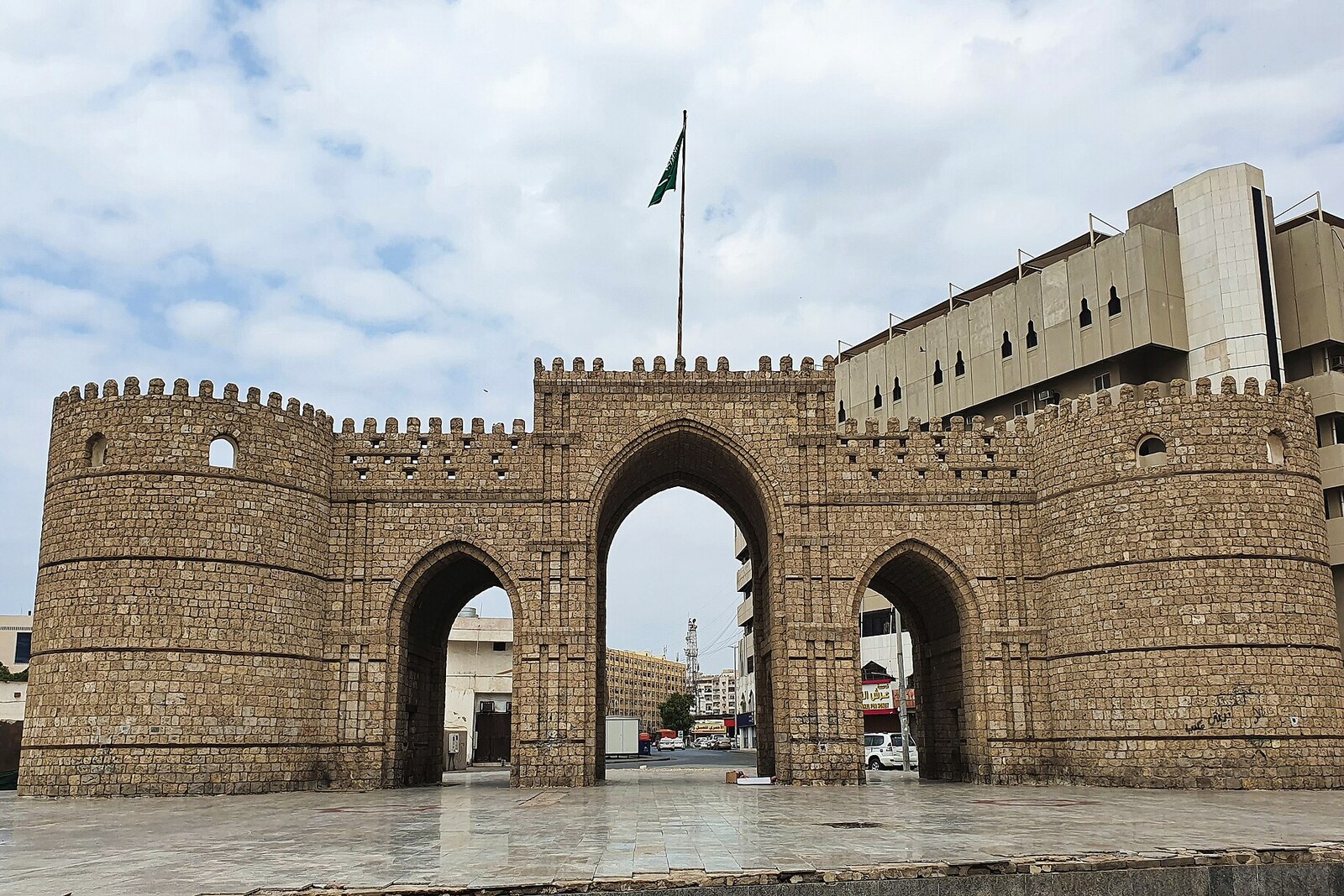
Look around first
What to notice
- The arched opening
- Market stalls
- The road east
The story of the place
Bab Makkah means “Gate of Mecca.” The name points to the road: the overland route from Jeddah to the sacred city, located about seventy kilometers to the east, began here.
This flow of people arose by decision of Caliph Uthman ibn Affan. In six hundred forty-seven, he designated Jeddah as Mecca’s seaport. Pilgrims from Africa and Asia disembarked from ships here, crossed the city from the shore to the eastern wall, and gathered at this gate. Beyond it there were no more city houses—the road across the plain began.
In eighteen fourteen, the traveler Johann Ludwig Burckhardt found Bab Makkah functioning as a transport hub. At ordinary times, caravans left from here almost every evening. During the four months before Hajj, the annual pilgrimage, they departed daily after sunset: too many people were arriving by sea to wait for the infrequent large columns.
At the gate, one chose not a pleasant way to travel, but its cost and duration. Loaded camels needed two nights; people waited out the daytime heat halfway there, in Hadda. A light caravan of donkeys covered the distance in fifteen or sixteen hours and arrived in Mecca in the morning. Letters between the two cities were sent with it as well.
Hiring a camel usually cost twenty to twenty-five piasters, the monetary units of the time. Before Hajj, the price could rise to sixty or seventy. For a poor pilgrim, such a difference determined whether they would continue the journey at once. Some stayed near the gate and earned a living alongside Bedouins who went to distant mountains for firewood. Drivers lived here as well, in huts on both sides of the road, so they could find passengers before those passengers spent their money in the city.
Nearby, people traded in what both the caravan and Jeddah needed: livestock, firewood, charcoal, fruit, and vegetables. Goods from inland areas passed through Bab Makkah after a duty was paid, while people and cargo arriving by sea moved in the opposite direction—toward Mecca.
In nineteen forty-seven, the city wall was demolished: Jeddah had outgrown its boundaries. Beyond the present arch, there is no longer a city that could be shut behind gates, but Bab Makkah Market operates nearby, selling dates, grain, honey, vegetables, and household utensils. The name remains at the same eastern exit where pilgrims hired animals and waited for the night caravan to depart.
Useful on site
Open around the clock from outside; before you is a symbolic reconstruction on the site of the lost gate, not a museum interior.
Checked: date not specified. Check the official source before visiting.View the passage from the side, without lingering in the middle of the busy market. The gate’s full meaning is best understood from outside.