 Guide On Map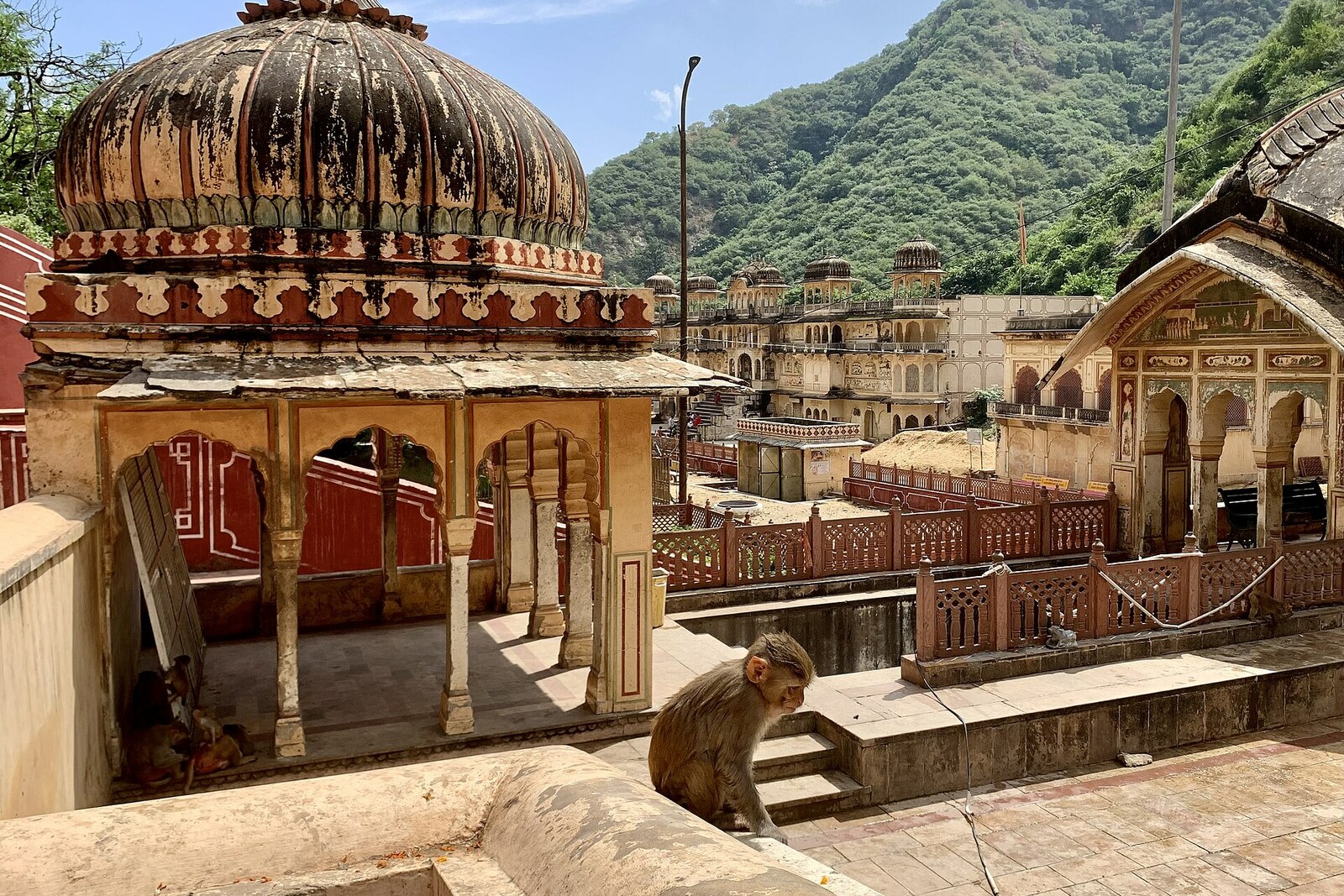
Look around first
What to notice
- Temple courtyards
- Macaques
- Cave
- Old wall painting
The story of the place
Locals call the Ramgopalji Temple complex Galwar Bagh (Ramgopalji Temple). It was nicknamed the “Monkey Temple” because of the macaques living here. Yet the temple courtyards appeared in this valley as a result of a dispute that began long before they were built.
At the beginning of the sixteenth century, the gorge was occupied by Nath yogis—Shaivite ascetics whose teachers were renowned for bodily and magical practices. For hermits, Galta was valuable territory: the narrow valley is sheltered by hills, and its spring provided water where a permanent retreat would otherwise have been impossible.
Prithviraj, the ruler of Amber at the time, regarded the Nath yogi Taranath as his teacher. One of Prithviraj's wives, Balan Bai, chose another teacher—Krishnadas Payahari, a Ramanandi who preached devotion to Rama. Prithviraj demanded that Balan Bai renounce Krishnadas Payahari and submit to Taranath. Balan Bai told her teacher about this. Krishnadas Payahari, an ascetic who, according to early biographies, lived on milk alone, left Pushkar and came to Galta.
Ramanandi tradition says that the Nath yogis ordered the stranger to leave. Krishnadas Payahari wrapped his sacred fire in cloth, carried it to another place, and sat again by the flame; the cloth, it is said, did not catch fire. Taranath turned into a tiger and tried to drive away his rival. Krishnadas Payahari called the tiger a donkey—and it immediately became a donkey, while its large earrings, the mark of belonging to the Nath yogis, fell to the ground.
Prithviraj, accustomed not to eat before meeting Taranath, set out to look for his teacher. Krishnadas Payahari agreed to restore Taranath's human form on two conditions: the Nath yogis would leave Galta and would bring firewood for the sacred fire. The ruler accepted the conditions and then became a disciple of Krishnadas Payahari himself.
The miraculous contest is a later tradition. In early texts, Krishnadas Payahari is already named as Prithviraj's teacher, but there is no duel with Taranath. The confirmed event is more stark: at the beginning of the sixteenth century, the Ramanandis displaced the previous community from Galta—perhaps after a dispute, perhaps by force—and Prithviraj gave them his patronage.
In Amber, Prithviraj installed the images of Sita and Rama and of Narasimha brought by Krishnadas Payahari. After this, the Kachhwaha dynasty supported the Ramanandis for more than three hundred years. With their participation, Krishnadas Payahari's successors turned the hermits' encampment into a major monastic center. In the middle of the seventeenth century, the abbot Narayandas oversaw the construction of Gopalji Temple and Raghunathji Temple, gardens, and water structures. The present Ramgopalji Temple complex, which later acquired its monkey nickname, also belongs to this line.
In one of Galta's caves, an old painting survives with the victors' version: Krishnadas Payahari sits in the center beside his disciples, while Taranath and Prithviraj stand to one side. Taranath is shown in his conical cap, already bowing before the new master of the monastery.
Useful on site
An open passage through the valley; safer in daylight. In the morning, the animals are usually less persistent, but food should still be kept covered.
Checked: July 1, 2026. Check the official source before visiting.Do not show food to the animals, do not stare at them challengingly, and do not stand between an adult and its young. Keep your bag closed.