 Guide On Map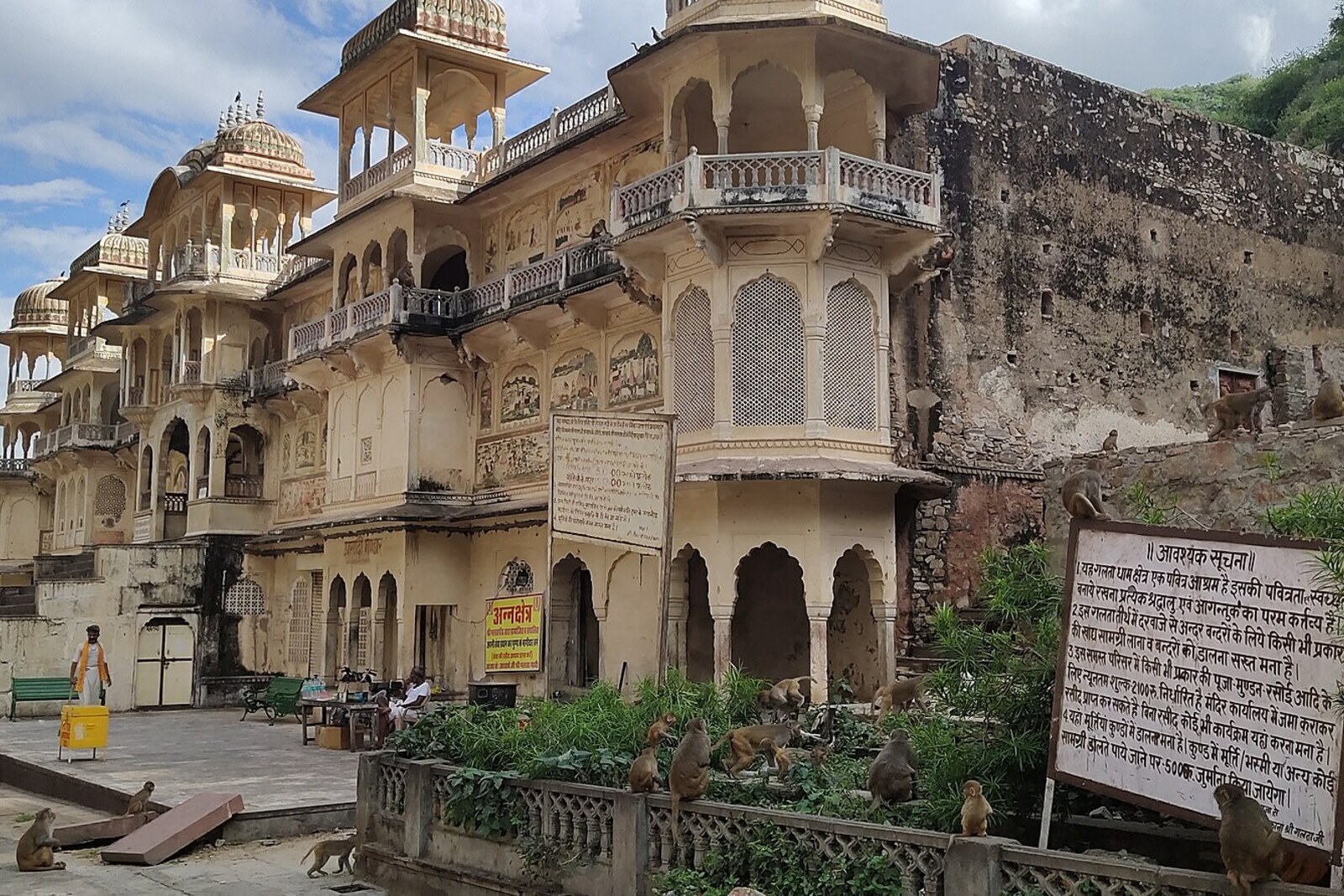
Look around first
What to notice
- Painted arcades
- Inner courtyard
- Main shrine
- Living quarters
The story of the place
The Main Temple of Galtaji is dedicated to Sita and Rama. Behind the painted arcades are a shrine, an inner courtyard, a kitchen, storerooms, and living quarters. Here, people worshipped divine images, supported the community, and managed its lands and donations. The abbot was both a spiritual teacher and the administrator of a large household.
In the first half of the eighteenth century, this office had to be reorganized at the demand of Sawai Jai Singh II. The ruler sought to make the influential religious communities of his state obey clear rules. Galta carried particular weight: its Ramanandis served the family of the rulers of Amber, and their abbot took part in the ruler's accession ceremony, initiating him into prayer to Rama. The monastery's lands, donations, and upkeep depended on its relationship with the court.
Previously, Galta was led by a celibate monk. Jai Singh was dissatisfied that some such monks, obliged to abstain from family life, practiced madhurapasana—the mental contemplation of the marital love of Sita and Rama. He saw in this an overly convenient discrepancy between their vow and their religious practice. Galta received a demand: the abbot had to give up celibacy and live as a householder.
The entire economy of the community was at stake. Defiance threatened the loss of patronage, while consent changed the very office of abbot. The head of Galta complied, married, and preserved the monastery's standing. His successors also lived with families. Because of this, Galta grew apart from those Ramanandis who still believed that only a celibate ascetic had the right to lead a monastery.
Sita and Rama remained in the main shrine—the very divine couple whose marital love, once contemplated, had cost the abbot of Galta his monastic celibacy.
Useful on site
For the Galtaji complex, India's official tourism source lists 05:00–21:00. In practice, individual shrines and courtyards depend on services, festivals, and the decisions of the attendants.
Checked: July 1, 2026. Check the official source before visiting.During services, stay at the edge of the passageway and follow the attendants' instructions. If the interior rooms are closed, view the courtyard architecture from the accessible side.