 Guide On Map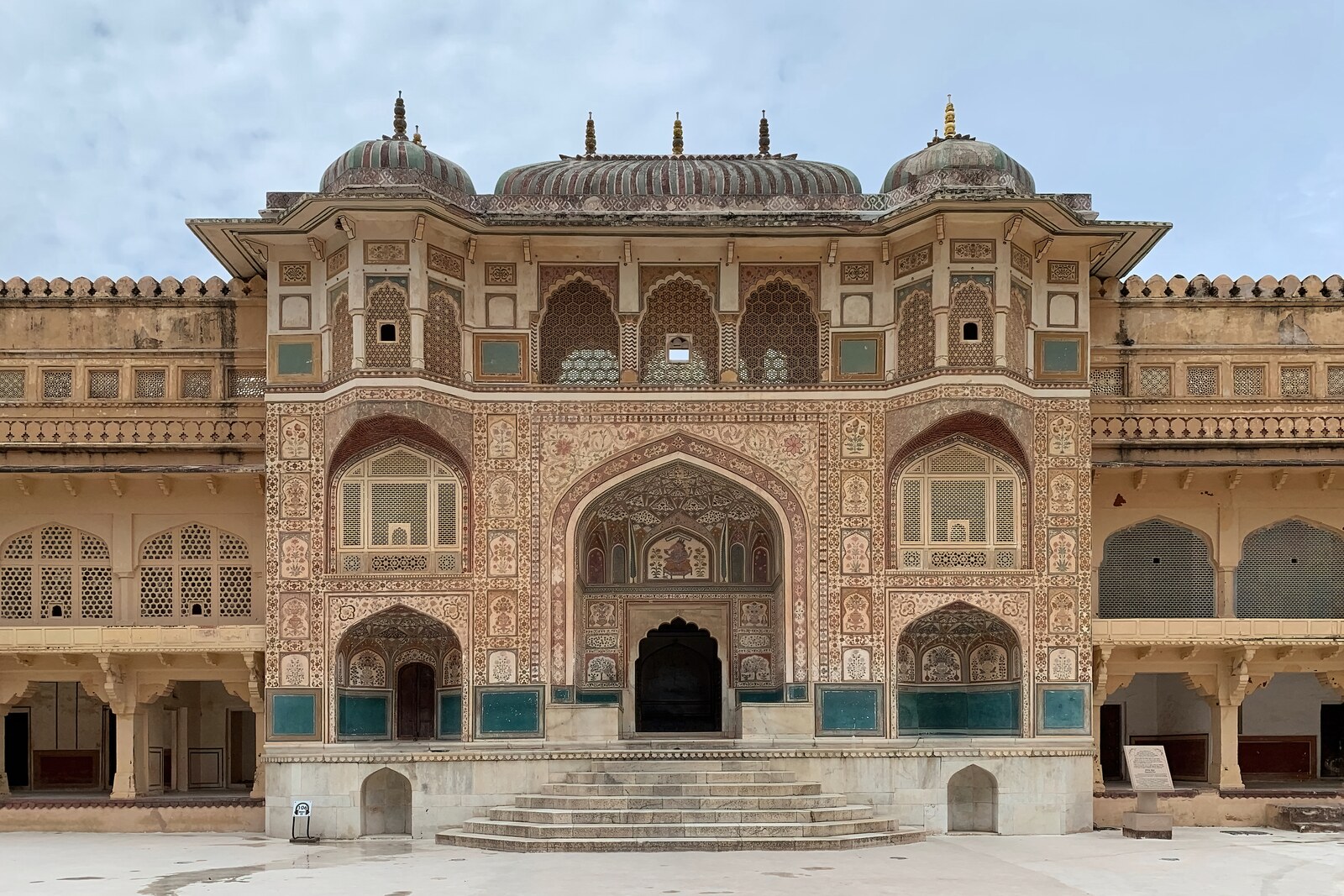
Look around first
What to notice
- Image of Ganesha
- Painted facade
- Marble jaali screens
The story of the place
The main action at Ganesh Pol took place above the arch. During palace receptions, the women of the ruling family gathered in the upper gallery. The custom of female seclusion, purdah, prohibited them from appearing before unrelated men. But below, the ruler received petitioners, officials, and ambassadors—and the women were not meant to miss everything happening at court either.
The gallery windows were covered with jaali—screens carved from marble. Through the small openings, the women could see the people in the courtyard, while the people could make out only a stone pattern before them. This allowed the women to watch the receptions while remaining invisible to those taking part. The result was quite literal: the women were given the place of witnesses, but for those gathered below, their own presence was as though excluded.
This gallery was arranged precisely here because, in the mid-seventeenth century, the ruler of Amer, Mirza Raja Jai Singh I, drew the boundary between two parts of the palace through the gate. In front of the facade stood Diwan-i-Aam—the hall of open audiences, where the raja heard subjects admitted to him. Beyond the arch began the inner courtyard, with Diwan-i-Khas—a room for private receptions—and the family’s private quarters. An ordinary petitioner remained outside. A guest permitted to go farther found himself already in the private part of the palace.
In Rajasthan, the word “pol” means gate. The gates were named for Ganesha because of the image above the central arch. In Hindu tradition, elephant-headed Ganesha is invoked at the beginning of an undertaking and regarded as the remover of obstacles. That is why his image was placed above the entrance to the inner courtyard: every admitted guest passed beneath it.
Today, visitors pass through the same arch, but the arrangement of the former boundary remains. Marble jaali still stand above the brightly painted facade. Beneath the image of Ganesha passed the guests to whom the inner courtyard was opened; behind the screens above them stood the women of the family, seeing the ceremony without the right to be seen.
Useful on site
Access depends on the operating schedule of Amer Fort; passage may be slowed by queues for photographs.
Checked: June 29, 2026. Check the official source before visiting.Do not touch the painted surfaces; the screens and the pavilion are best viewed from below and from a short distance.