 Guide On Map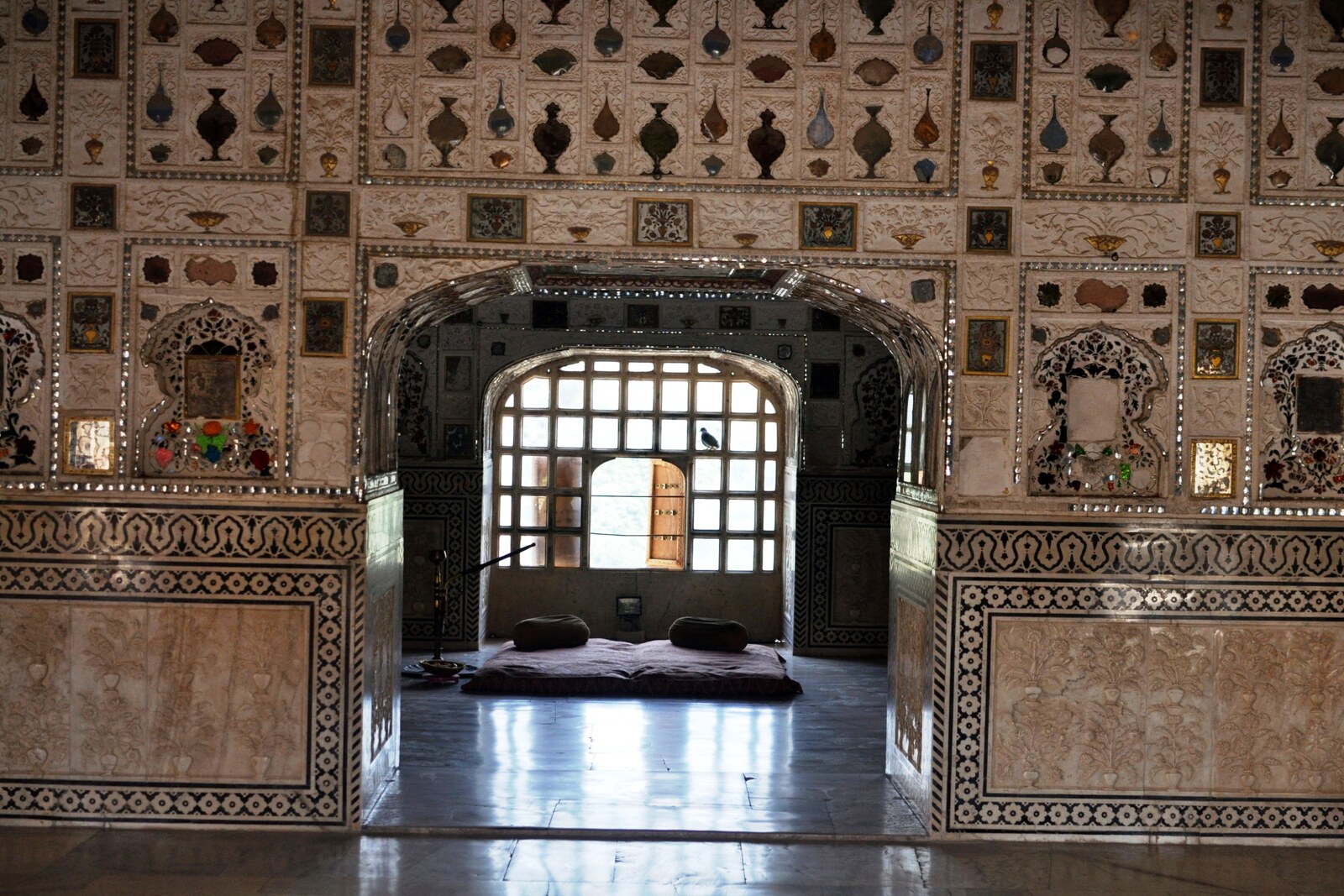
Look around first
What to notice
- Convex mirrors
- Colored glass
- Open gallery
- Four-part garden
The story of the place
Under mirrored vaults, Mirza Raja Jai Singh I received envoys from other rulers. Sheesh Mahal was built for this purpose: in palace usage, it was called Diwan-i-Khas—a hall for private audiences. Petitioners remained in the outer courtyard, while a distinguished guest was escorted through Ganesh Pol into the princely residence.
Mirza Raja Jai Singh I ruled Amer while also commanding the troops of the Mughal emperor. Imperial service gave him military rank and land revenues, from which he maintained cavalry; failure on campaign could result in the loss of his position. The envoys he received here knew Mughal court protocol very well. Mirza Raja Jai Singh I wanted them to see at Amer a court of the same standing as the one at which they were used to negotiating with the emperor.
At his commission, craftsmen laid out a four-part garden with a pool before the hall, and covered the walls, arches, and ceilings with pieces of mirrored and colored glass. Many of the mirrors were made convex and supplemented with colored foil. They were not intended for looking at one's face: each reflected only a small fragment of light. In the evening, lamp flames broke into countless reflections, and the audience began even before the conversation. The guest already knew that he had been admitted to a place ordinary petitioners did not enter.
The romantic story of a queen whose husband gave her a starry sky beneath this ceiling belongs to later traditions. Reliable descriptions give the room a different purpose: Mirza Raja Jai Singh I received selected guests and envoys here. The name, too, refers to the material rather than the legend: the Persian word "shisha" means glass or mirror. The pavilion's second name, Jai Mandir, is associated with Mirza Raja Jai Singh I, who commissioned it.
No records of individual negotiations held here have survived. What remains is their setting: two inner rooms, an open gallery, and many small convex mirrors in which it is still impossible to see yourself whole.
Useful on site
Access depends on the operating arrangements of Amer Palace; some of the decoration is viewed through protective barriers. Check photography restrictions on site.
Checked: June 29, 2026. Check the official source before visiting.Give your eyes time to adjust to the lighting, and do not expect to try the candle experiment; observe local restrictions on photography and lighting.