 Guide On Map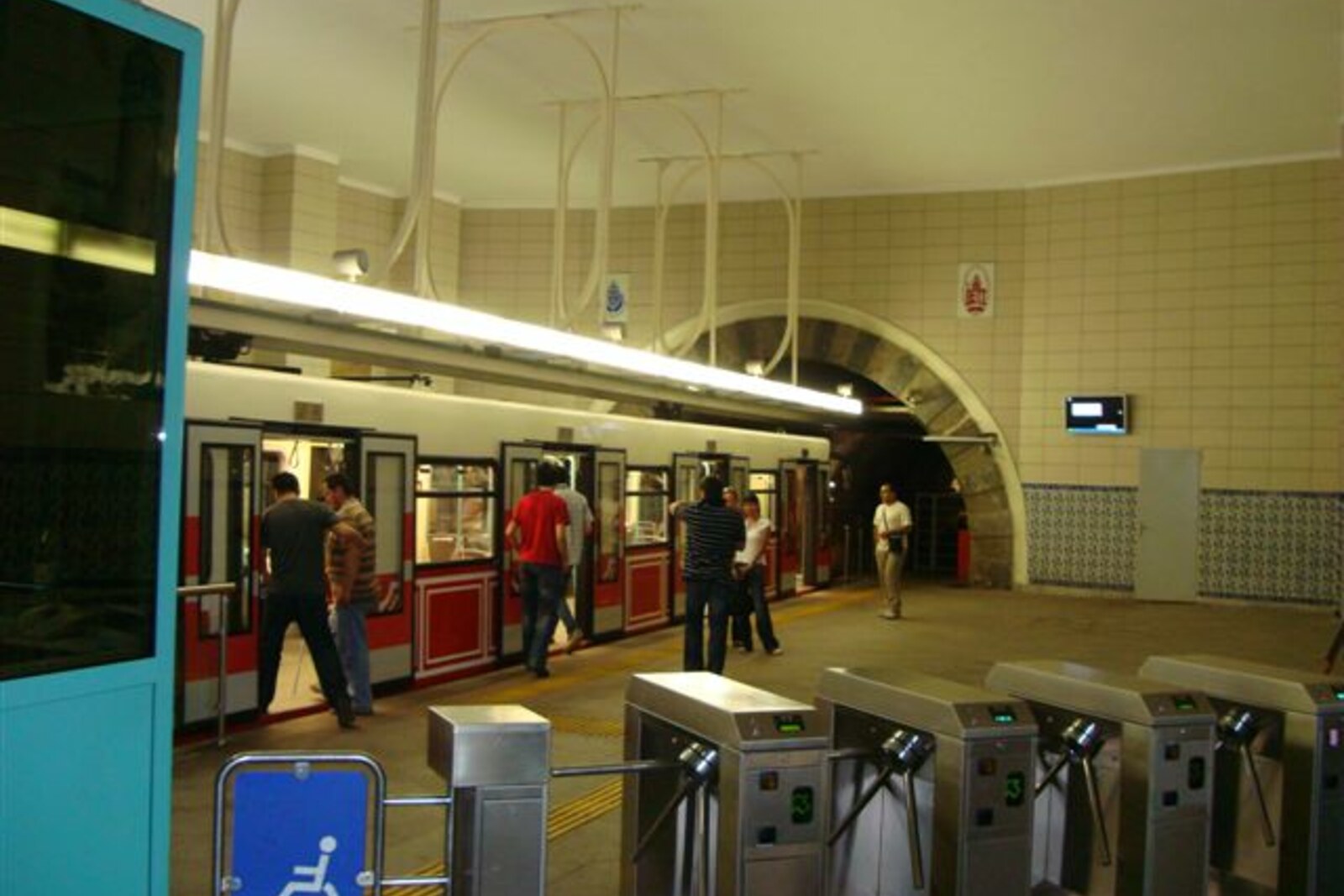
Look around first
What to notice
- Entrance with the “Tünel” sign
- Upper station
- Metrohan façade
- Funicular car
The story of the place
Above the entrance is the word “Tünel.” In Turkish, it means “tunnel,” but here it refers both to the short underground railway to Karaköy, its upper station, and the square. It is a funicular: a car negotiates the steep difference in elevation between Galata by the Golden Horn and Beyoğlu above.
In May eighteen sixty-seven, the French engineer Eugène-Henri Gavand appeared here. He came to Istanbul as a traveler and spent several days watching Yüksek Kaldırım—the High Pavement—which led up from Galata to Pera, as present-day Beyoğlu was then called. At the bottom were quays, the stock exchange, and banks; above were embassies, hotels, and shops. By Gavand’s count, around forty thousand people passed between them each day. On some stretches, the six-meter street narrowed to four meters, and the gradient reached as much as twenty-four percent.
Gavand decided to turn this flow into a fare-paying railway. Beneath the slope, he proposed laying two tracks and pulling the cars by cables with the help of a steam engine at the upper station. In its design, it was a horizontally laid elevator: one train rose while the other, descending into Galata, helped it with its weight.
The engineer sought a concession—the exclusive right to build the railway and charge fares. In eighteen sixty-nine, Sultan Abdulaziz gave his consent, but the terms protected the treasury, not the inventor. Gavand had to manage without government money, buy the land for the stations himself, complete the work within thirty months, and answer for any losses. He expected to recover his expenses through ticket revenue over forty-two years; one and a half percent of the income was to go to the state.
He had no funds of his own for such a construction project. Gavand went to France to seek shareholders, founded a company—and almost immediately the Franco-Prussian War began. The French financing plan collapsed. The engineer then went to London and, with the support of the Ottoman Bank, assembled a new company of British and Istanbul bankers. This money made it possible to begin excavating the tunnel, but it also brought a board of directors that wanted to run the enterprise itself.
A representative was sent from London, formally to help Gavand but in fact to supervise him. The engineer argued with the directors over expenses, management of the construction, and the purchase of land. The documents do not allow us to say with certainty exactly what finally caused the parties to fall out. The outcome is known: in October eighteen seventy-four, when the tunnel was nearly ready, the company removed Gavand from management.
On January seventeenth, eighteen seventy-five, the railway was ceremonially opened. Ministers, diplomats, and shareholders attended the ceremony, but the man who had conceived the line and found the money for it did not come. A newspaper explained his absence by illness. Gavand sent a letter and corrected the editors: he was absent of his own will and for “special reasons.” He did not disclose them.
The company received an operating funicular. Seventy-five thousand passengers used it in the first fourteen days. Gavand remained one of the shareholders, and a few weeks later the sultan awarded him an Ottoman order. Another year later, the engineer published a book in Paris with drawings of Tünel, then reissued it when projects for underground railways began to be discussed in France. He lost management of the enterprise, but it was this line that made his name in the profession.
The building Gavand envisioned above the upper station was never built. The present Metrohan was erected here in nineteen fourteen. Beneath it, the route chosen by the engineer, five hundred seventy-three meters long, has been preserved, and the word “Tünel” passed from the underground structure to the station and the square.
Useful on site
Regular line schedule: Monday–Saturday 07:00–22:45, Sunday 07:30–22:45. As of the verification date, an official announcement reported a temporary suspension of Tünel and the nostalgic tram from June 28, 2026 until further notice.
Checked: June 29, 2026. Check the official source before visiting.Do not count on taking a ride without checking whether the line is currently operating; the stop remains understandable when viewing the station from outside.