 Guide On Map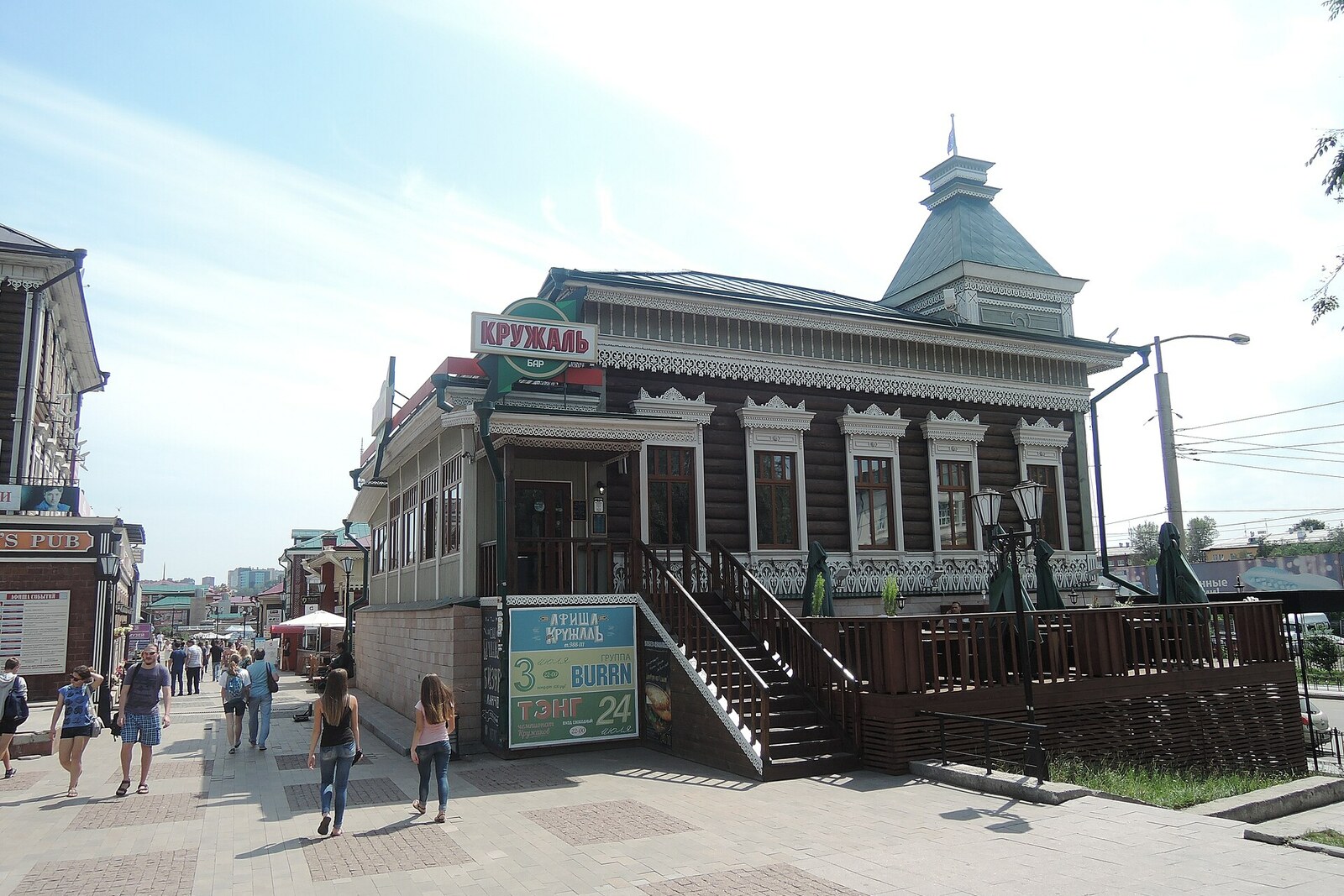
Look around first
What to notice
- Bronze Babr
- Sable in its mouth
- Broad tail and webbed paws
- Carved wooden facades
The story of the place
At the entrance to the low-rise quarter stands a bronze animal with a sable in its mouth; its broad tail and webbed paws make it resemble both a predator and a beaver. Behind it stretch streets with carved wooden facades, but the houses have different histories: some were preserved here, others were recreated from archival documents, and still others were moved from other districts or built anew. Restaurants, hotels, shops, small museums, and a planetarium now operate in the former estates, so the residential quarter has become a busy urban place.
Mark Meerovich and Elena Grigoryeva had two and a half months to propose a different fate for this slope. Meerovich, an architectural historian, had studied wooden Irkutsk for many years. Grigoryeva, the project's chief developer, was to turn his research into a quarter suitable for modern urban life. One option already proposed for this area was glass-and-concrete buildings thirteen to sixteen stories high.
The architects set out to prove that old estates could generate income after restoration. They worked without New Year holidays or weekends, studied the development of this place over two centuries, and proposed keeping thirty-two historic houses here. Another sixteen lost Irkutsk buildings were to be recreated from archival drawings, and eight were to be moved from other districts. This is how the ordinary city block numbered one hundred thirty received the official name Irkutsk Sloboda (130th Quarter).
By the start of the work, almost ninety percent of the houses here had been declared dilapidated or unsafe. The residents were resettled, and new utilities were run to the estates. The architects expected to bring housing, museums, workshops, and galleries back here, while cafés and shops were to occupy only part of the premises.
The deadline was set by Irkutsk's anniversary. When funding stopped, plots began to be transferred to investors along with the right to build on them independently. Meerovich and Grigoryeva were gradually removed from overseeing the realization of their own concept. Hardly anyone bought housing in the quarter: it was expensive, and a noisy public area was already taking shape nearby. Commercial establishments took over spaces intended for apartments and workshops; a shopping center appeared in place of the planned amphitheater.
The quarter opened in September two thousand eleven. Its authors managed to preserve the low-rise silhouette and some authentic houses, but their intended residential sloboda did not materialize. That is why restaurants, hotels, shops, small museums, and a planetarium now operate among the carved facades. Some buildings really stood here before the reconstruction, others were recreated from old surveys, and still others were built anew.
A year later, the Babr was installed at the entrance—a symbol by which the new quarter is now recognized from afar. The name means tiger: in Eastern Siberia, the word “babr” referred to a rare striped predator. On the old Coat of arms of Irkutsk, it carried a sable in its mouth.
The animal's strange appearance came from one person's decision. In eighteen seventy-eight, Bernhard Köhne, head of the Heraldry Department, was bringing provincial coats of arms into line with uniform rules. Contradictory materials lay before him: an old drawing showed a tiger, while the printed description listed a beaver. In a signed note, Köhne chose the printed version and ordered a heraldic beaver to be depicted. The artist retained the predator's pose and the sable in its teeth but added beaver features. The result was a black animal with a feline mouth, a broad tail, and webbed paws. It was officially approved, and the mistake ceased to be a typo.
Later, the word “babr” was restored to the description of the coat of arms, but Irkutsk residents kept the hybrid itself. The sculptor Natalya Bakut reproduced precisely that creature. The four-ton bronze figure was brought here on the evening of October fourth, two thousand twelve; city electric transport workers had to raise the wires so that the animal with a sable in its mouth could make its way to Irkutsk Sloboda (130th Quarter).
Useful on site
The pedestrian area is open; individual museums, cafés, and shops keep their own schedules.
Checked: date not specified. Check the official source before visiting.Compare the houses by material and details, without trying to declare the whole quarter equally old. Looking around from outside does not require separate visits to the establishments.