 Guide On Map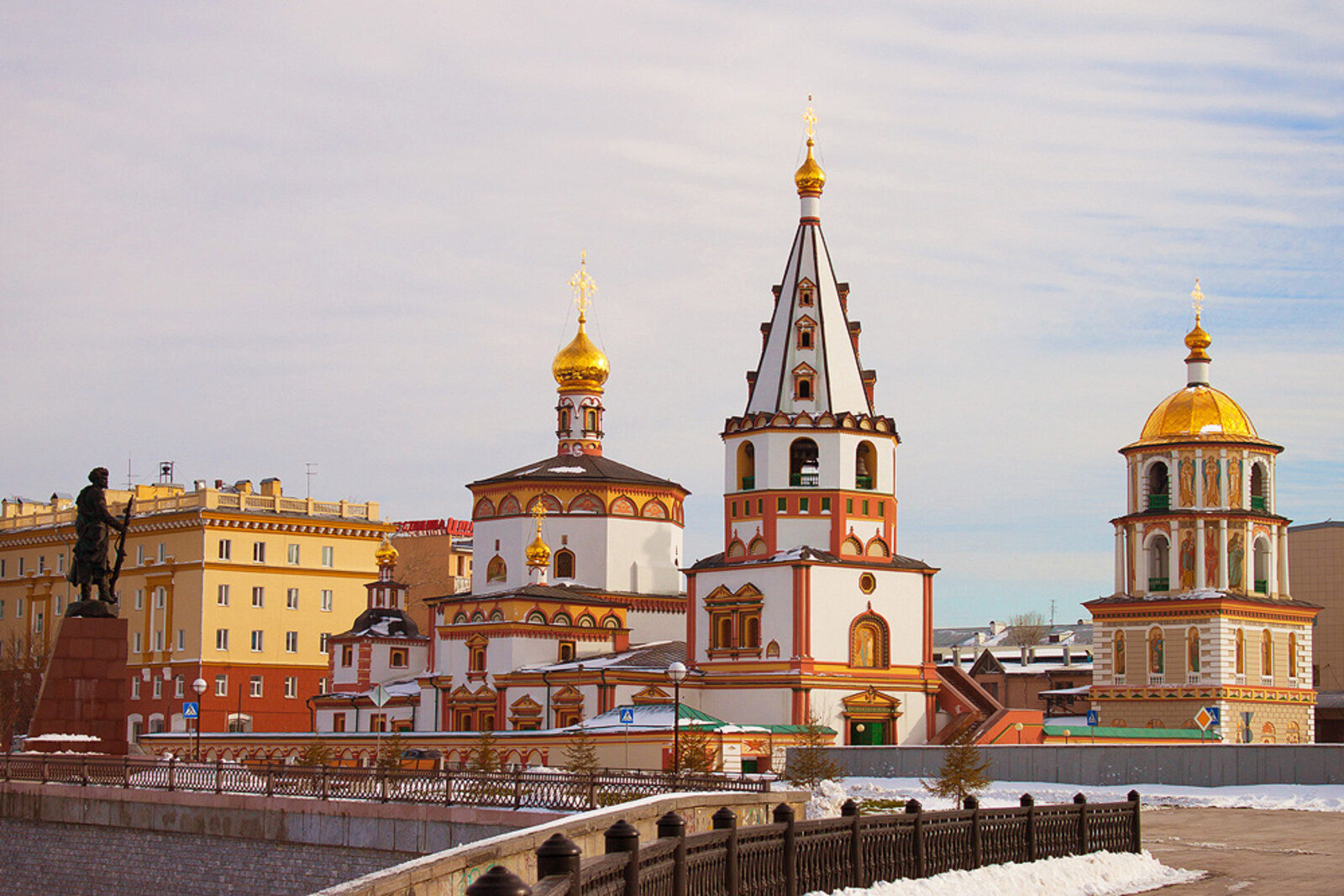
Look around first
What to notice
- The tented roof of the bell tower
- The cathedral domes
- Colorful facades
The story of the place
In nineteen sixty, a cleared site might have remained in place of Epiphany Cathedral. By then, no one had prayed here for a quarter of a century. A confectionery workshop of the bread factory operated in the church, industrial ovens stood inside, and the main volume was divided by floor slabs to create a dormitory. The old masonry was damaged, and the building was considered unsafe.
Irkutsk was being prepared for the visit of United States President Dwight Eisenhower. Regional institutions stood nearby, and the city leadership viewed the cathedral and the neighboring Church of the Saviour as dilapidated structures that were awkward to show a guest. Galina Oranskaya, an architect-restorer from the state combine of the Ministry of Culture, was called in from Moscow to give an assessment. She was expected to provide a professional justification for demolition.
Oranskaya lived on a state salary and received work from the same institutions whose decision she now had to challenge. Her inspection showed her that she was looking at one of the principal documents of early Irkutsk. After the fire of seventeen sixteen, townspeople raised money and built a stone cathedral on the site of the burned wooden one. When the Diocese of Irkutsk separated from the Diocese of Tobolsk, its principal church was established here.
In Oranskaya's later account, during the survey she climbed the cathedral using ropes and, from a height of about forty meters, explained to those accompanying her exactly what they were preparing to dismantle. In the office of the first secretary of the regional committee, the architect spoke sharply against demolition. An assistant led her out of the office, and Oranskaya later admitted that she became afraid of the consequences of her speech only once she was outside.
This scene did not end in her dismissal. Oranskaya prepared a plan to preserve the building, defenders of Irkutsk's antiquities secured protected status for it, and restoration began instead of dismantling. In the late sixties, the bread factory's equipment was removed from the cathedral. The work continued for eighteen years; Oranskaya designed the restoration and supervised its progress. In nineteen eighty-five, the building was transferred to the art museum, and in nineteen ninety-four, to the Diocese of Irkutsk.
Daily services are now held here again. “Cathedral” means that this is the principal church of a diocese, where its bishop serves. The name comes from the main altar: in Orthodox tradition, the Epiphany is the Baptism of Christ in the Jordan River, when, according to the Gospel, the Trinity was revealed to the world.
The tall tented roof of the bell tower above the cathedral has not stood untouched in this form since the eighteenth century. It was recreated to a design by Galina Oranskaya—the architect who came here to provide an assessment before demolition.
Useful on site
Active cathedral; according to the official parish listing, services are held daily at 8:30 and 17:00, and tourist viewing depends on the services.
Checked: date not specified. Check the official source before visiting.First, examine the building from outside, from the side of the open space. Inside the church, turn off the audio and plan your visit around the service in progress.