 Guide On Map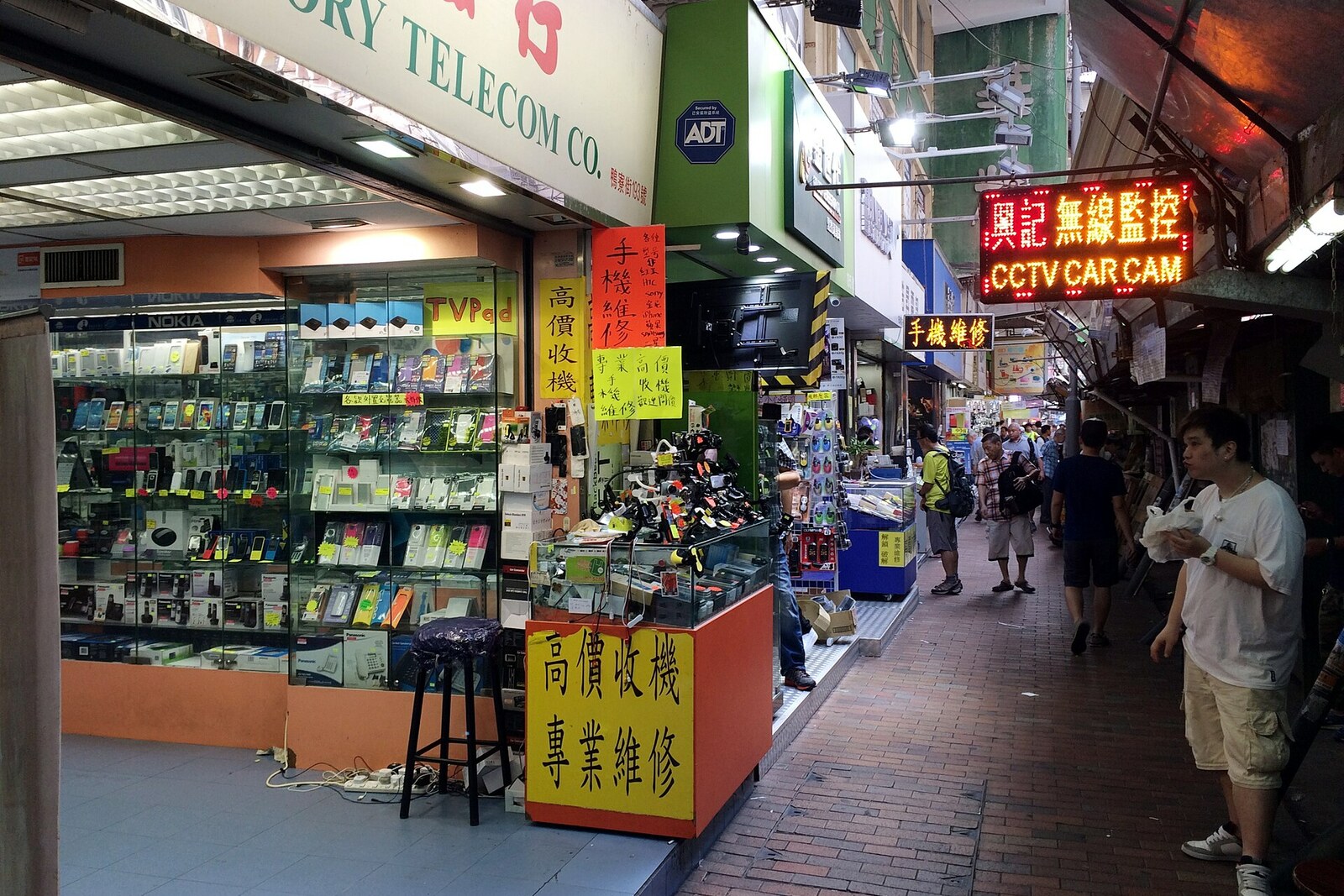
Look around first
What to notice
- Street stalls
- Old radios
- Circuit boards
- Wires and switches
The story of the place
Apliu Street is given over to a street market: stalls stand one after another, and among phone cases lie old radios, circuit boards, wires, switches, and tools. Sellers of secondhand goods came here in the nineteen thirties, and later the street became a refuge for hawkers during inspections. Owners of workshops and small factories looked here for buyers for parts and equipment, so new small items and things that can still be dismantled for needed parts are sold side by side.
The street signs say “Apliu”—in Cantonese, that means “duck shed.” At the beginning of the twentieth century, there were shelters here where residents raised ducks. In nineteen oh nine, the settlement was cleared for a new road; construction was completed eleven years later, but the name remained. The duck pens have been gone for a long time, and the present rows occupy roughly the same site.
By the nineteen thirties, dealers in secondhand goods had moved here. Later, the quiet street became a refuge for hawkers: when inspectors appeared, they wheeled their carts of goods here. In the nineteen sixties, owners of the multiplying Hong Kong workshops and small factories were looking for buyers for parts and equipment. Dealers added wires, switches, transformers, and tools to the old goods. By the nineteen eighties, Apliu had become a market for electronic components. That is why, among phone cases and new adapters, you can still come across dismantled devices, individual circuit boards, radio parts, and equipment for which its former owner had already found no use.
In nineteen eighty-three, Paul Au came to Apliu—an emigrant from Saigon who collected records and was trying to make money by reselling them. He left his first collection in Vietnam when, at seventeen, he fled military conscription. In Hong Kong, Paul worked in hotels, restaurants, and supermarkets, and after moving to Sham Shui Po, he discovered that people were throwing away music from the nineteen sixties and seventies. Shops were clearing their shelves for compact discs, apartment owners were getting rid of heavy record sleeves, and records flowed to this market along with old radios and amplifiers.
Paul began with his own duplicates: he sold one record to buy or keep another. There were few buyers, but musicians were among them, and the trade became his regular income. At first, all the stock fit on one cart; then a second and a third were needed. At last, an entire train of carts trailed behind Paul. When Urban Council staff cleared the street, he rolled the goods from place to place. At night, Paul slept beside the records, otherwise they might have been taken away or carried off. Later, he sold the Harley-Davidson motorcycle he had owned for fifteen years and paid for a warehouse.
Beside the public toilet where Paul first laid out his goods, his stall is no longer there. After twenty years of street trading, he moved the records into Vinyl Hero, an apartment-shop on the fifth floor of the neighboring Wai Hong Building. Around thirty thousand records fit there; the rest stand in the warehouse for which Paul parted with the motorcycle.
Useful on site
The street market and shops keep different private schedules; come during the day or closer to noon, when more stalls are open.
Checked: June 25, 2026. Check the official source before visiting.Keep close to the edge of the flow, do not block the stalls, and ask the price before buying; private collections nearby require a separate arrangement.