 Guide On Map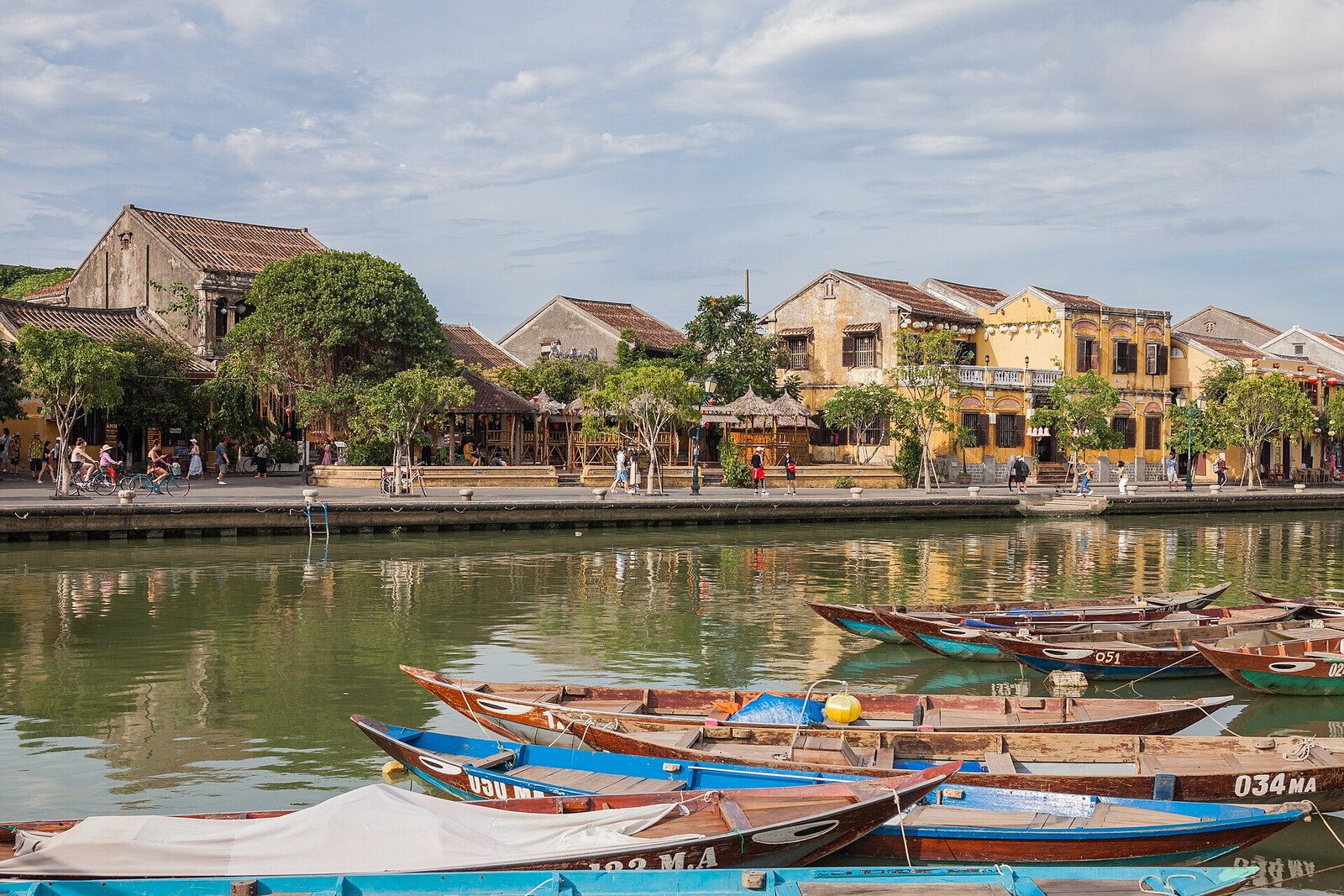
Look around first
What to notice
- Stone embankment
- Descent to the water
- Market buildings
- River branch
The story of the place
The stone embankment in front of the market appeared later than the market wharf itself. Even before the nineteen thirties, on major market days, rows of stalls stretched from the Japanese Covered Bridge along what is now Bach Dang Street. There was no retaining wall then. Boats came right up to the market, and some goods were sold directly on the water, from boat to boat.
From here, merchants traveled upstream on the Thu Bon River. In broad covered boats, they carried fish sauce, cloth, pottery, and sometimes gongs and drums; on the return journey, they took on fruit, honey, pepper, cinnamon, and other goods from the mountain regions. The journey, with stops at river markets, took about ten days. The cargo supported the boat owner and the owner's family, so the wharf by the main market was a place for settling accounts: here they unloaded what they had managed to bring and assembled a new shipment.
In nineteen forty-nine, the same descent to the water was needed by the French garrison. After the occupation of Hoi An, a river post was set up at the market wharf. Two motor launches traveled from here along the stretch between Hoi An and Cau Lau and fired on villages along the riverbanks. A local unit ambushed them several times, but the launches escaped every time.
Twenty-four-year-old Bui Chat, a resident of neighboring Cam Ha and a fighter in the town self-defense unit, volunteered to stop them. He had joined it after the French occupation of Hoi An and did not yet belong to the regular army at that time. Bui Chat led a small group to the river post itself. All night, the fighters carried a naval mine by water to where the launches were moored. They had to get right up to the armed crews: earlier attempts to strike from ambush had already failed.
The mine explosion sank both launches. Fourteen French servicemen died. Bui Chat emerged from the operation alive; two years later, he was enlisted in the regular army. The two boats for which the unit had watched the river route time after time never traveled along it again.
There is no longer a French post by the market, and the former open shore and the trading boats that came up to the rows of stalls without an embankment have also disappeared. The name “Old Market Wharf” refers to this stretch: it was here that the market once had its own entrance from the water, and in nineteen forty-nine two patrol launches were stationed at that entrance.
Useful on site
Open public space; the lower edge may be inaccessible during flooding or high water.
Checked: date not specified. Check the official source before visiting.View the wharf from the upper sidewalk without obstructing unloading. Do not step on ropes or go down wet steps or boat platforms.