 Guide On Map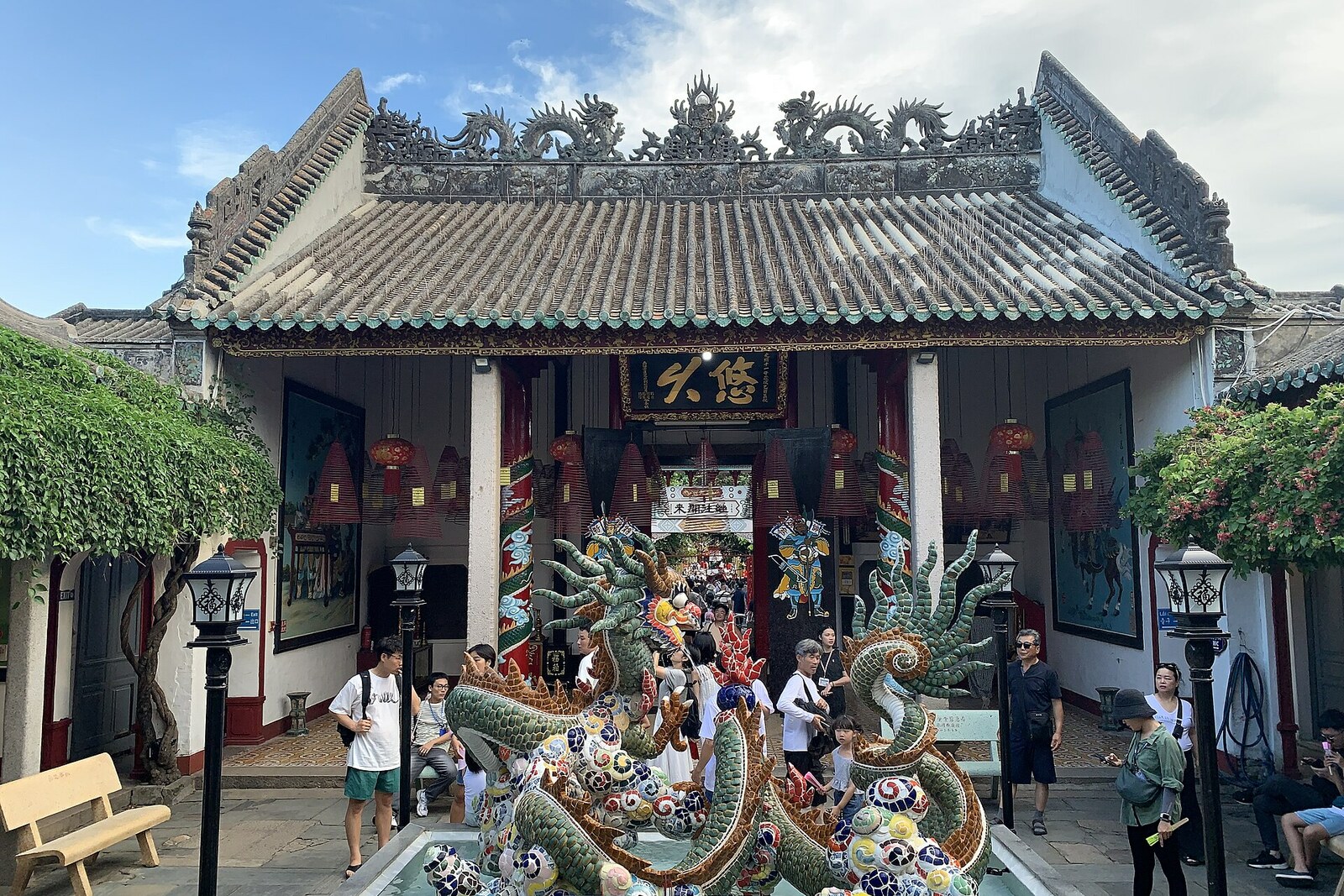
Look around first
What to notice
- The statue of Guan Yu
- Side altars
- Stone plaques with the names of the organizers
- Stone list of donations
The story of the place
Under the hall's roof, the central altar is devoted to Guan Yu, a third-century military commander remembered for keeping his promise; at the side altars, Mazu, the patroness of seafarers, and the god of wealth are venerated. A shrine and a meeting house for Hoi An's Chinese merchants are combined here. Finished building components were brought by water from China, and the names of the organizers were carved on three stone plaques. Later, donations sent for restoration from different countries were recorded on one more stone.
In eighteen eighty-five, merchants from the southern Chinese districts of Guangzhou and Zhaoqing pooled their money for a house of their own in Hoi An. The name “Guangzhao” was formed from the names of these two districts—hence the hall's second name. “Cantonese” means that it was managed by a single native-place association: people with a shared origin, language, and trading ties.
A merchant lived on money invested in goods and sea transport. A shipwreck deprived him of his cargo, illness of the chance to return home, and death left the family with the expense of a burial in a foreign country. The old rules of Hoi An's common Chinese assembly hall required a contribution from every arriving junk. This money fed shipwreck victims, supported those who fell ill, and buried those who died far from their relatives. The Cantonese merchants created the same system here for people from their own home region: they gathered, discussed deals, and helped one another in business and daily life.
Many details for the new building were ordered in China, transported by sea, and assembled in Hoi An. The merchants brought the building components along the same route by which they carried goods and reached the Vietnamese port themselves. Three stone plaques bearing the names of the organizers preserve a record of their shared contribution.
At first, the community dedicated the altars to Mazu, the patroness of seafarers, and Confucius. In nineteen eleven, the Cantonese changed the order of veneration and placed Guan Yu at the center—a third-century military commander renowned for keeping his word. For merchants, this quality had a literal price: partners had to trust one another with cargo, money, and the fulfillment of agreements across the sea. Along with Guan Yu, they began to venerate the first organizers of the native-place association. Today, his statue occupies the central altar, while Mazu and the god of wealth stand at the sides.
When a new major restoration was needed in nineteen ninety-two, the committee again turned to people from the same home region. Former residents of Hoi An sent money from the United States, Switzerland, Hong Kong, Australia, and Canada; residents of Da Nang and Hoi An itself also contributed. A stone list gives the amounts beside the names—from twenty to seven hundred dollars. Merchant junks have disappeared, but the Cantonese still share the expenses of this hall among their own people; only now the contributions come from several continents.
Useful on site
Interior access with a single ticket; check the exact daily schedule at the ticket office.
Checked: date not specified. Check the official source before visiting.This is an active place of worship: do not go beyond the altar barriers, do not touch the figures, and ask permission before photographing worshippers.