 Guide On Map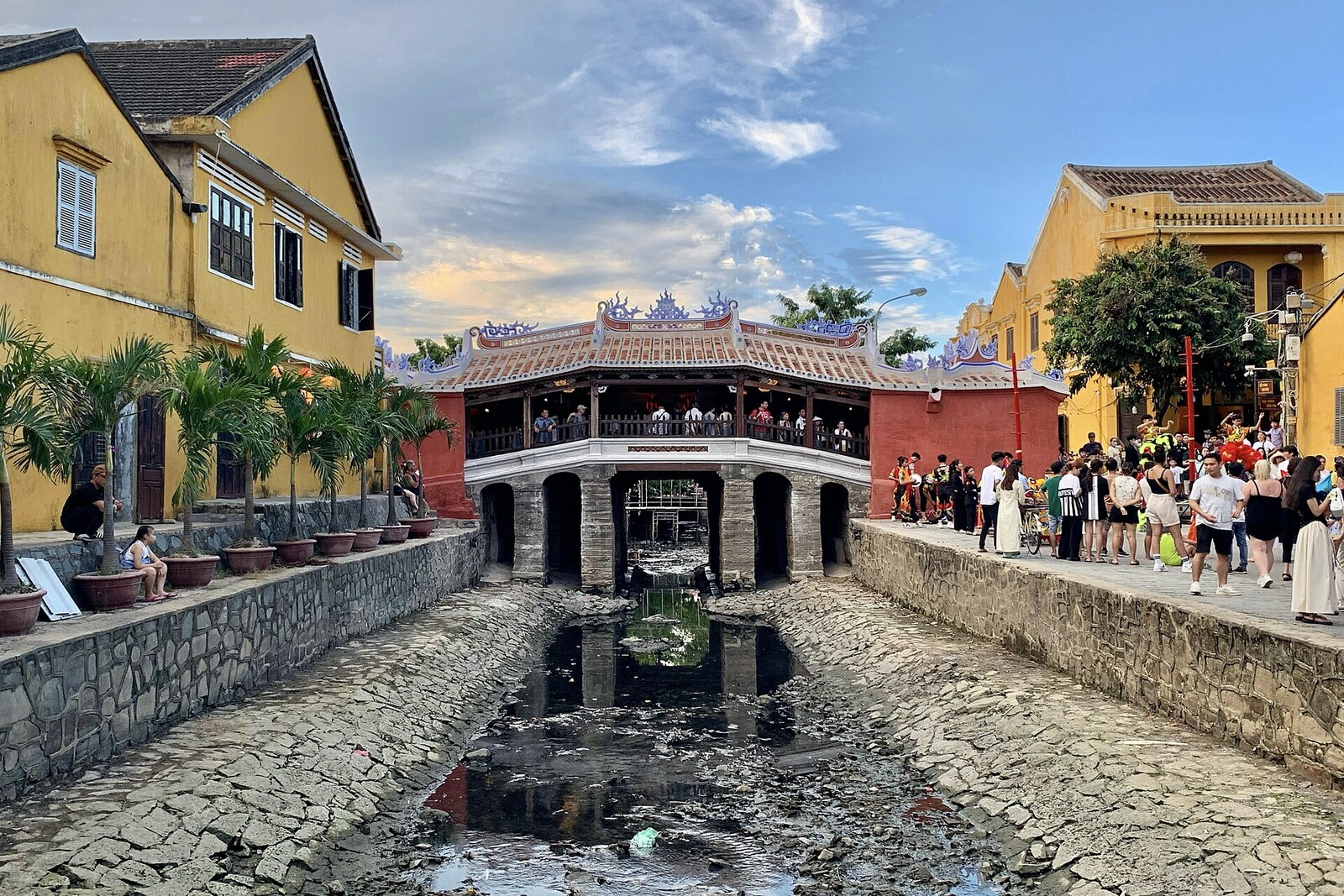
Look around first
What to notice
- Covered passage
- Side shrine
- Inscribed board above the entrance
The story of the place
This bridge is called Japanese after the people who once lived on one side of the canal. No one has established the exact date of its construction. An inscription carved during repairs in eighteen seventeen cautiously states that, according to legend, Japanese merchants built the crossing. Archaeologists found traces of earlier supports and decking from the late sixteenth century beneath the eastern section.
The merchants came to Hoi An because of a trade ban. China’s Ming dynasty did not allow Japanese people to buy goods directly in China, while silk was especially prized in Japan. This Vietnamese port became the intermediary. Shipowners received letters with a red seal from the Tokugawa shogunate: it distinguished a legitimate trader from a smuggler or pirate. Silver, copper, and weapons were brought here; silk, sugar, spices, and aloeswood went back. Merchants profited from this difference, lived away from home for months for its sake, and established their own settlement in Hoi An.
A branch of water lay between their houses and the shops of Chinese traders. Japanese merchants paid for the covered crossing so that every exchange would not depend on a boat. Goods were carried across here, people went to negotiate a price, and returned to their own quarter. The roof protected people and bales from tropical downpours; later, goods were even put out for sale along the sides of the passage.
In sixteen thirty-five, the Tokugawa shogunate prohibited Japanese ships from leaving the country. Ships with red seals stopped arriving. Some merchants remained in Hoi An for several more decades, but without ties to the Japanese market, their settlement disappeared. The bridge lost those for whom it had been built.
The crossing was taken over by Chinese migrants of the Minh Huong community, who arrived after the fall of the Ming dynasty. In sixteen fifty-three, Khong Thien Nhu, one of the first founders of their settlement, asked the Nguyen ruler for permission to repair the bridge and add a shrine. In the northern section, they installed an altar to Bac De Tran Vu, a Taoist deity from whom people sought protection against storms and floods. The passage for trade acquired a second purpose, and townspeople began calling the entire complex the Japanese Covered Bridge—“bridge-pagoda.”
In seventeen nineteen, the ruler Nguyen Phuc Chu arrived in Hoi An and saw foreign merchants by the crossing. He gave it the name Japanese Covered Bridge—“bridge for guests from afar”—and bestowed a board with this inscription. It still hangs above the entrance. After numerous reconstructions, the Japanese features in the architecture have almost disappeared; the name has remained with the bridge, the shrine added by the Chinese community stands beside the passage, and the Vietnamese ruler’s words are above the door.
Useful on site
With the Old Town combined ticket; separate visiting hours were not published in the 2026 notice.
Checked: date not specified. Check the official source before visiting.The passage is narrow: do not block it while looking around, and step aside if a flow of people gathers. Keep quiet at the shrine.