 Guide On Map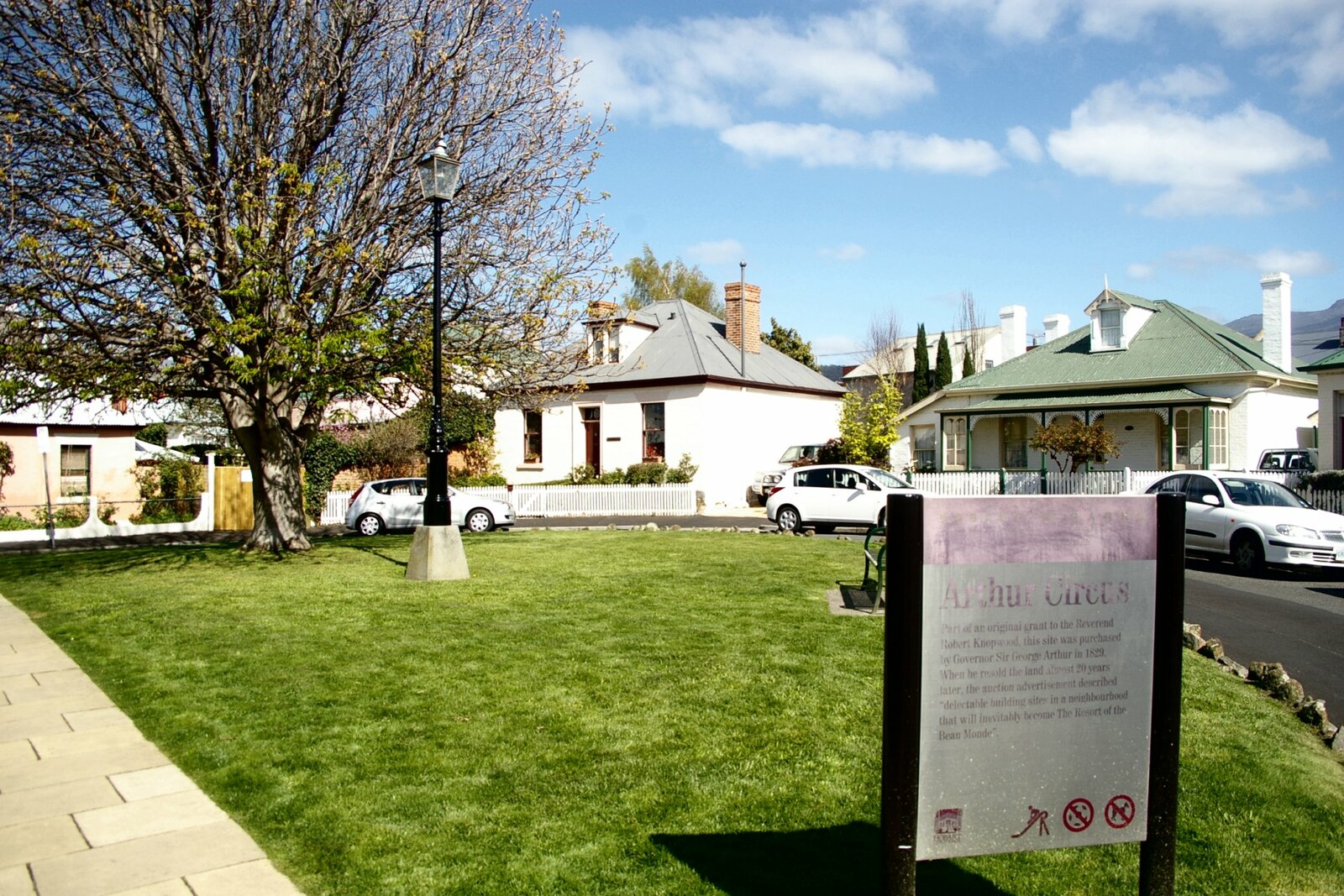
Look around first
What to notice
- Ring of single-story cottages
- Central lawn
- Circular street
- Brick facades
The story of the place
Arthur Circus is a circular street with single-story brick cottages and a shared lawn. The word “circus” here describes the layout, and the name belongs to George Arthur, the former Lieutenant-Governor of Van Diemen's Land. It appeared as the owner's surname on a plan for a private sale.
Before Arthur, this land formed part of the estate of Robert Knopwood, the first colonial clergyman. Knopwood's house itself stood lower down, closer to present-day Salamanca Place, but the site of the future circle was part of the same property. Knopwood invested about one thousand pounds in the house, outbuildings, and land. After leaving office, his annual pension was one hundred pounds, and the unsuccessful sale of the estate deprived him of his financial support.
In eighteen sixteen, Knopwood agreed to sell the property to Captain Townsend Jones for two thousand pounds. Jones paid half the amount but died before the final settlement. His widow could not pay the remainder. Knopwood tried to force her through the courts to complete the purchase and lost. The debts remained; first, creditors forced him to sell off part of the land, then the creditor Edward Lord secured the sale of the remaining twelve acres.
In June eighteen twenty-nine, the land was bought by the Launceston entrepreneur Henry Jennings. As early as August, he transferred it to George Arthur for eight hundred pounds. Arthur acted in two roles at once: he governed the colony and invested his own money in land. He knew of planned works at Sullivans Cove that were to bring roads, wharves, and warehouses closer to the site. The project was known in the town, but many doubted that it would actually be carried out. Arthur risked private capital, with an official understanding of how likely the construction was.
The purchase was discussed during Arthur's lifetime. When title to the site had to be confirmed by a Crown grant, the document was first made out to Arthur's personal secretary, William Parramore, who then transferred the land back, stating that he had held it for Arthur as a trustee. Opponents of the Lieutenant-Governor saw an attempt to conceal ownership. Archival records do not prove a secret sham transaction: the original conveyance was openly recorded in Arthur's own name, and the arrangement through the secretary may have been necessary because the Lieutenant-Governor would otherwise have had to approve a grant to himself in person. The real controversy was different: public works increased the value of his private land.
Arthur promised Knopwood that he could remain in the old house rent-free for another eighteen months. By eighteen thirty-one, the road inspector Roderic O'Connor had already moved in there. Knopwood moved across the river to Clarence Plains and died in eighteen thirty-eight, fighting off creditors until the end of his life. Arthur had left the colony by then, but he kept this land.
In eighteen forty-seven, he divided the upper part of the property into sixteen narrow lots around an area marked on the auction plan as a place for recreation. The auctioneer John Charles Stracey invited buyers to invest capital and promised that the neighborhood would become a meeting place for well-to-do society. It turned out differently. Builders and small property owners bought the small lots, and for more than a century the cottages were home to large families whose livelihoods were tied to the waterfront.
One lot was bought by the stonemason Edward Brown and the plasterer Thomas Collins. They built a two-room brick house on it. In eighteen fifty, the widow Catherine Jackson bought this cottage for one hundred pounds; soon afterward, her older sister Margaret Figg moved in with her children after her marriage broke down. Later, Margaret's relatives also lived in the neighboring house. The shared area inside the ring served as a yard for families who lacked their own space in the small cottages.
Today, the cottages remain private homes, while the central green area is a public recreation space. Since nineteen thirty-nine, their postal addresses have been on Runnymede Street, but the old name, Arthur Circus, has remained for the whole ring.
Useful on site
The public park and street are accessible at all times; dogs are not permitted in the grassed area.
Checked: date not specified. Check the official source before visiting.The lawn and homes are in a residential setting: do not enter the yards and keep quiet near private windows.