 Guide On Map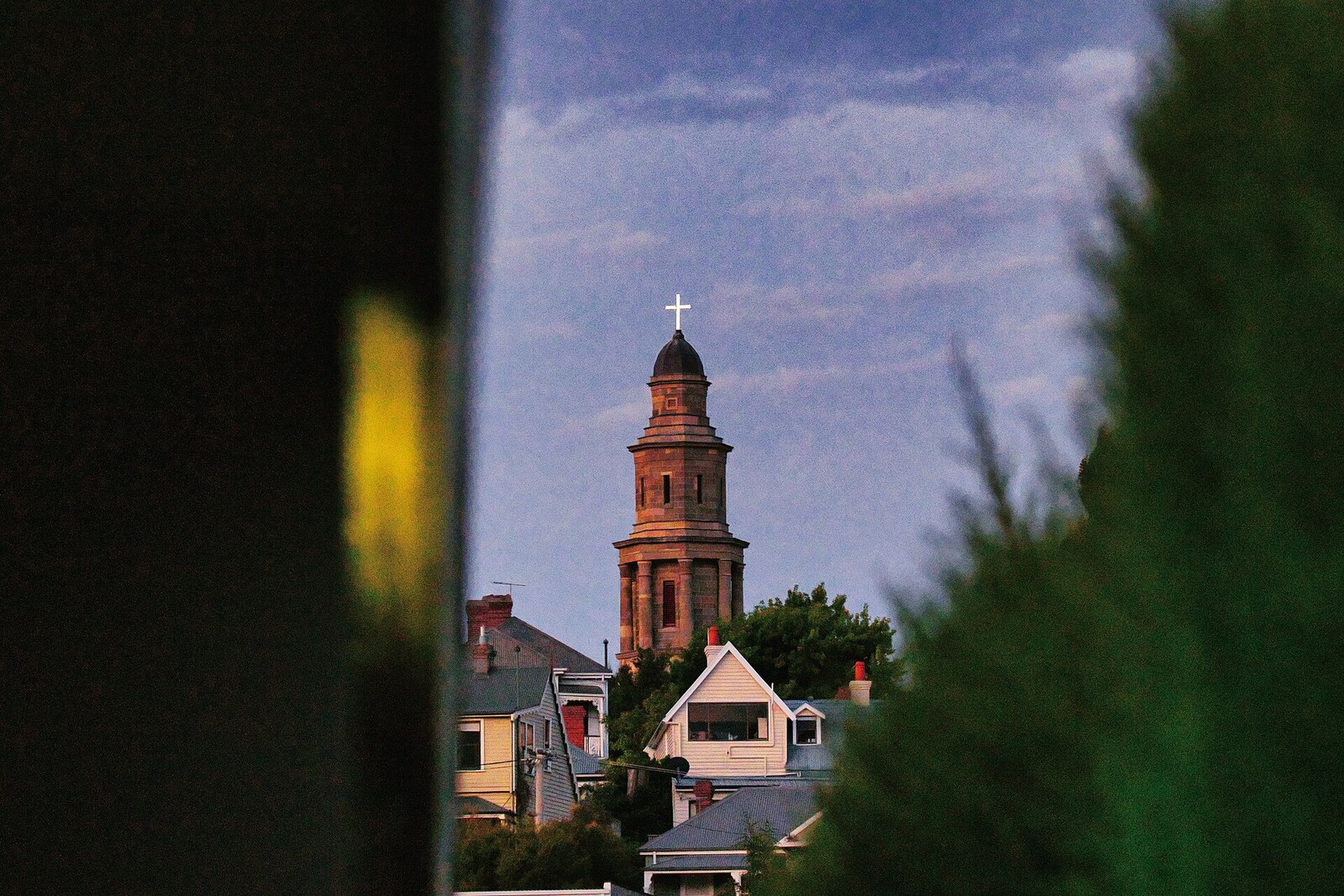
Look around first
What to notice
- Tall tower
- Colonnaded portico
- Lancet windows
- Enclosed pews of Tasmanian cedar
The story of the place
Lancet windows, columns at the entrance, and enclosed wooden pews identify the Anglican church of Battery Point. After the neighborhood's residents asked for their own parish, the trustees bought the hilltop for it from a private owner. The colonial architect John Lee Archer drew up the building's plans, and the cedar pews inside have remained since the first services. The colonnaded portico by the door was added much later, carrying out part of the original design.
The church is dedicated to Saint George, a Christian who served in the Roman army and was executed for his faith around three hundred four. Little reliable information about him remains. The dragon appeared in tradition many centuries later. By the middle of the fourteenth century, George was revered as the patron saint of England. Parish records do not say why the trustees chose his name specifically for the new church.
The church itself was built after the residents of Battery Point petitioned the colonial administration: they needed their own Anglican parish. The trustees bought the summit of Kermode's Hill from the landowner William Kermode. John Lee Archer, the colonial architect, designed the main body, and services began here in May eighteen thirty-eight. The original enclosed pews of Tasmanian cedar still stand inside.
James Blackburn designed the tower. In London, he earned his living as an engineer and drainage inspector, and invested his money in building houses for sale. The venture collapsed, and Blackburn's property was due to be seized. Trying to pay his debts, he forged his employers' signatures on a cheque for six hundred pounds. Even the people he tried to defraud gave the court favorable references for him, yet Blackburn was sentenced to transportation for life. In eighteen thirty-three, he was brought to Hobart, leaving his wife and daughter in England; they were able to follow him only two years later.
The convict engineer was immediately assigned to the Roads and Bridges Department. He designed structures that were officially signed by his supervisor. Influential colonists who knew Blackburn through this work petitioned for his release, and in eighteen forty-one he received a full pardon.
That same year, parishioners decided to add a tower to St George's Anglican Church. It was to serve as a landmark for vessels on the River Derwent: captains, sailors, shipwrights, and port officials lived nearby. The administration promised stone, timber, and convict labor if subscribers paid for lime, lead, transport, and the remaining materials. Blackburn prepared the design.
When the builders began work, it became clear that the foundation laid for the tower could not bear its weight. The parishioners had to dismantle the foundation, the porch, and two vestries. There were not enough suitably skilled convicts, construction stopped for long periods, and the church remained partly exposed to the weather for about five years. The tower was completed in eighteen forty-seven; sailors really did begin to recognize Battery Point by it.
The colonnaded portico in front of the entrance appeared only in eighteen eighty-eight, when the builders carried out the remaining part of Blackburn's design. An active Anglican congregation now gathers behind it, and above the portico rises a tower designed by a man brought to Hobart under a life sentence.
Useful on site
Sunday services — 08:00 and 10:00. Daily hours for unrestricted interior viewing are not stated; the facade is visible from the street.
Checked: date not specified. Check the official source before visiting.Do not count on unrestricted entry: go inside only when the doors are open, and do not view the interior during a service without an explicit invitation.