 Guide On Map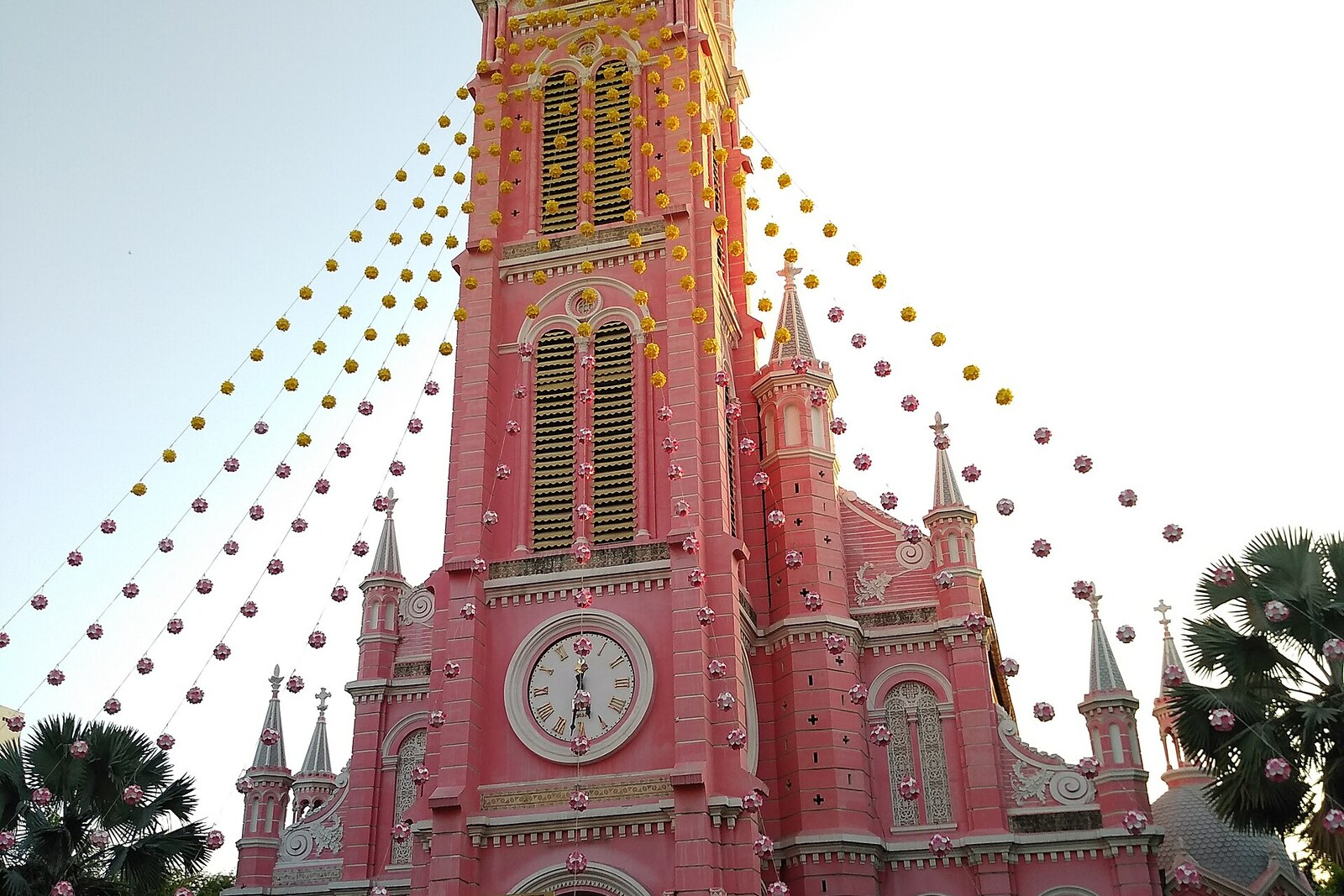
Look around first
What to notice
- Pink facade
- Tall tower
- White marble slab
- Hai Bà Trưng School building
The story of the place
The tall tower rises above the Catholic complex, which once occupied an entire plot around the church. Nearby stood clergy housing, classrooms for future church assistants, and a printing workshop, while Hai Bà Trưng School now operates in the building next door. The present facade and tower appeared only after the original church; inside, by the altar of the Virgin Mary, a light-colored marble tombstone of the man who assembled this parish has survived.
The full name of the pink church is the Church of the Sacred Heart of Jesus of Tân Định Parish. The Heart here means the Catholic image of Christ’s love and sacrifice, while Tân Định is the name of the parish and the neighboring quarter. Masses are still celebrated in the church; the pink color that made it a tourist landmark appeared only in nineteen fifty-seven.
The first church on this site was built by the French missionary Donatien Éveillard, a parish priest who wanted to give local orphans an education and a trade that could support them. As early as eighteen sixty-five, he bought a small printing press, type, and supplies in France with his own money. There was no one to operate it. The first students were two orphans aged thirteen to fifteen. Éveillard learned techniques himself from Saigon printers and passed them on to the boys. The paper first had to be moistened, then dried, and pressed one sheet at a time onto a hand-inked form.
In eighteen seventy-four, Éveillard was appointed pastor of Tân Định Parish and moved the presses here. While the priest raised money and directed the construction of the church, a clergy house, a school for church assistants, and a printing shop appeared nearby. Éveillard then invited the Sisters of Saint Paul of Chartres to open an orphanage with boarding accommodations at the church. By the early eighteen eighties, about three hundred children lived and studied here.
The printing shop was part of this arrangement. Éveillard expanded the workshop to about thirty workers; the orphanage’s pupils worked there alongside monks. They were housed and taught to set type, print, and bind books. Once grown, a student could remain in the workshop or leave and earn a living independently.
That is what Đinh Thái Sơn did, a young Catholic from Nghệ An who came to Saigon without a trade. He studied bookbinding here for four years, then received orders from the government book depot, saved money, and opened his own printing house, Phát Toàn. Later, together with the entrepreneur Lê Phát An, he founded another one, Đông Hiệp. Its workshops printed newspapers, plays, folk tales, and books in Vietnamese. A student of the church bookbinding workshop became one of Saigon’s notable Vietnamese publishers.
By the early eighteen eighties, Éveillard had already been seriously ill for nearly two years. He asked to be relieved of managing the parish, but kept the printing shop and prepared the priest Jean-François Gernibrel to continue the work. On September fifteenth, eighteen eighty-three, Éveillard died here. Two days later, he was buried inside the church he had built, before the altar of the Virgin Mary, and his grave was covered with a white marble slab.
The printing shop beside the church is gone, and the present facade and tall tower appeared only after Éveillard’s death. The white slab over his grave remains inside. Hai Bà Trưng School now occupies the neighboring complex where the sisters took in orphans.
Useful on site
Active church; visits depend on services and current parish rules.
Checked: date not specified. Check the official source before visiting.Respect services and classes at the neighboring school; access inside may depend on parish life. The old printing presses are not here and require a separate arrangement with the seminary museum.